Common Thread Collective agency campaign ideas that work


1. The problem that showed up EVERYWHERE
Objective
This email aims to drive engagement with a video episode that highlights a critical data trust issue among mid-market ecommerce brands, while also promoting a limited-time offer of three free custom models to help brands make data-driven decisions with confidence.
Why this works
The email opens with a bold, data-driven hook, '224 Calls Later... This One Problem Showed Up Everywhere', which immediately signals authority and relevance, making the reader feel this isn’t just another generic tip but a pattern uncovered through real-world analysis.
How to implement
By framing the core problem as 'NO ONE TRUSTS DATA' in a video thumbnail with a pointing gesture, the email leverages psychological urgency and personalization, making the viewer feel directly addressed and more likely to click to resolve their own data confusion.
Pro Tip
The CTA 'GET 3 CUSTOM MODELS FOR FREE' appears after a dense block of text and a chart, consider adding a sticky or floating CTA button above the fold or repeating the CTA after the first two bullet points to capture early interest before scroll fatigue sets in. • The Axon by AppLovin ad section interrupts the narrative flow between the video value proposition and the core offer, consider moving it to the footer or replacing it with a shorter, branded testimonial that reinforces the data trust theme without breaking momentum.
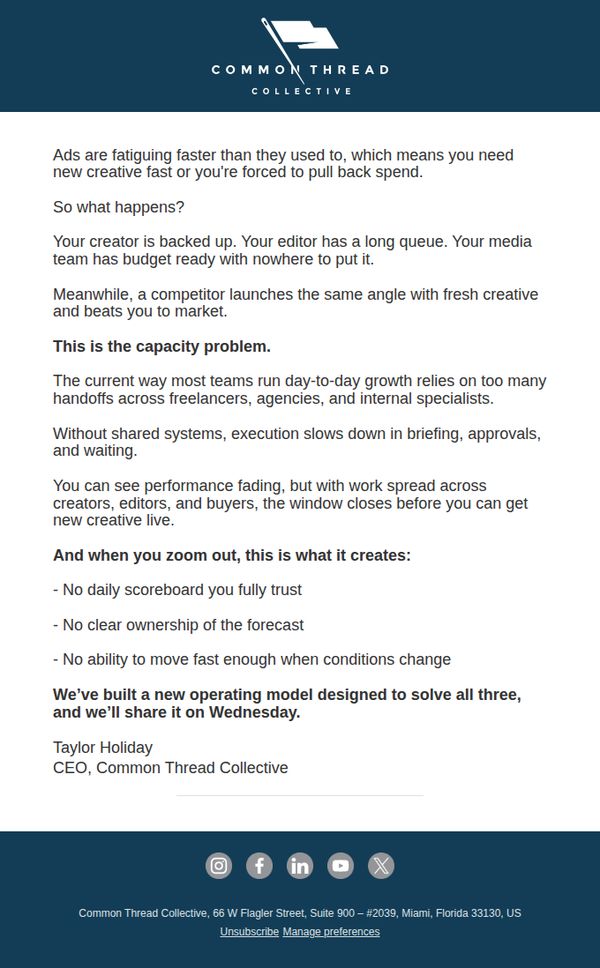
2. Why coordination is killing your speed advantage
Objective
This email aims to position Common Thread Collective as a strategic solution for marketing teams struggling with creative bottlenecks, by highlighting the hidden costs of coordination overhead and teasing a new operating model that restores speed and agility to growth execution.
Why this works
The email brilliantly reframes a common operational pain point, creative delays, as a strategic vulnerability, making the reader feel the urgency of solving it before competitors exploit the gap with faster, fresher content.
How to implement
By naming the problem ‘the capacity problem’ and listing its three concrete symptoms, no trusted scoreboard, no ownership of forecast, no speed to adapt, the message transforms abstract frustration into a diagnosable, solvable business issue.
Pro Tip
Add a subtle visual hierarchy or iconography next to each of the three symptoms (no scoreboard, no ownership, no speed) to make them scannable and emotionally resonant, right now they blend into the text and lose impact. • Include a micro-CTA before the signature, like ‘Reply with “Model” to get early access’, to capture intent from engaged readers who may not wait until Wednesday, turning passive interest into active qualification.
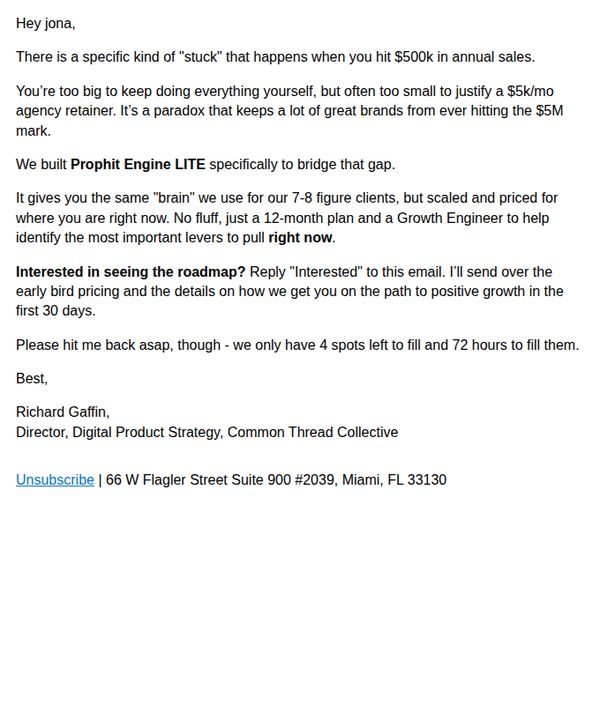
3. The 7-figure unlock (72 hrs left to work with CTC)
Objective
This email aims to convert mid-tier brands stuck at the $500k revenue mark by offering them access to Prophit Engine LITE, a scaled-down version of their premium service, with urgency created by a 72-hour window and only 4 spots remaining.
Why this works
The email brilliantly frames a common growth plateau as a paradox, too big to DIY, too small to afford elite help, making the reader feel uniquely seen and primed for a tailored solution that bridges that gap.
How to implement
By positioning Prophit Engine LITE as the same 'brain' used for 7–8 figure clients but scaled down, it leverages social proof and perceived exclusivity without alienating mid-market brands who might otherwise feel underserved.
Pro Tip
Add a brief bullet-point summary of what Prophit Engine LITE includes (e.g., '12-month plan + Growth Engineer access') right after the product intro to reduce cognitive load and reinforce value before the CTA. • Include a micro-testimonial or client result (e.g., 'Brand X hit $1.2M in 6 months using LITE') to strengthen social proof and reduce skepticism about the scaled-down offering’s effectiveness.
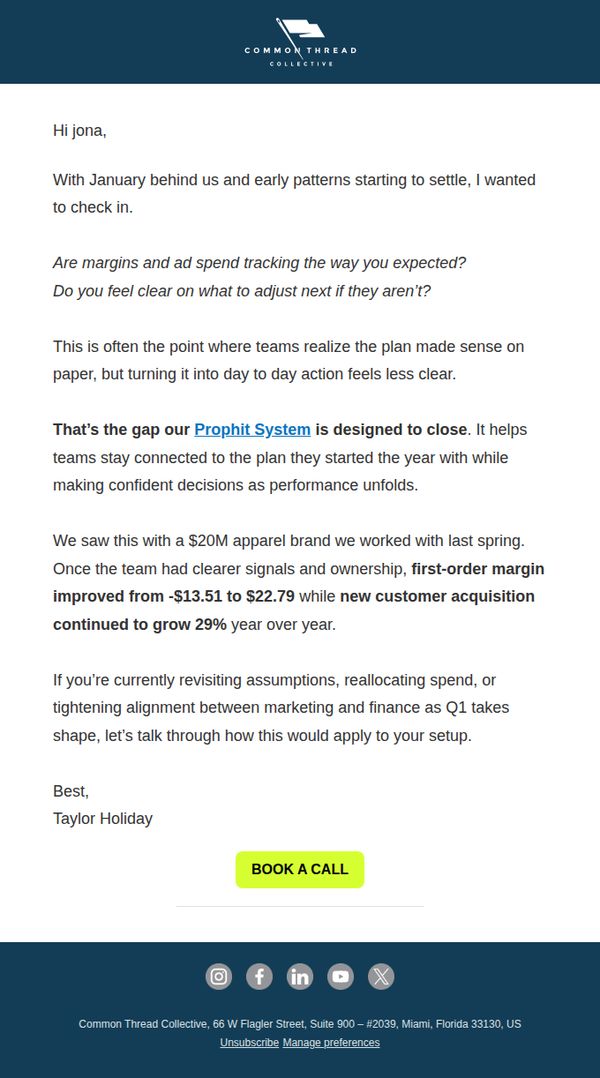
4. Starting February With Clearer Signals
Objective
This email aims to re-engage a recipient by addressing early-year performance uncertainty and positioning the Prophit System as the solution to bridge planning and execution gaps. It seeks to drive a conversation through a personalized, consultative CTA.
Why this works
The email opens with a timely, empathetic question that mirrors the recipient’s likely internal dialogue, making the message feel less like a pitch and more like a strategic check-in tailored to their current business rhythm.
How to implement
By anchoring the product’s value in a specific, quantifiable client result, a $20M apparel brand turning negative margins into $22.79 positive, the email transforms abstract promise into credible, outcome-driven proof that builds immediate trust.
Pro Tip
Add a subtle visual hierarchy to the testimonial section, perhaps a light background tint or icon, to visually separate the client result from the surrounding text and draw the eye to the most persuasive data point. • Include a micro-copy line just above the CTA (e.g., 'Spots fill fast, let’s map your Q1 adjustments in 15 minutes') to reduce friction and create mild urgency without compromising the consultative tone.
5. Want to know how much more your brand can make in Q2?
Objective
This email aims to position Common Thread Collective as a strategic growth partner for DTC and multi-channel brands by showcasing real-world retention strategies from OLLY and offering a personalized Q2 revenue forecast. It seeks to convert readers into leads by highlighting data-driven marketing models that reduce financial risk and increase predictability.
Why this works
The email opens with a compelling case study that flips the script on acquisition by spotlighting retention, a smart psychological hook that positions the brand as a thought leader who understands where real growth hides in today’s crowded market.
How to implement
Instead of vague promises, it offers concrete, proprietary frameworks like the Spending Power Model and Incrementality Roadmap, turning abstract marketing advice into tangible, data-backed tools that resonate with finance-savvy brand leaders who crave certainty over hype.
Pro Tip
The email’s CTA placement after the Offer Section is strong, but adding a secondary, sticky CTA button near the top (e.g., 'Book a Q2 Revenue Forecast') would capture early intent from readers who skim or scroll quickly. • While the Attentive ad section is visually distinct, it interrupts the narrative flow, consider relocating it to the footer or integrating its value proposition into the main body as a supporting testimonial or tech partner endorsement.
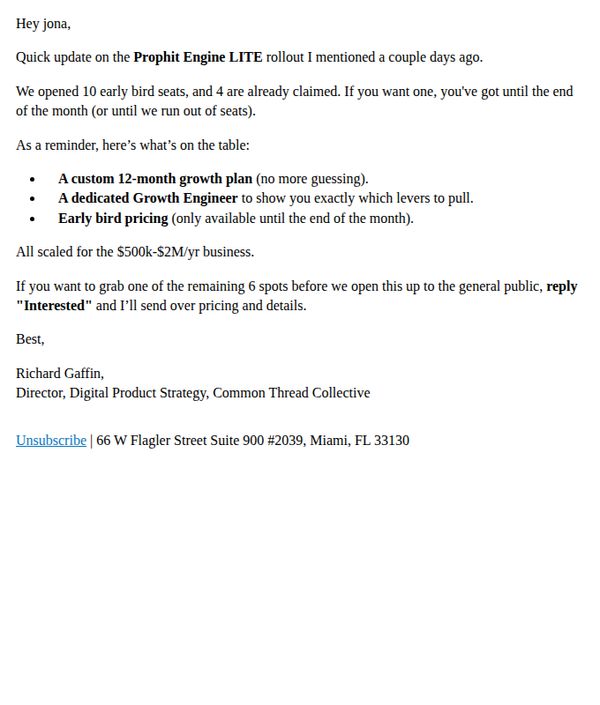
6. Only a few spots left for Prophit Engine LITE
Objective
To create urgency and drive immediate sign-ups for the Prophit Engine LITE program by highlighting limited availability and early bird pricing, targeting business owners seeking growth strategy support.
Why this works
The email masterfully leverages scarcity by specifying exactly how many seats remain, not just ‘limited’, which transforms vague urgency into a concrete, emotionally compelling reason to act immediately.
How to implement
By framing the offer around solving real business pain points, like ending ‘guessing’ and getting a dedicated Growth Engineer, the message speaks directly to the reader’s desire for clarity and expert guidance, not just features.
Pro Tip
Add a subtle countdown timer or visual indicator (e.g., ‘6/10 seats left’) near the CTA to reinforce urgency visually, since text-only scarcity can lose impact in fast-scrolling inboxes. • Include a one-sentence social proof element, such as ‘Join 4 other $1M+ founders who’ve already claimed their seat’, to validate the offer and reduce perceived risk for hesitant prospects.
7. 6-Fig Brands Can Now Work with CTC (Early Bird Announcement)
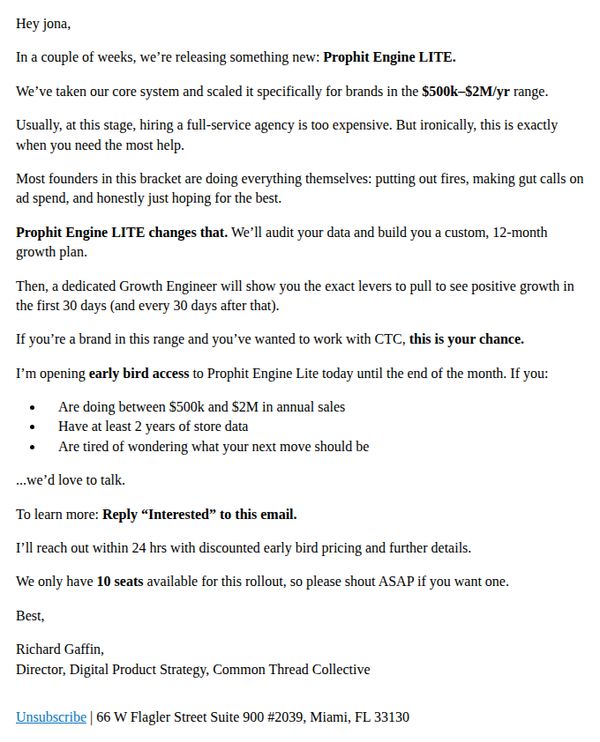
Objective
To announce the launch of Prophit Engine LITE, a scaled service for brands earning $500k–$2M annually, and to secure early sign-ups by offering limited discounted access before the official release.
Why this works
The email immediately identifies a high-value, underserved audience, brands at the $500k–$2M revenue stage, and positions the new offering as the precise solution they didn’t know they needed, creating instant relevance and urgency.
How to implement
By framing the service as a scaled-down version of their core system, the brand leverages existing credibility while lowering the perceived barrier to entry, making it feel like an exclusive upgrade rather than a new, untested product.
Pro Tip
Add a brief testimonial or case study snippet from a similar brand that benefited from CTC’s core system to reinforce credibility and reduce perceived risk for new prospects. • Include a simple visual element, like a 3-step graphic or timeline, showing how the 12-month growth plan works, to make the abstract promise of ‘custom growth’ feel more concrete and actionable.
8. Your budget + creative + measurement plan (built for you, free)
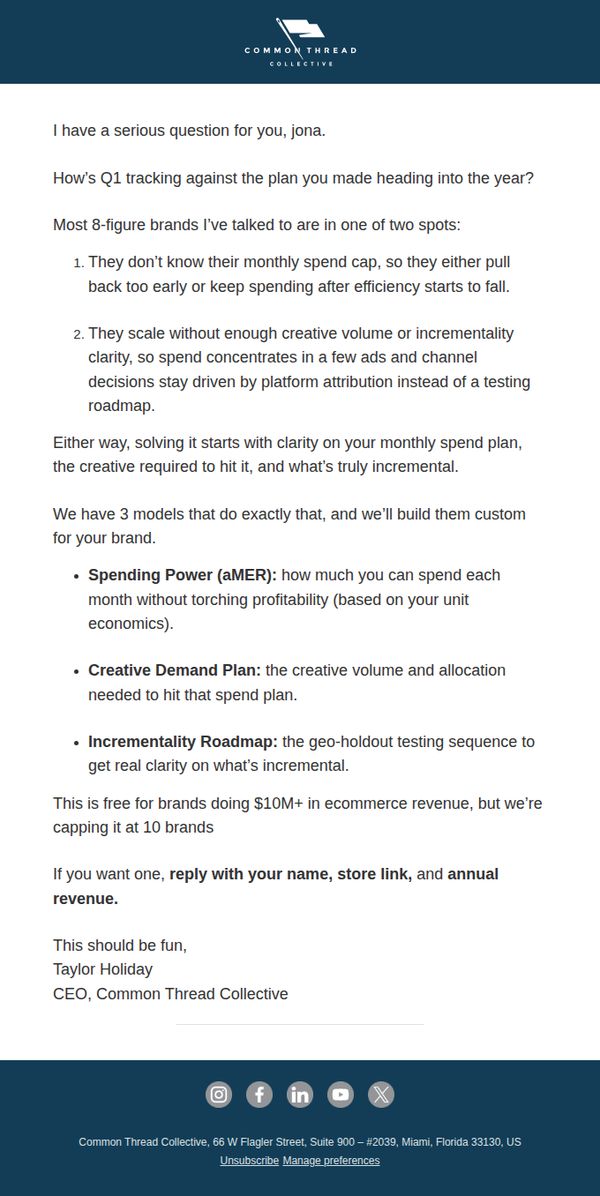
Objective
To offer a personalized, free strategic planning tool for high-revenue e-commerce brands struggling with budget allocation and creative scaling, positioning Common Thread Collective as a trusted advisor who solves real operational pain points.
Why this works
The email opens with a direct, personalized question that immediately taps into the recipient’s current operational anxiety, making the message feel urgent and relevant rather than promotional.
How to implement
Instead of vague promises, it names three concrete, jargon-free deliverables, Spending Power, Creative Demand Plan, Incrementality Roadmap, that map directly to the pain points described earlier, building instant credibility.
Pro Tip
Add a subtle visual hierarchy or bullet icons next to each of the three models to improve scannability and reinforce their distinct value, currently, they blend into the paragraph and may be overlooked. • Include a micro-testimonial or social proof line (e.g., 'Used by brands like [X] to increase ROAS by 37%') near the offer to reduce perceived risk and strengthen trust before the CTA.
9. Turning incrementality tests into CASH

Objective
This email aims to drive engagement with a video episode that explains how to turn incremental testing insights into profitable marketing decisions, while also promoting Axon by AppLovin as a performance solution and sharing a newly published measurement methodology to establish authority and trust.
Why this works
The email masterfully bridges tactical curiosity with strategic urgency by listing real, painful questions marketers face, making the content feel immediately relevant and personally valuable rather than just educational.
How to implement
By featuring recognizable brand names like Home Chef and Cozy Earth alongside specific performance metrics (1B+ customers, 35-second watch time), the email builds social proof and credibility without sounding like generic fluff or exaggerated claims.
Pro Tip
The CTA 'WATCH NOW' appears only once above the Axon ad, adding a secondary, sticky CTA button near the bottom after the methodology section would capture late-stage readers who’ve scrolled for value but haven’t yet converted. • The Axon section feels slightly disconnected from the main theme; adding a brief transition line like 'Here’s how brands like these are applying the insights from our episode' would better integrate the sponsor and reinforce campaign cohesion.
10. Wait... consumer confidence is at its lowest since when? 🤔

Objective
This email aims to inform DTC marketers about the disconnect between consumer confidence surveys and actual purchasing behavior, while highlighting how major platforms like Meta, Google, and OpenAI are reshaping digital advertising through AI-driven content and intent-based targeting. It positions Common Thread Collective as a strategic thought leader helping brands adapt.
Why this works
The email brilliantly reframes consumer confidence by contrasting official survey data with real-world spending behavior, creating immediate intrigue and positioning the brand as a counterintuitive truth-teller in a noisy industry.
How to implement
By spotlighting Meta’s AI-generated Vibe app and OpenAI’s Facebook-style ChatGPT redesign, the email ties platform shifts directly to tactical implications for marketers, making abstract AI trends feel urgent and actionable for daily strategy.
Pro Tip
Add a visual timeline or annotated graphic in the 'Market Performance' section to show the divergence between survey sentiment and actual spending, making the paradox more digestible and memorable for skimmers. • Reposition the sponsor CTA 'Get started.' to appear after the sponsor’s value proposition and performance stats, rather than buried mid-paragraph, to improve conversion flow and reduce cognitive friction.