Semrush Data email examples & ideas
1. Verification code for Semrush
Objective
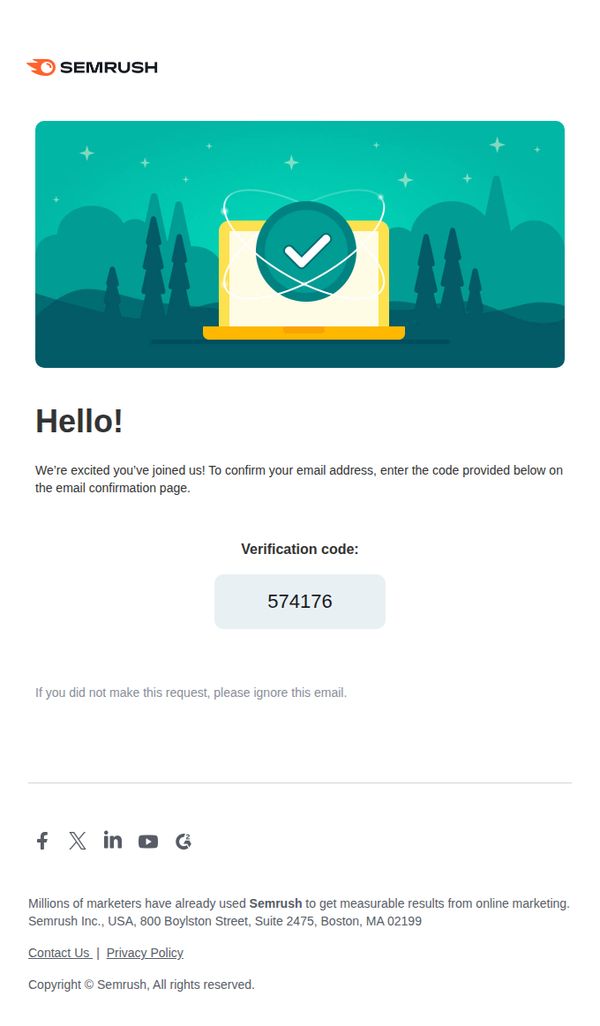
This email aims to verify the user’s email address during account creation, ensuring secure onboarding while reinforcing brand trust through a friendly, reassuring tone and clear instructions.
Why this works
The email opens with a warm, celebratory tone, 'Hello! We’re excited you’ve joined us!', which transforms a routine verification step into a welcoming onboarding moment that builds early brand affinity.
How to implement
The verification code is visually isolated in a soft, rounded container with ample padding, making it instantly scannable and reducing cognitive load for users who need to copy and paste it quickly.
Pro Tip
Add a direct clickable link to the email confirmation page to reduce friction, users shouldn’t have to manually navigate or remember where to enter the code, especially on mobile. • Include a brief countdown timer (e.g., 'Code expires in 10 minutes') to create urgency and prevent user abandonment due to expired codes, improving completion rates.
2. How often does AI mention your brand?
Objective
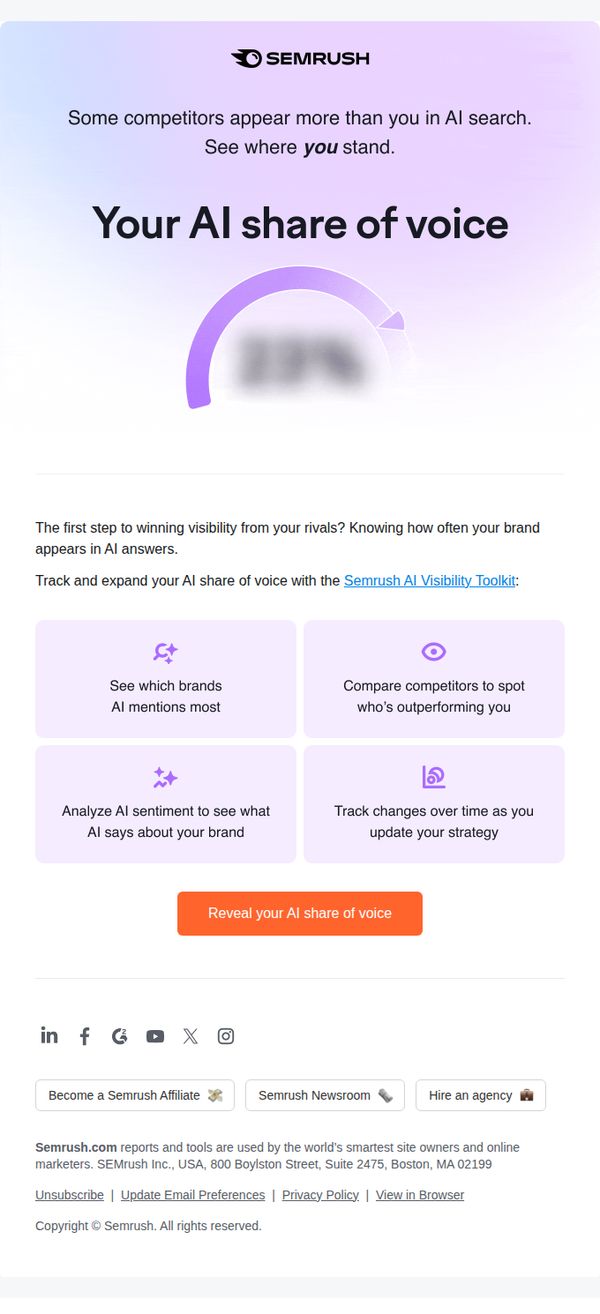
This email aims to drive awareness and engagement around brand visibility in AI-generated search results, encouraging recipients to assess their competitive standing using Semrush’s AI Visibility Toolkit.
Why this works
The email smartly frames AI visibility as a competitive battlefield, positioning Semrush as the essential tool to measure and reclaim your brand’s narrative in AI-driven search results.
How to implement
By using a partially blurred progress arc labeled 'Your AI share of voice,' the design creates instant curiosity and urgency, prompting users to click without revealing the full metric upfront.
Pro Tip
Add a subtle countdown timer or urgency cue near the CTA to increase conversion, since the current design lacks temporal pressure despite promoting a competitive insight. • Include a short customer testimonial or stat (e.g., '87% of marketers using this toolkit improved AI visibility in 30 days') to build social proof and reinforce the value proposition before the CTA.
3. Is your site built to be seen?
Objective
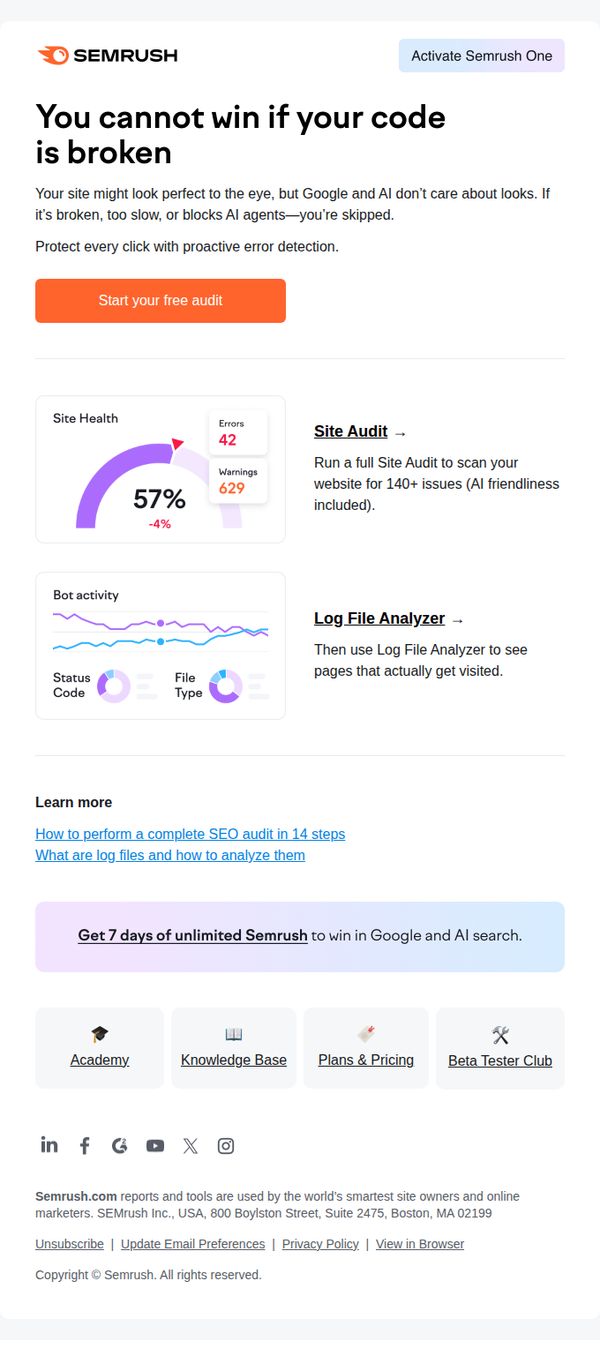
The email aims to drive immediate action by convincing site owners that technical SEO issues are invisible but critical barriers to visibility, prompting them to start a free audit before losing traffic to competitors. It positions Semrush as the essential tool to diagnose and fix these hidden problems.
Why this works
The email opens with a bold, confrontational headline that immediately reframes the reader’s perception of website quality, it’s not about looks, but about whether Google and AI can even see or index the site, which creates urgency and relevance for technical marketers.
How to implement
By pairing a visual health score with specific error counts and a downward trend, the email transforms abstract SEO concerns into tangible, measurable problems that demand immediate attention, making the audit feel less like a suggestion and more like a diagnostic necessity.
Pro Tip
Add a countdown timer or urgency indicator next to the 'Start your free audit' CTA to reinforce the time-sensitive nature of technical SEO fixes and reduce hesitation in clicking. • Include a short testimonial or case study snippet near the Site Audit section showing how a real user recovered traffic or rankings after fixing errors, to build social proof and reduce perceived risk.
4. Show up where search happens now
Objective
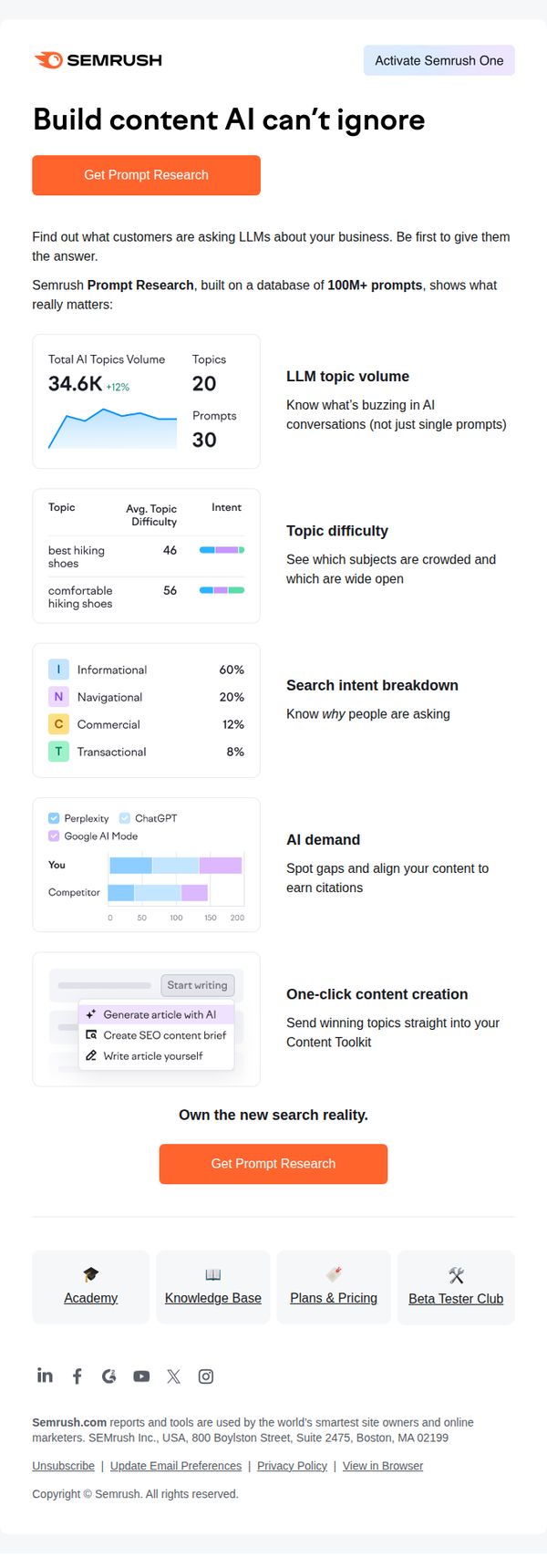
This email aims to drive adoption of Semrush’s new Prompt Research tool by positioning it as essential for creating AI-resistant content that ranks in LLM-powered search environments. It targets marketers who want to stay ahead of AI-driven search trends by offering actionable data and seamless content creation workflows.
Why this works
Semrush brilliantly reframes SEO as a battle for AI attention, not just Google rankings, positioning Prompt Research as the essential weapon for marketers who want to dominate LLM-powered search conversations before competitors catch on.
How to implement
The email uses clean, data-driven visuals to translate abstract AI search trends into tangible metrics like topic volume, difficulty, and intent breakdown, making complex insights feel accessible and immediately actionable for time-strapped marketers.
Pro Tip
Add a subtle countdown timer or limited-time offer badge near the CTA to create urgency, since the tool is positioned as cutting-edge, implying scarcity or early-adopter advantage could boost conversion rates. • Include a short customer testimonial or case study snippet showing measurable results (e.g., 'Increased AI citations by 70% in 30 days') to reinforce credibility and reduce perceived risk for first-time users.
5. Position Tracking Update (njaemail.com)
Objective
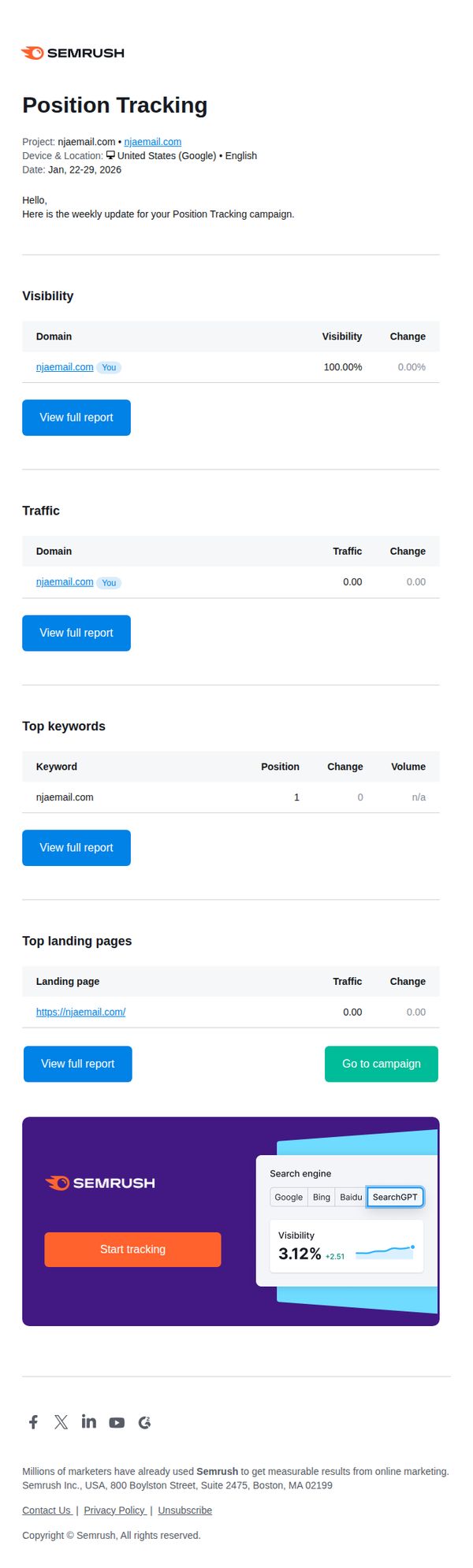
This email aims to inform the user about their weekly position tracking performance for the domain njaemail.com, highlighting visibility, traffic, top keywords, and landing pages, while encouraging deeper engagement through report access and campaign continuation.
Why this works
The email smartly frames performance data as a personalized weekly update, making the recipient feel monitored and supported rather than just sold to, building trust through transparency and consistency.
How to implement
Each metric section includes a dedicated 'View full report' button, which turns passive data into actionable next steps without overwhelming the reader, a brilliant way to guide users toward deeper platform engagement.
Pro Tip
Add a brief explanatory note beside 'Traffic: 0.00' to clarify why no traffic is recorded, perhaps due to new tracking or lack of organic clicks, to prevent misinterpretation and reduce support inquiries. • Replace the generic 'Start tracking' CTA in the banner with context-aware messaging like 'Resume your campaign' or 'Track more keywords now' to better align with the user’s existing project state.
6. Position Tracking Update - Your rankings declined (njaemail.com)
Objective
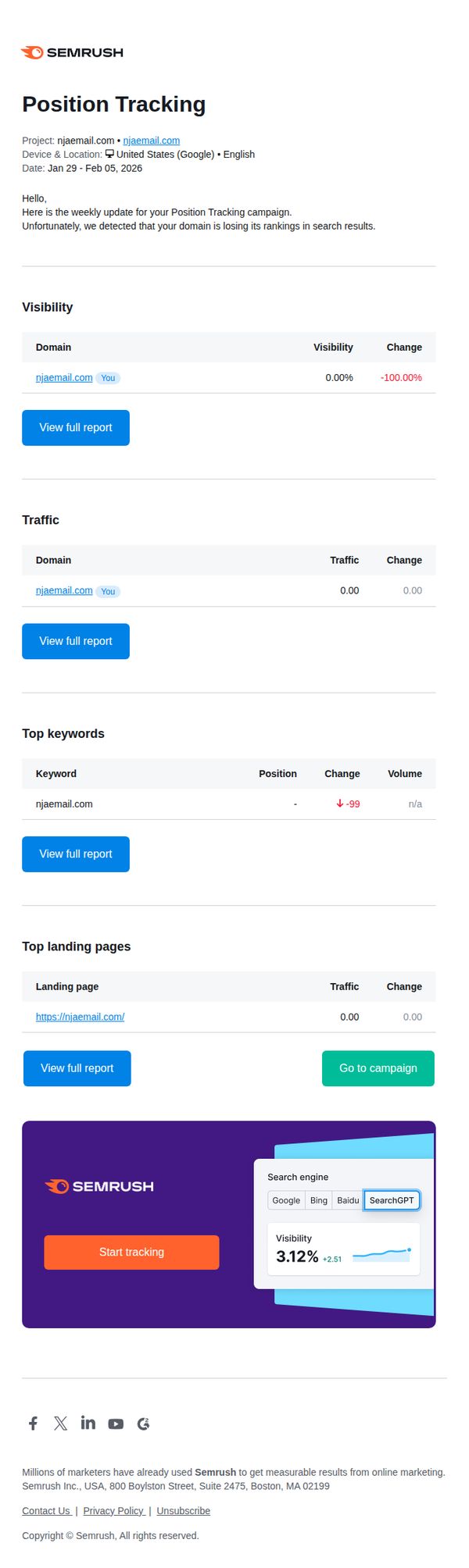
To alert the user that their website’s search engine rankings have declined and encourage immediate action by reviewing detailed reports and re-engaging with Semrush’s tracking tools to diagnose and resolve performance issues.
Why this works
The email immediately communicates a negative performance signal, rankings decline, to trigger urgency, then offers structured data sections that guide the user from problem awareness to actionable diagnosis without overwhelming them with technical jargon.
How to implement
Each metric section includes a dedicated 'View full report' button, creating multiple frictionless entry points for deeper engagement, which reinforces user autonomy while subtly nudging them toward platform reactivation and extended analysis.
Pro Tip
Add a brief explanation or tooltip next to the '-100.00%' visibility change to clarify whether this reflects a technical tracking issue or actual ranking collapse, reducing user confusion and preventing premature disengagement. • Include a time-sensitive element like a '7-day recovery window' or 'limited-time audit offer' near the CTA to heighten urgency and convert concern into immediate action rather than passive observation.
7. Build a complete AI visibility plan
Objective
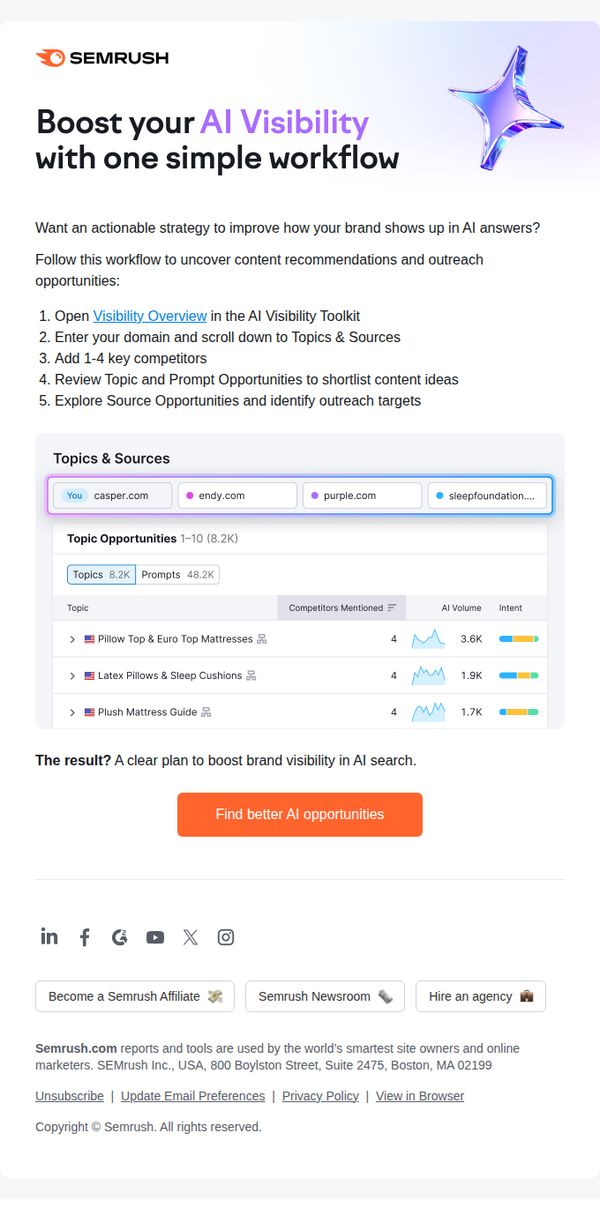
This email aims to guide marketers toward building a complete AI visibility strategy using Semrush’s AI Visibility Toolkit by simplifying complex workflows into actionable steps that uncover content and outreach opportunities. It positions Semrush as the essential tool for brands seeking to dominate AI search results.
Why this works
The email brilliantly simplifies AI visibility into a five-step workflow, making a complex topic feel approachable and actionable, a perfect example of turning technical features into user-friendly value propositions that drive engagement.
How to implement
By visually embedding a real screenshot of the ‘Topics & Sources’ interface, the email builds instant credibility and reduces cognitive friction, helping prospects envision themselves using the tool without needing to click through to a demo or tutorial.
Pro Tip
Add a subtle countdown timer or urgency indicator near the CTA to encourage immediate action, since AI visibility is a time-sensitive competitive advantage and prospects may delay if no friction is introduced. • Include a short testimonial or stat from a recognizable brand that successfully used this workflow to improve AI visibility, social proof would strengthen trust and reduce skepticism among enterprise-level decision-makers.
8. Discover what's new this month
Objective
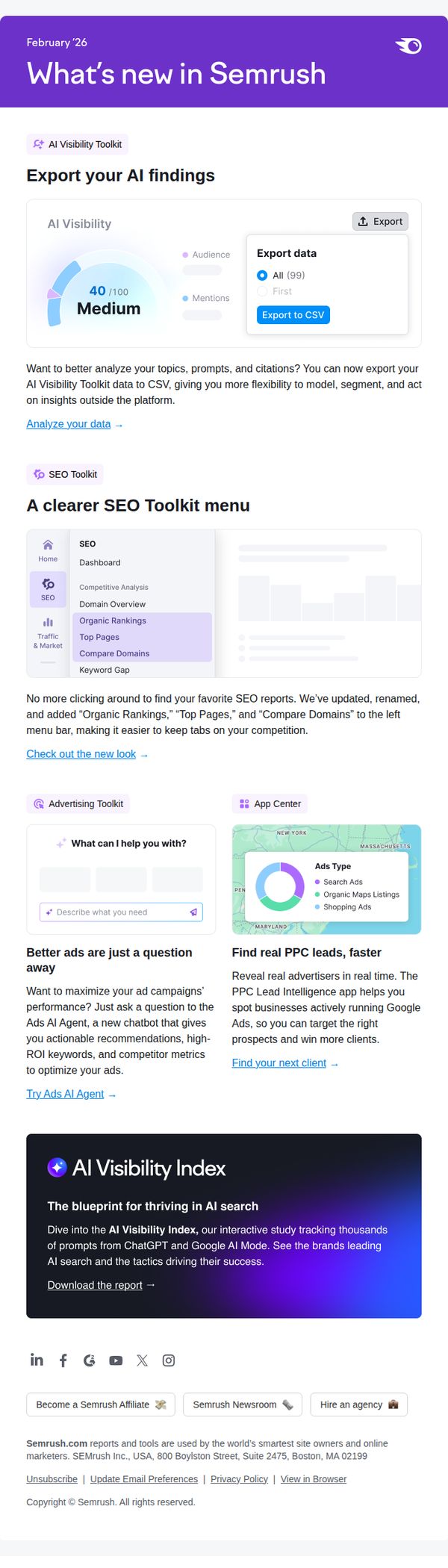
This email aims to inform Semrush users about the latest platform updates and new features released in February, encouraging engagement by highlighting actionable improvements and driving traffic to explore new tools and reports.
Why this works
The email strategically groups updates by toolkit, AI Visibility, SEO, Advertising, to help users quickly identify what’s relevant to their workflow, reducing cognitive load and increasing feature adoption through targeted relevance.
How to implement
By embedding visual UI mockups alongside concise explanations, the email transforms technical updates into digestible, scannable value propositions that speak directly to users’ daily pain points and productivity goals.
Pro Tip
Add a countdown timer or 'New This Month' badge near the header to create urgency and reinforce the timeliness of the updates, encouraging immediate exploration rather than passive reading. • Include a short testimonial or user quote under one of the key features (e.g., Ads AI Agent) to build social proof and demonstrate real-world impact, increasing trust and conversion likelihood.
9. February AI search trends
Objective
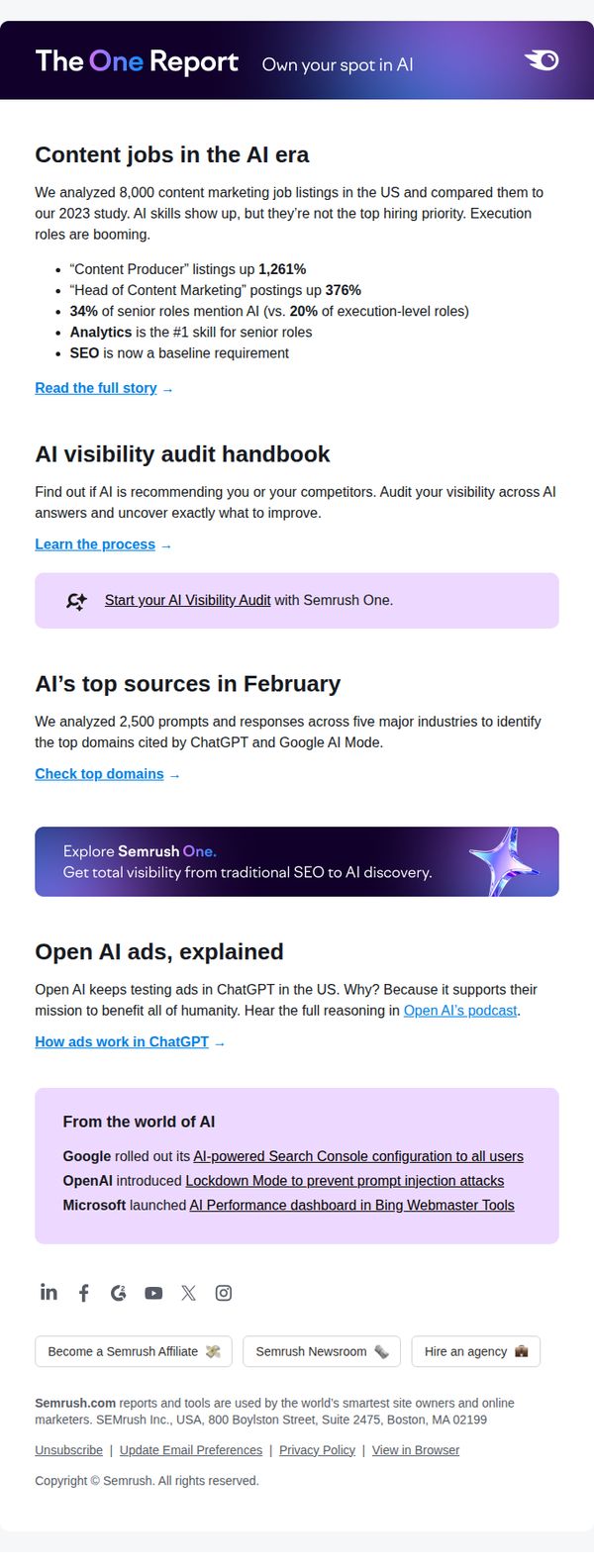
This email aims to position Semrush as a thought leader in AI-driven marketing by sharing timely, data-backed insights from February while driving engagement with Semrush One’s AI Visibility Audit tool. It seeks to convert curiosity into product trial through strategic CTAs embedded in high-value content sections.
Why this works
The email opens with a bold, data-driven hook about AI job market trends, immediately establishing credibility and relevance for marketers who need to stay ahead of hiring shifts and skill demands in the AI era.
How to implement
Each content block is tightly focused on a single insight with a clear next step, such as auditing AI visibility or exploring top domains, which reduces cognitive load and increases the likelihood of user action without overwhelming them.
Pro Tip
Add a subtle countdown timer or urgency indicator near the 'Start your AI Visibility Audit' CTA to nudge procrastinators, since the report is time-sensitive (February trends), implying limited access could boost conversion. • Include a short testimonial or client result snippet under the AI Visibility Audit section to build social proof, for example, '87% of users improved AI visibility within 2 weeks', to reduce perceived risk and increase trust in the tool’s value.
10. Position Tracking Update (njaemail.com)
Objective
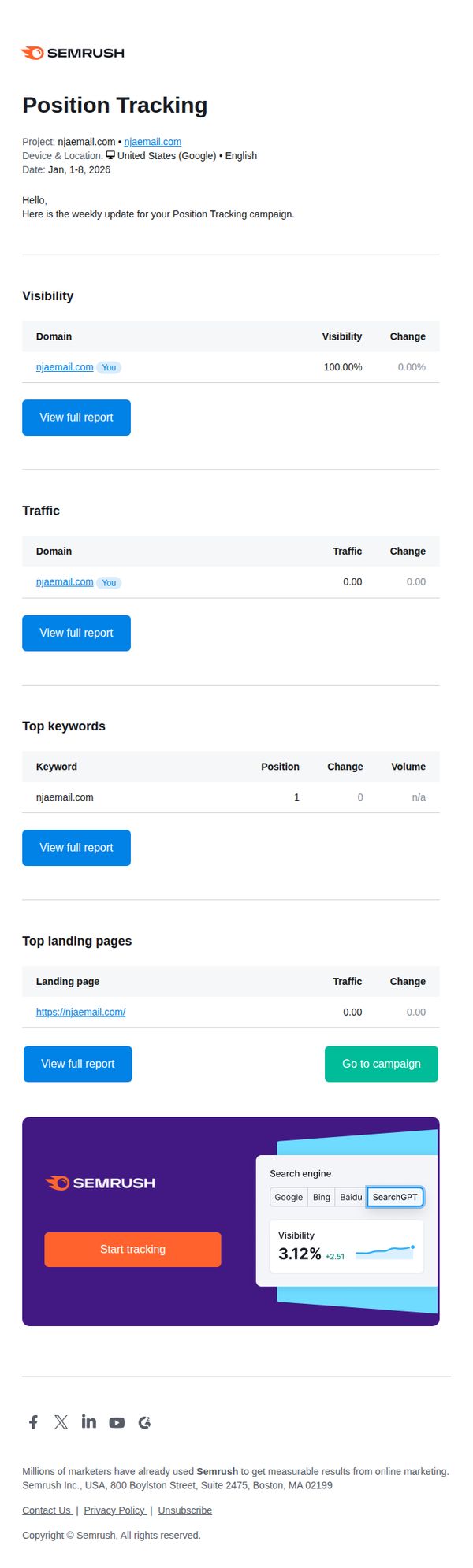
This email aims to deliver a weekly performance snapshot of the recipient’s Position Tracking campaign, highlighting key metrics like visibility, traffic, and keyword rankings to encourage continued engagement and platform usage. It also subtly promotes deeper exploration of the tool’s capabilities through strategic CTAs.
Why this works
The email smartly personalizes the data by anchoring it to the recipient’s specific domain and campaign, making the insights feel immediately relevant and actionable rather than generic or overwhelming.
How to implement
By segmenting performance into digestible sections, Visibility, Traffic, Top Keywords, the email reduces cognitive load and guides the reader through a logical progression of metrics that build toward a clear next step.
Pro Tip
Add a brief explanatory note or tooltip next to the '0.00' traffic metric to clarify why no traffic is recorded, perhaps due to tracking setup or low search volume, reducing potential confusion or perceived inaccuracy. • Include a time-sensitive element like a 'Last 7 Days' badge or a small progress bar next to the visibility metric to create urgency and encourage immediate action rather than passive reading.