Educational campaign ideas that work from HubSpot




1. What SHOULD be obsolete in 2026? 🫢
Objective
This email aims to engage marketing professionals by sparking curiosity about the future of AI in marketing through expert predictions for 2026, while subtly promoting HubSpot’s thought leadership and encouraging newsletter subscriptions.
Why this works
The email brilliantly uses provocative, curiosity-driven questions as section headers to pull readers deeper into expert commentary, turning abstract predictions into relatable, emotionally resonant conversations that feel both urgent and personal.
How to implement
By featuring real HubSpot employees as credible, named experts, the campaign builds authentic authority without sounding salesy, it positions the brand as a hub of internal innovation rather than just a vendor pushing tools.
Pro Tip
Add a visual timeline or progress bar near the top to show how close we are to 2026, this would heighten urgency and make the future feel tangible, reinforcing the ‘what’s next’ theme without adding clutter. • Include a short, punchy pull quote or stat from one of the experts in the hero section to immediately hook skimmers, this would increase retention for readers who might otherwise scroll past the intro paragraph.
2. ☎️ The 2 types of top cold callers (according to new data)
Objective
This email aims to engage sales professionals by revealing data-driven insights into the psychological profiles of top cold callers, while positioning HubSpot as a thought leader in sales strategy and driving interest in their sales playbook and related content.
Why this works
The email brilliantly reframes cold calling from a dreaded chore into a data-backed science by spotlighting two distinct psychological profiles, intellectual curiosity and analytical detachment, making the content feel both fresh and deeply actionable for sales leaders.
How to implement
By anchoring insights in real survey data from 300+ sales leaders and citing Panopli as the source, the email builds instant credibility and positions HubSpot as a trustworthy authority, which subtly primes readers to trust their recommended playbook and resources.
Pro Tip
Add a visual progress bar or checklist under the 'What can you do with this insight?' section to help reps and managers quickly map the advice to their own workflows, increasing perceived value and actionability. • Include a short video testimonial or quote snippet from a sales leader who implemented these insights, even if fictionalized, to strengthen social proof and make the data feel more immediately applicable to the reader’s context.
3. What's your circus dream? 🎪
Objective
This email aims to engage marketers by sharing a compelling entrepreneurial story that reframes failure and emotional connection as strategic assets, while subtly promoting HubSpot’s thought leadership and related content offers to deepen subscriber loyalty and drive conversions.
Why this works
The email masterfully uses a circus metaphor to humanize entrepreneurial struggle, turning vulnerability into a relatable leadership lesson that resonates emotionally while reinforcing brand authority without overt selling.
How to implement
By structuring the narrative around three digestible lessons, the email transforms a personal story into actionable marketing philosophy, making complex emotional intelligence concepts feel accessible and immediately applicable to the reader’s own journey.
Pro Tip
The CTA 'Enter the tent' is creatively themed but lacks clarity on what the user will gain; adding a micro-benefit like 'Get 2 bonus lessons on resilience' would strengthen conversion intent without breaking the metaphor. • The 'Lingering Questions' section feels disconnected from the main narrative; integrating Venardos’s answer more visually or tying it back to the three lessons would reinforce thematic cohesion and deepen the takeaway for readers.
4. Hey there, I like your sweater 👚
Objective
This email aims to educate marketers on leveraging AI ethically and effectively through expert insights from Ashley Faus, while subtly promoting HubSpot’s ICP GPT tool as a practical solution for understanding customer behavior without relying on biased human feedback.
Why this works
By framing AI as an unbiased focus group, this email reframes a technical tool as a human-centered solution, making complex marketing concepts feel approachable and immediately actionable for overwhelmed practitioners.
How to implement
The strategic use of a real executive’s voice and personal anecdotes transforms abstract marketing theory into relatable, memorable advice, proving that authority and authenticity can coexist without sounding corporate or salesy.
Pro Tip
Add a subtle visual cue or icon next to the 'Study your customers' CTA to reinforce its importance and improve click-through rates, currently, it blends into the text-heavy layout and lacks visual hierarchy. • Include a short, one-sentence testimonial or social proof near the CTA from a real user who successfully built their ICP with the GPT tool, this would strengthen trust and reduce perceived risk before conversion.
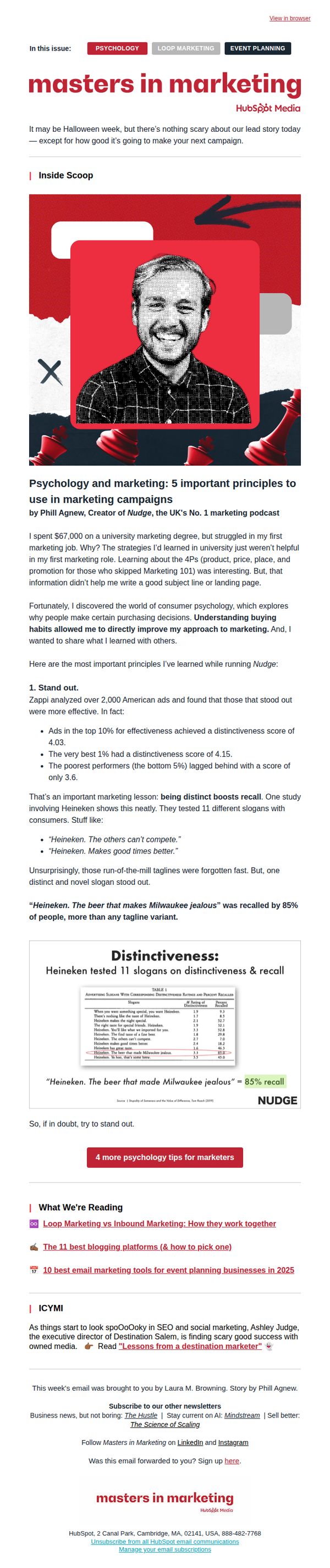
5. How to make Milwaukee jealous 👀
Objective
To educate marketers on consumer psychology principles that improve campaign effectiveness, using real-world examples like Heineken’s slogan testing to demonstrate how distinctiveness drives recall and engagement.
Why this works
The email brilliantly uses a quirky, locally resonant headline, 'How to make Milwaukee jealous', to hook readers by tying a global brand’s psychology lesson to a specific, humorous cultural reference that sparks curiosity and emotional connection.
How to implement
By embedding a real-world case study with data visualization, Heineken’s slogan recall experiment, the email transforms abstract marketing theory into tangible, memorable proof that distinctiveness drives consumer behavior, making complex psychology feel actionable and credible.
Pro Tip
Add a subtle countdown or urgency cue near the CTA button, such as 'Only 4 psychology tips left, grab them before Friday', to nudge immediate action without disrupting the educational tone. • Include a short testimonial or quote from a marketer who applied one of these principles successfully, placed just before the CTA, to reinforce social proof and bridge theory with real-world results.
6. 📉 The losing test that led to 4% more leads

Objective
This email aims to engage marketers by sharing a counterintuitive case study where a failed A/B test led to a 4% increase in leads, encouraging readers to rethink CTA best practices and trust data over assumptions. It also promotes deeper engagement with HubSpot’s content ecosystem.
Why this works
By openly sharing a failed experiment that ultimately improved lead generation, this email builds trust and credibility while positioning HubSpot as a transparent, data-driven authority that values learning over perfection.
How to implement
The narrative arc, starting with a confession of failure, then revealing the surprising positive outcome, creates curiosity and emotional investment, making the lesson more memorable and actionable for marketers seeking conversion optimization insights.
Pro Tip
Add a subtle visual indicator (like a progress bar or mini-timeline) near the CTA to suggest the reader is nearing the payoff of the story, reinforcing momentum and reducing drop-off before the key insight. • Reposition the 'Open Tabs' section below the main article to avoid interrupting the narrative flow; its current placement distracts from the core lesson and dilutes the emotional payoff of the case study.
7. Sta-stay-staying alive

Objective
This email aims to inspire marketers to focus on depth over breadth by showcasing how authentic, community-driven strategies can sustain brand relevance, even with limited resources or small audiences. It positions HubSpot as a thought leader by spotlighting real-world tactics from a rising marketing strategist.
Why this works
The email masterfully reframes 'staying alive' as a strategic marketing imperative rather than a survival tactic, using cultural references and relatable analogies to make abstract concepts feel urgent and human.
How to implement
By spotlighting a lesser-known but highly effective marketer with tangible results, the campaign builds credibility through specificity, proving that real impact comes from deep audience connection, not just follower count or flashy budgets.
Pro Tip
Add a subtle countdown or urgency indicator near the 'Community blueprint' CTA to increase conversion, especially since the offer is timelessly valuable but lacks perceived scarcity. • Include a short video or audio clip thumbnail from Jemma Wu to humanize her expertise further, this would strengthen emotional connection and reinforce the 'authentic community' theme visually.
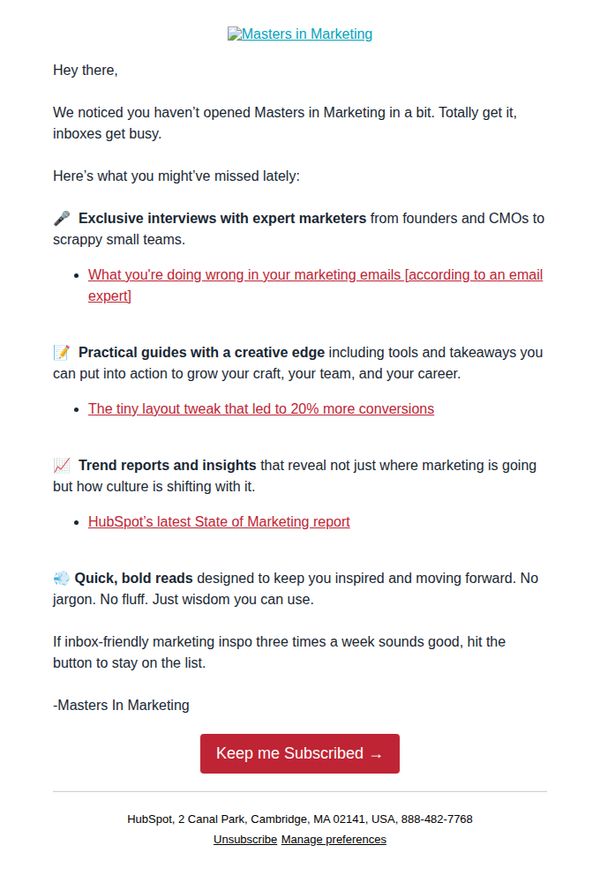
8. Still want marketing ideas in your inbox?
Objective
This email aims to re-engage subscribers who haven’t opened recent issues of 'Masters in Marketing' by reminding them of the high-value content they’re missing and encouraging them to stay subscribed with a clear, low-friction CTA.
Why this works
The email opens with empathy, acknowledging inbox fatigue rather than shaming inactivity, a subtle but powerful psychological nudge that disarms resistance and invites re-engagement without pressure.
How to implement
Each content highlight is framed as a benefit-driven teaser with a specific outcome, like '20% more conversions', making abstract value tangible and giving readers a concrete reason to stay subscribed.
Pro Tip
Add a subtle visual indicator, like a small badge or icon, next to each content item to visually differentiate interview guides, trend reports, and quick reads, helping readers quickly identify content formats that match their preferences. • Include a micro-testimonial or social proof snippet, such as '92% of subscribers say this newsletter helps them ship better campaigns', near the CTA to reinforce credibility and reduce perceived risk of staying subscribed.
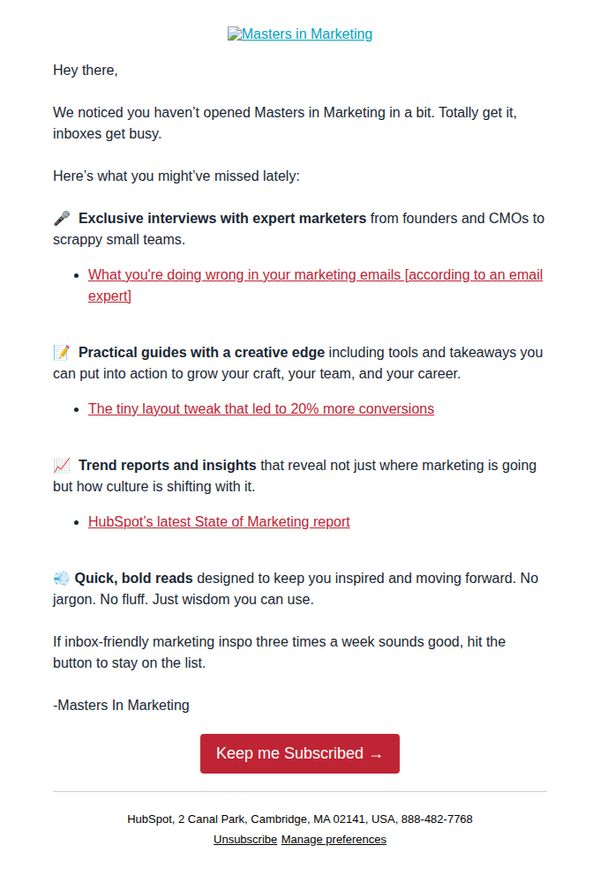
9. Still want marketing ideas in your inbox?
Objective
To re-engage inactive subscribers by reminding them of the valuable, actionable marketing content they’ve been missing and encouraging them to stay subscribed to the 'Masters in Marketing' newsletter.
Why this works
The email opens with empathy, acknowledging inbox fatigue to disarm skepticism and build trust before pitching value, making the reader feel understood rather than marketed to.
How to implement
It structures content around tangible outcomes, like 20% more conversions or cultural marketing shifts, which turns abstract insights into compelling, results-driven reasons to stay subscribed.
Pro Tip
Add a subtle countdown timer or urgency cue near the CTA (e.g., 'Resubscribe by Friday to unlock the next trend report') to nudge procrastinators toward immediate action without sounding pushy. • Include a short, authentic testimonial from a past subscriber who re-engaged and benefited, this social proof would reinforce the value proposition and reduce perceived risk of staying subscribed.
10. The economics of dog shows

Objective
This email aims to entertain and inform readers about the hidden economic ecosystem behind prestigious dog shows like Westminster, while subtly reinforcing HubSpot’s brand voice through storytelling and data visualization. It positions The Hustle as a source of quirky, well-researched business narratives that blend culture with commerce.
Why this works
The email masterfully turns a niche cultural event into a compelling economic narrative by spotlighting the hidden costs, emotional investment, and profit motives behind dog shows, proving that even seemingly frivolous topics can reveal deep business truths when framed with curiosity and data.
How to implement
By blending rich visuals, like the ornate gold-framed illustrations and skyline photo of the winning Doberman, with conversational storytelling, the email creates an immersive experience that feels more like a magazine feature than a marketing message, elevating reader engagement without overt sales pressure.
Pro Tip
Add a subtle countdown timer or urgency cue near the referral CTA to encourage immediate action, since the incentive is time-sensitive (‘3 referrals away’), visual reinforcement could boost conversion without disrupting the editorial tone. • Integrate a mini ‘Did You Know?’ sidebar or tooltip near the ‘Land of the Dogs’ chart to highlight one surprising stat (e.g., ‘Dog population grew 66% since 1996’), this would reinforce the data’s impact without requiring readers to parse the full graphic.