How insurance brands do educational emails that build trust


1. Ethos Life : Sell Ethos Estate Plans—no policy required
Objective
This email aims to empower insurance agents to sell Ethos Estate Plans independently, without requiring a life insurance policy, by highlighting the ease, differentiation, and digital convenience of the offering. It seeks to drive immediate action through clear pricing, product benefits, and a direct CTA to start selling.
Why this works
The email brilliantly positions the estate planning product as a low-commitment, high-differentiation tool for agents, making it feel like an easy add-on rather than a complex new offering, which reduces perceived friction and boosts adoption.
How to implement
By clearly displaying discounted pricing alongside crossed-out original values, the email creates instant perceived value and urgency, encouraging agents to act quickly without needing to compare or research further.
Pro Tip
Add a short testimonial or agent success stat near the pricing section to reinforce social proof, agents are more likely to trust and act on peer validation than on feature lists alone. • Include a subtle countdown timer or limited-time badge near the CTA to create urgency, since the offer’s value is already established but lacks a time-bound incentive to act now.
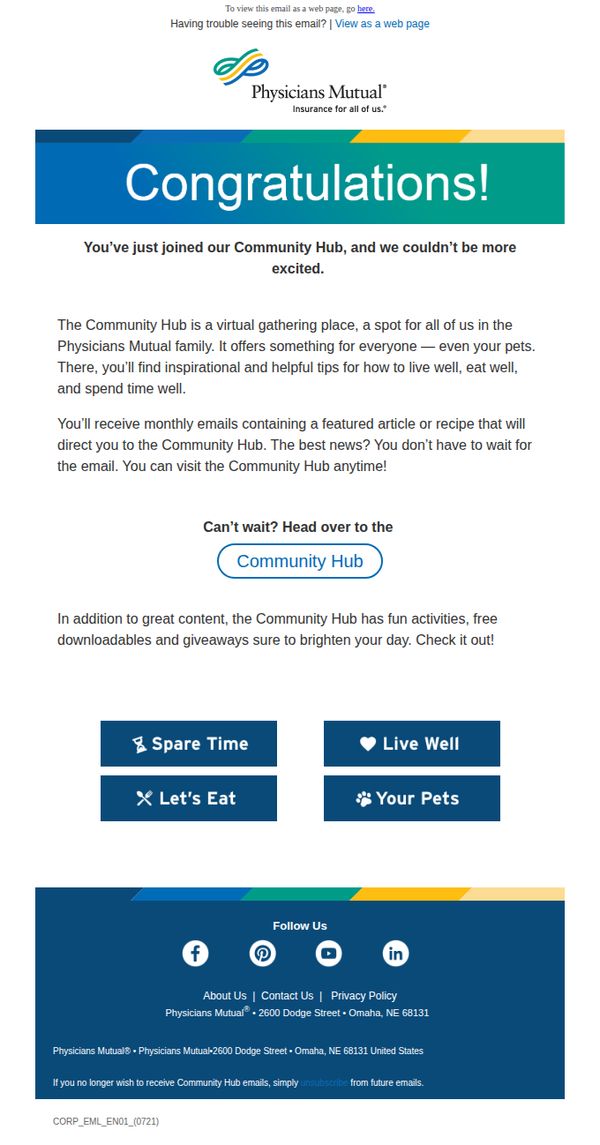
2. Physicians Mutual: Thank You for Subscribing to Our Community Hub.
Objective
This email aims to warmly welcome new subscribers to the Physicians Mutual Community Hub, reinforcing their decision to join while immediately directing them to explore valuable content and activities available on the platform. It also sets expectations for future monthly communications.
Why this works
The email opens with a celebratory tone that makes the subscriber feel valued from the moment they join, turning a simple confirmation into an emotional welcome experience that builds early brand loyalty.
How to implement
By clearly outlining what the Community Hub offers, including articles, recipes, activities, and giveaways, the email creates immediate perceived value, reducing subscriber hesitation and encouraging instant exploration without waiting for the next email.
Pro Tip
Add a subtle countdown or urgency cue near the CTA (e.g., 'First 100 visitors this week get a bonus download') to encourage immediate clicks instead of passive reading, leveraging FOMO to drive action aligned with the 'Can’t wait?' prompt. • Include a brief testimonial or member quote under the hero section, such as 'Over 12,000 members already enjoy weekly tips here!', to build social proof and reinforce trust before users decide whether to click through.
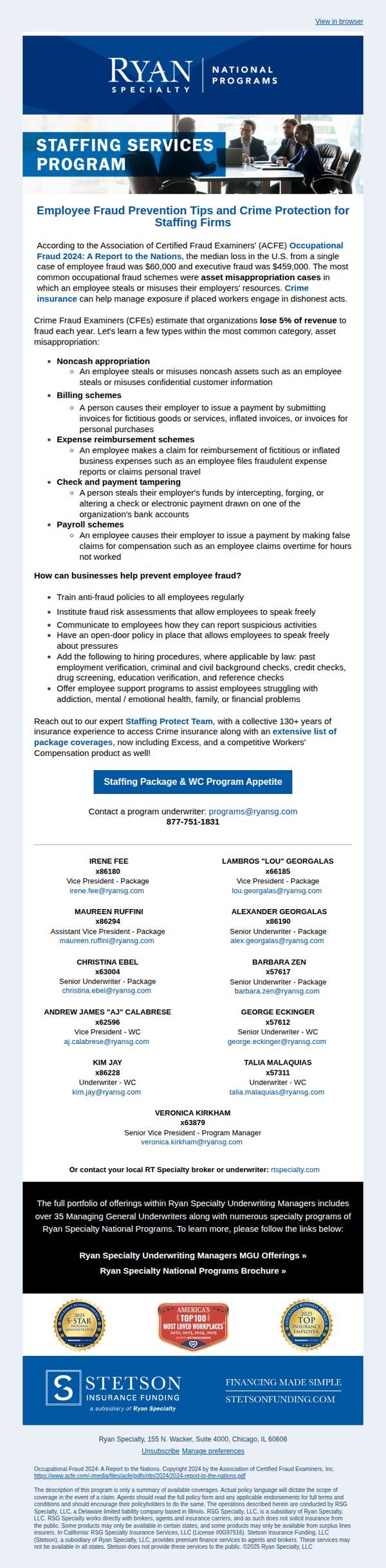
3. RT Specialty: Employee Fraud Prevention Tips and Crime Protection for Staffing Firms
Objective
This email aims to educate staffing firms on preventing employee fraud by highlighting common schemes and actionable prevention strategies, while positioning RT Specialty as a trusted expert offering tailored insurance solutions to mitigate financial and operational risk.
Why this works
The email effectively builds credibility by citing authoritative sources like the ACFE report, grounding the message in real-world data to immediately establish urgency and relevance for staffing firms concerned about financial exposure from internal fraud.
How to implement
It transforms complex risk topics into digestible, actionable advice by breaking fraud types and prevention tactics into bullet points, making it easy for busy decision-makers to scan, understand, and implement practical safeguards without feeling overwhelmed.
Pro Tip
Add a visual hierarchy or iconography next to each fraud type (e.g., billing schemes, payroll schemes) to improve scannability and reinforce the educational value, this would help busy readers quickly identify and retain key risk categories without slowing down. • Include a short testimonial or case study snippet from a staffing firm that successfully reduced fraud using RT Specialty’s guidance or coverage, this would strengthen social proof and emotionally connect the educational content to real-world outcomes.
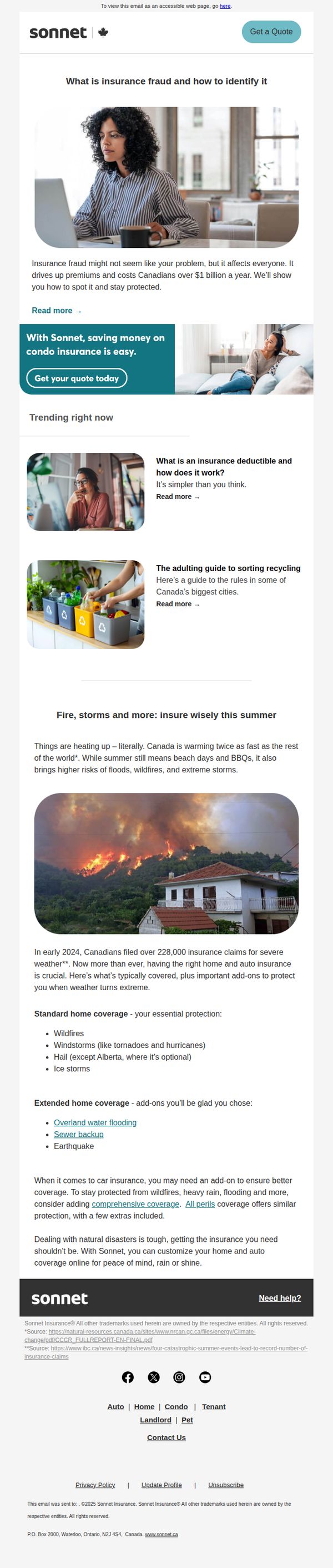
4. Sonnet Insurance: You can’t predict but you can prepare
Objective
This email aims to educate Canadian homeowners about the rising risks of insurance fraud and extreme weather while positioning Sonnet as a trusted, easy-to-use solution for customized home and auto coverage. It encourages readers to act by getting a quote before disaster strikes.
Why this works
The email opens with an urgent, emotionally resonant hook, 'You can’t predict but you can prepare', that immediately frames insurance not as a chore but as proactive self-defense against unpredictable threats like fraud and natural disasters.
How to implement
By pairing real-world data (like 228,000 severe weather claims in early 2024) with clear, scannable bullet points on standard and extended coverage, the email transforms complex insurance jargon into digestible, actionable protection categories that feel relevant and timely.
Pro Tip
Add a countdown timer or urgency cue near the 'Get your quote today' CTA to capitalize on the summer weather risk messaging and encourage immediate action rather than passive reading. • Include a short customer testimonial or trust badge near the offer section to strengthen credibility, especially since the email discusses fraud, a topic that inherently requires heightened trust signals to convert skeptical readers.
5. Sonnet Insurance: 💬 What’s driving up renewal rates?
Objective
This email aims to educate existing and prospective customers on why auto insurance renewal rates are increasing, while positioning Sonnet as a trusted, transparent resource that offers solutions like discounts and policy reviews to help mitigate rising costs.
Why this works
The email smartly reframes rising insurance costs as an industry-wide issue, not the customer’s fault, by citing concrete factors like car theft, supply chain delays, and modern vehicle tech, which builds empathy and positions Sonnet as a knowledgeable guide rather than a sales pusher.
How to implement
By embedding a clear, benefit-driven CTA within an educational context, ‘Unlock more savings with an alumni, employee or professional discount’, the email turns awareness into action without feeling transactional, making the value proposition feel earned rather than forced.
Pro Tip
Add a visual countdown timer or urgency indicator near the ‘Get your quote today’ CTA to nudge immediate action, especially since the email discusses rising rates, creating a ‘save now before it gets more expensive’ psychological trigger. • Include a short testimonial or customer quote near the ‘No auto claims, but still paying more at renewal?’ section to humanize the data and reinforce trust, e.g., ‘I was shocked my rate went up too, Sonnet helped me save 15% by reviewing my coverage.’
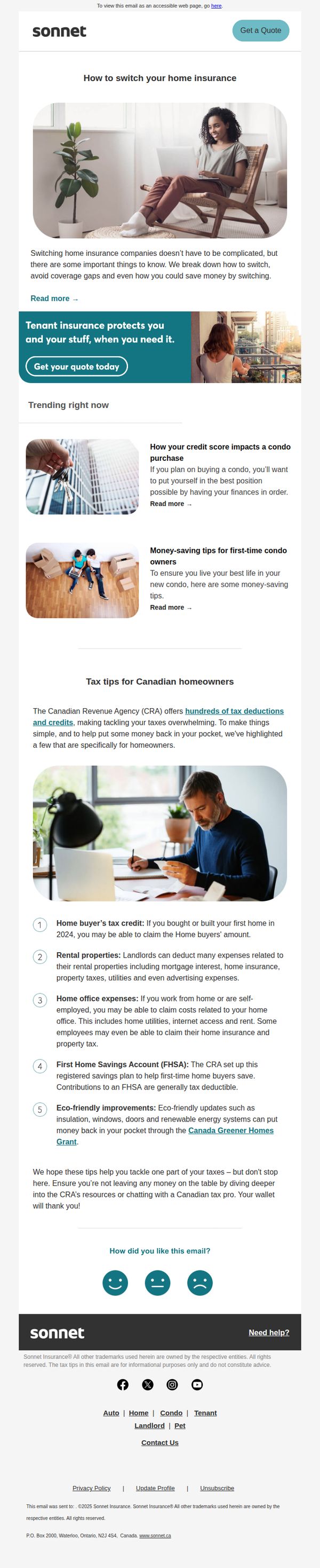
6. Sonnet Insurance: It’s tax time! Home write-offs you might be missing 👀
Objective
This email aims to position Sonnet Insurance as a helpful, tax-savvy resource for Canadian homeowners during tax season by highlighting overlooked home-related deductions, while subtly encouraging policy review or switching through educational content and strategic CTAs.
Why this works
By tying tax season urgency to home insurance relevance, the email transforms a routine financial chore into a strategic opportunity for homeowners to save, making insurance feel less like a cost and more like a smart financial tool.
How to implement
The inclusion of specific, numbered CRA-aligned deductions, like the Home Buyer’s Tax Credit and FHSA, builds instant credibility and gives readers actionable takeaways, which increases the likelihood they’ll trust and return to Sonnet for future guidance.
Pro Tip
Add a countdown timer or seasonal urgency cue near the tax tips section (e.g., 'File by April 30 to claim these deductions') to reinforce time sensitivity and nudge readers toward immediate action or consultation. • Include a short testimonial or stat like '87% of homeowners we surveyed missed at least one deduction' under the tax tips to boost social proof and personalize the value proposition for hesitant readers.
7. Sonnet Insurance: Protect your ride with car-theft prevention tips
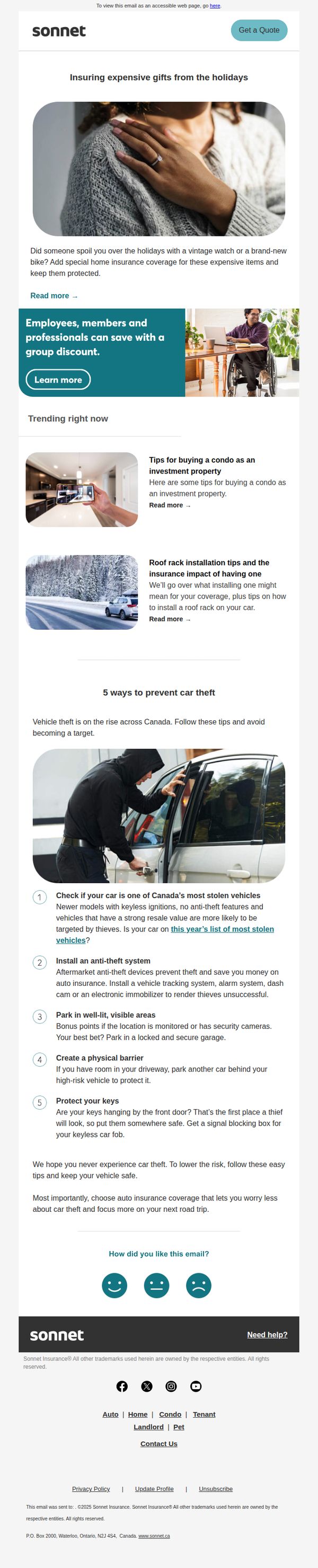
Objective
This email aims to position Sonnet Insurance as a trusted advisor by offering practical car-theft prevention tips, while subtly encouraging readers to consider their auto insurance coverage as a necessary safeguard against rising vehicle theft in Canada.
Why this works
The email smartly opens with a relatable holiday gift protection hook before pivoting to car theft, a seamless transition that builds trust by offering value before pitching insurance, making the audience more receptive to the brand’s message.
How to implement
By listing five specific, actionable car-theft prevention tips with clear numbering and visual cues, the email transforms generic advice into a memorable, shareable resource that positions Sonnet as an authority without sounding salesy or overwhelming.
Pro Tip
Add a visual progress bar or checklist next to the 5 car-theft tips to gamify engagement and encourage readers to mentally tick off each step, increasing perceived value and time-on-email without adding content. • Include a short testimonial or stat like '92% of Sonnet customers felt safer after reviewing our theft prevention guide' near the CTA to reinforce social proof and reduce friction before the quote request.
8. Sonnet Insurance: ✂️ Cut costs, not coverage
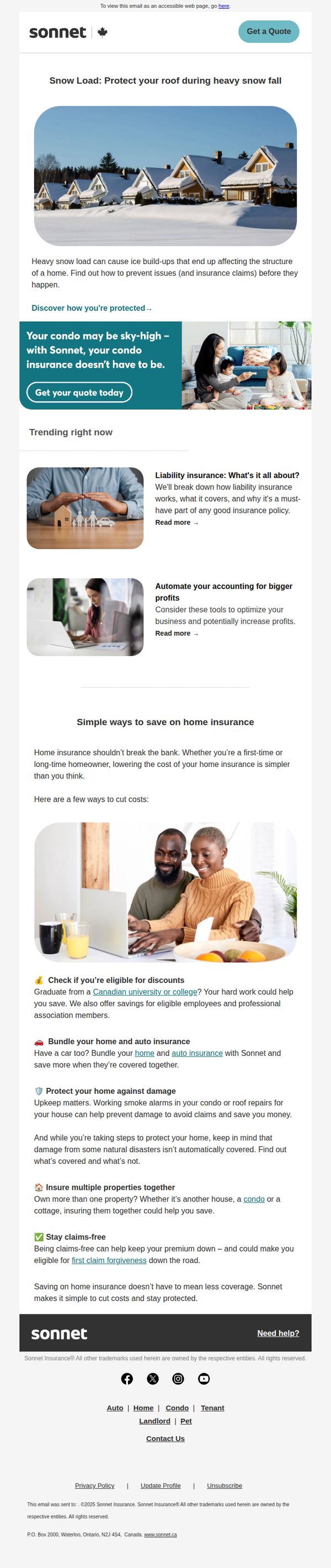
Objective
This email aims to position Sonnet Insurance as a cost-effective yet comprehensive coverage provider, encouraging homeowners and condo owners to get a quote while educating them on practical ways to reduce premiums without sacrificing protection.
Why this works
The email brilliantly reframes cost-saving not as a reduction in value but as smart, proactive protection, making savings feel empowering rather than compromising, which builds trust with price-conscious homeowners.
How to implement
By embedding real-life scenarios like snow load damage and condo ownership into the narrative, the campaign transforms abstract insurance concepts into tangible, relatable risks that motivate immediate action.
Pro Tip
Add a dynamic countdown timer near the CTA to create urgency around seasonal risks like snow load, prompting faster quote requests before winter peaks. • Reposition the 'Trending right now' section below the main savings tips to avoid interrupting the core message flow; its current placement distracts from the primary goal of driving quotes.
9. Sonnet Insurance: ✅ Your checklist to avoid buying a stolen car

Objective
This email aims to educate car buyers on how to avoid purchasing stolen vehicles while subtly promoting Sonnet’s insurance coverage and a limited-time financial incentive through Tangerine. It positions the brand as a trusted advisor in auto safety and smart purchasing decisions.
Why this works
By framing insurance not just as a product but as a protective ally against real-world risks like buying stolen cars, Sonnet builds trust and positions itself as an indispensable guide for savvy consumers navigating complex purchases.
How to implement
The inclusion of a practical, numbered checklist transforms abstract advice into actionable steps, making the content feel immediately useful and memorable, ideal for driving engagement without overt sales pressure.
Pro Tip
The CTA 'Get your quote today' appears twice but lacks visual hierarchy; one should be more prominent or rephrased to match the educational tone (e.g., 'Protect Your Next Purchase, Get a Quote') to better align with the email’s advisory positioning. • The Tangerine offer section feels disconnected from the main educational theme; adding a sentence explicitly linking vehicle safety awareness to smarter insurance choices would strengthen narrative cohesion and justify the cross-promotion.
10. Blue Cross Blue Shield: 🚨Youth mental health crisis
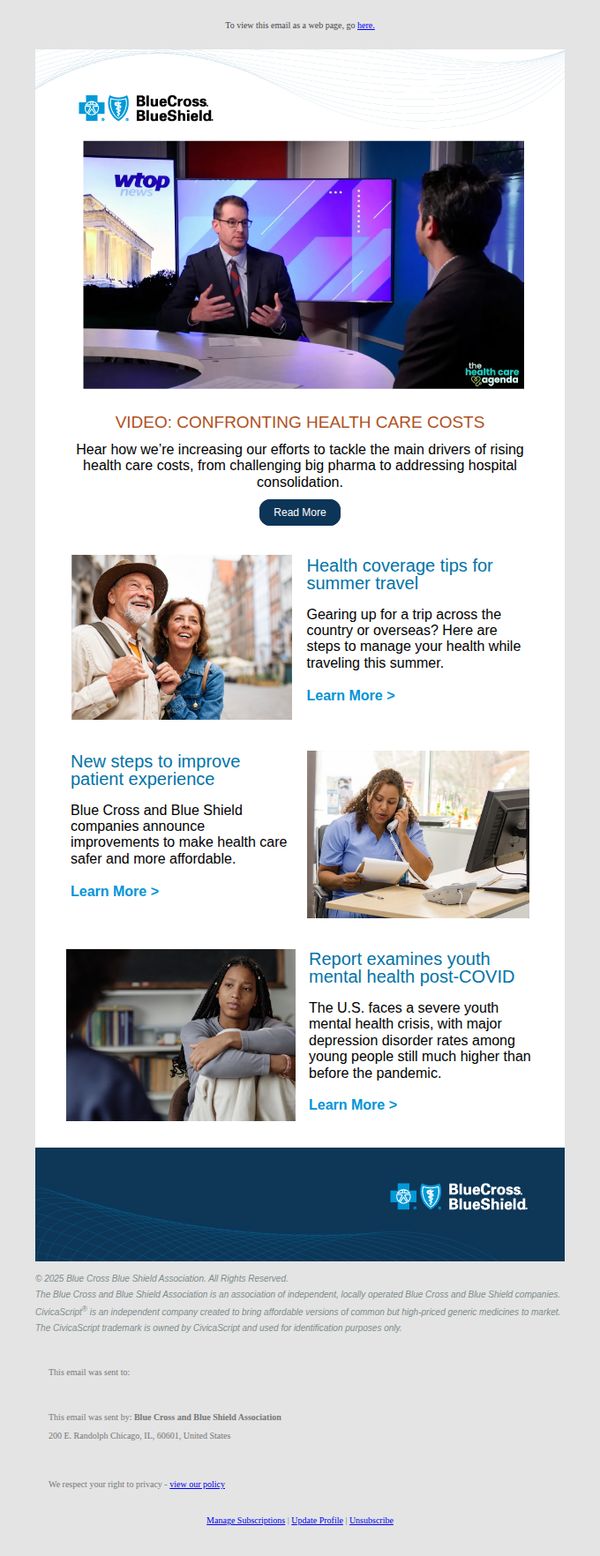
Objective
This email aims to raise awareness about the youth mental health crisis while positioning Blue Cross Blue Shield as a proactive, informed partner in addressing systemic health care challenges. It also seeks to drive engagement through educational content and reinforce brand trust by highlighting company initiatives.
Why this works
The email opens with a bold, emotionally resonant subject line and hero video that immediately frames the brand as a thought leader tackling urgent, socially relevant health issues, a powerful way to capture attention and build credibility.
How to implement
By pairing a serious topic like youth mental health with actionable, digestible content blocks, each with a clear 'Learn More' CTA, the email balances urgency with empowerment, guiding readers from concern to informed next steps without overwhelming them.
Pro Tip
Add a secondary CTA button beneath the youth mental health section that says 'Get Support Now' linking to a crisis hotline or mental health resource page, this would convert awareness into immediate, life-saving action. • Include a short testimonial or quote from a mental health professional or parent in the youth mental health section to humanize the data and strengthen emotional resonance, making the crisis feel more immediate and relatable.