Event Campaign seasonal email examples & ideas

1. Mejuri: The Stacking Event
Objective
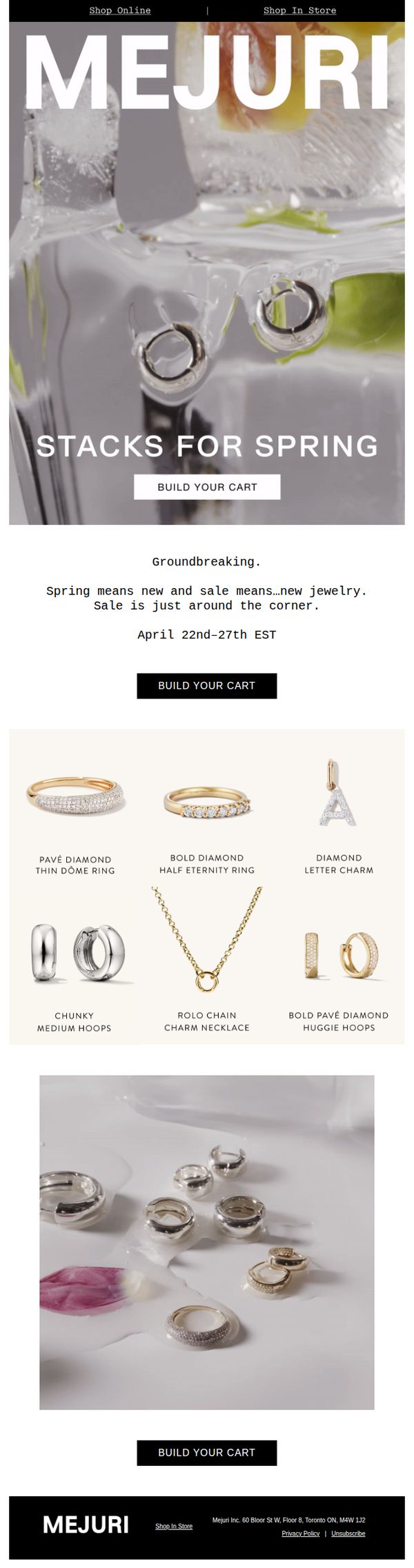
To drive immediate cart-building behavior by promoting a limited-time spring jewelry sale centered around stackable designs, encouraging customers to mix and match pieces before the event ends.
Why this works
The email brilliantly ties seasonal energy to product behavior, using 'Stacks for Spring' to position layering as a fresh, timely ritual rather than just a style choice, making the sale feel experiential and culturally relevant.
How to implement
By featuring curated product pairings in a clean grid with descriptive names like 'Bold Pavé Diamond Huggie Hoops,' the email reduces decision fatigue while subtly educating customers on how to build their own stack with confidence.
Pro Tip
Add a countdown timer beneath the sale dates to amplify urgency, currently, the April 22nd–27th window is stated but not visually emphasized, missing a chance to trigger immediate action. • Include a short testimonial or social proof near the product grid (e.g., '92% of customers stack 3+ pieces') to validate the stacking concept and reduce perceived risk for first-time buyers.
2. Le Collectionist: // Last call for winter holidays
Objective
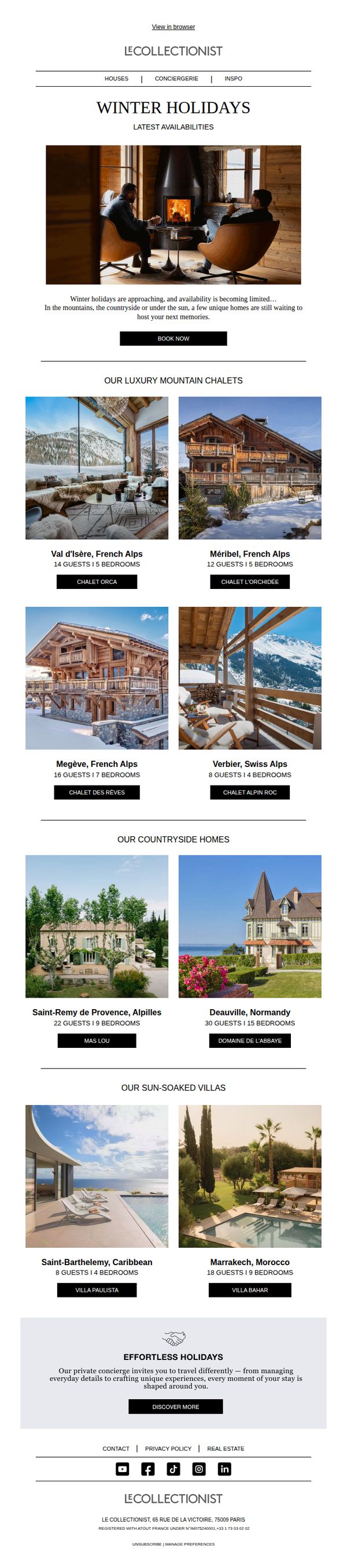
This email aims to drive last-minute bookings for luxury holiday homes by highlighting limited winter availability across mountain, countryside, and sun-soaked destinations, creating urgency while showcasing curated properties that match varied guest preferences.
Why this works
The email masterfully combines urgency with aspiration by opening with a warm, fireside scene and immediately following it with a scarcity-driven message, making the reader feel both emotionally connected and time-pressed to act.
How to implement
By organizing properties into three distinct, visually rich categories, mountain chalets, countryside homes, and sun-soaked villas, the email caters to diverse traveler psychographics while maintaining a cohesive, luxurious brand identity across all segments.
Pro Tip
Add a countdown timer or ‘X homes left’ indicator near the hero CTA to amplify urgency, especially since the subject line implies last-minute availability, this would strengthen the psychological trigger already set up in the opening copy. • Include a short testimonial or guest quote beneath the hero image to build social proof early, since luxury travelers often rely on peer validation, even one authentic voice could significantly increase conversion confidence before scrolling to product grids.
3. Westchester Magazine: Fall Craft Fairs to Attend in Westchester🍂
Objective
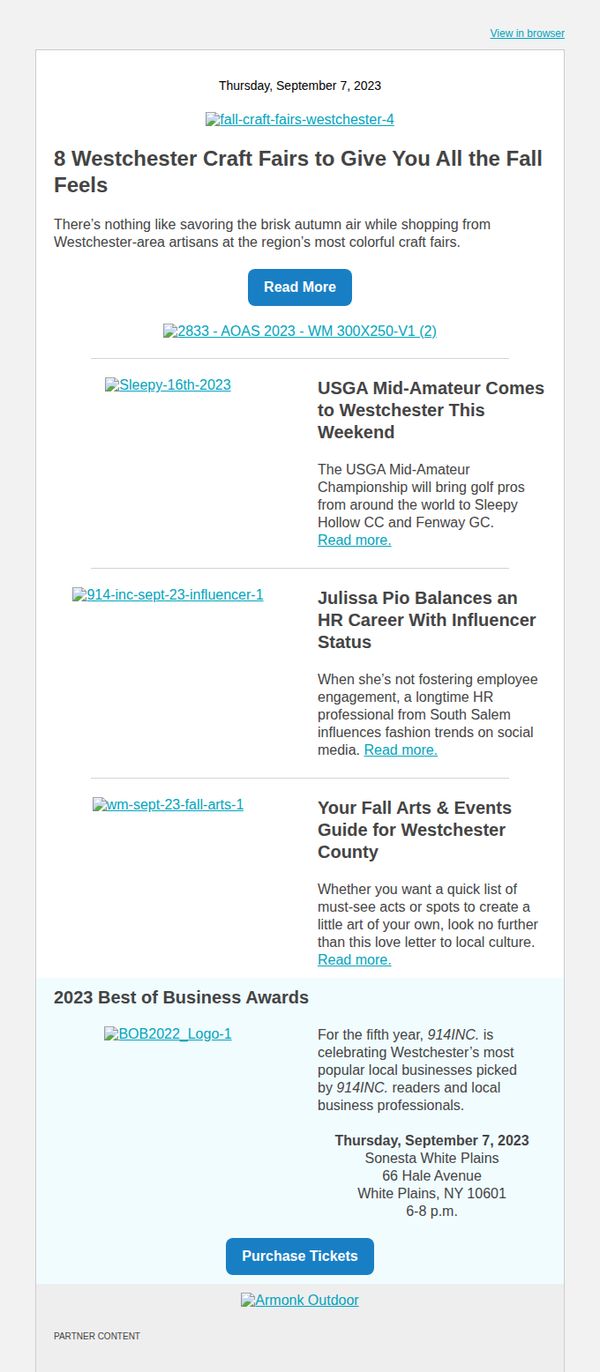
This email aims to drive local engagement by highlighting seasonal craft fairs and cultural events in Westchester County, encouraging readers to explore fall activities while subtly promoting ticketed events and local business recognition through the Best of Business Awards.
Why this works
The email opens with a sensory-rich headline that evokes autumn nostalgia, immediately connecting with local readers’ seasonal emotions and positioning craft fairs as immersive experiences rather than just shopping events.
How to implement
By blending editorial content with promotional elements, like the Best of Business Awards, it creates a natural bridge between community storytelling and commercial action, making the CTA feel like a continuation of discovery rather than a sales pitch.
Pro Tip
The primary CTA 'Read More' is generic and underwhelming for a seasonal event guide; replacing it with action-oriented text like 'Find Your Fall Fair' or 'Get Event Details' would better match the campaign’s goal of driving attendance. • The layout buries the ticketed event (Best of Business Awards) at the bottom with minimal visual distinction; elevating it with a contrasting background, icon, or countdown timer would increase conversion by aligning design hierarchy with business priority.
4. Viator.com: Cozy up with these activities fit for fall
Objective
To inspire recipients to embrace the autumn season by showcasing curated fall-themed travel experiences and activities, encouraging immediate booking through emotional appeal and visual storytelling.
Why this works
The email opens with a warm, sensory-rich visual and headline that instantly taps into seasonal nostalgia, making the audience feel the coziness of fall before they even scroll further.
How to implement
By blending editorial-style content like 'A brewer’s guide to Vermont beer' with product offerings, the campaign builds trust and context, subtly guiding readers from inspiration to conversion without feeling salesy.
Pro Tip
Add a subtle countdown timer or limited-time badge near the 'Fall into fun' CTA to create urgency, since seasonal offers benefit from perceived scarcity to drive faster conversions. • Reposition the 'Why book with Viator?' section higher, perhaps below the hero, to reinforce trust signals earlier in the journey, especially for new users who may hesitate before browsing products.
5. Kalahari Resorts: Kick Off Summer with Kalahari's After-Hours Event!
Objective
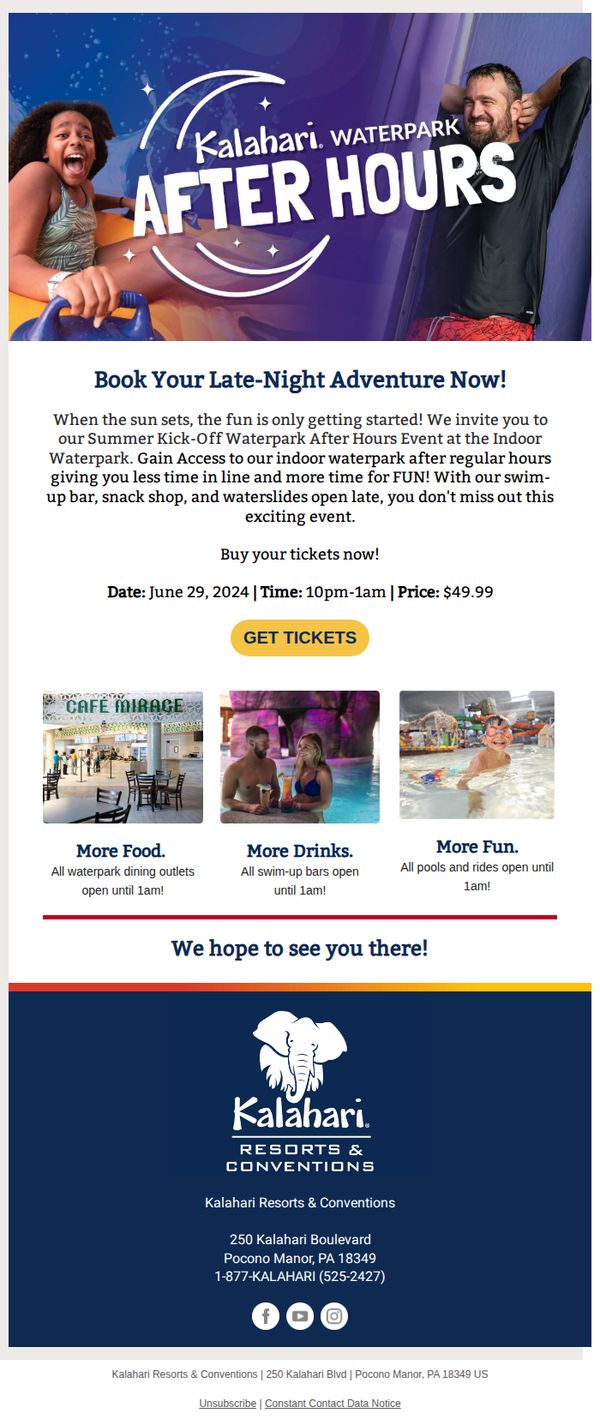
This email aims to drive ticket sales for Kalahari’s Summer Kick-Off Waterpark After Hours Event by highlighting extended access, late-night amenities, and exclusive fun after regular hours. It targets families and adults seeking unique evening entertainment with a clear, time-sensitive offer.
Why this works
The email brilliantly frames the event as a ‘late-night adventure’ rather than just extended hours, tapping into emotional excitement and positioning the experience as exclusive and thrilling for both kids and adults.
How to implement
By visually breaking down the value proposition into ‘More Food,’ ‘More Drinks,’ and ‘More Fun,’ the email simplifies the benefits into digestible, benefit-driven buckets that resonate with different guest priorities and reduce decision fatigue.
Pro Tip
Add a countdown timer near the CTA to create urgency around the June 29 date, since the event is time-bound and ticket availability may be limited, this would boost conversion by leveraging scarcity psychology. • Include a short testimonial or guest quote from a past After Hours event to build trust and reinforce the fun experience, especially since the audience may be unfamiliar with nighttime waterpark offerings.
6. Corro: Hard launch: a better way to prevent mud fever 🤝
Objective
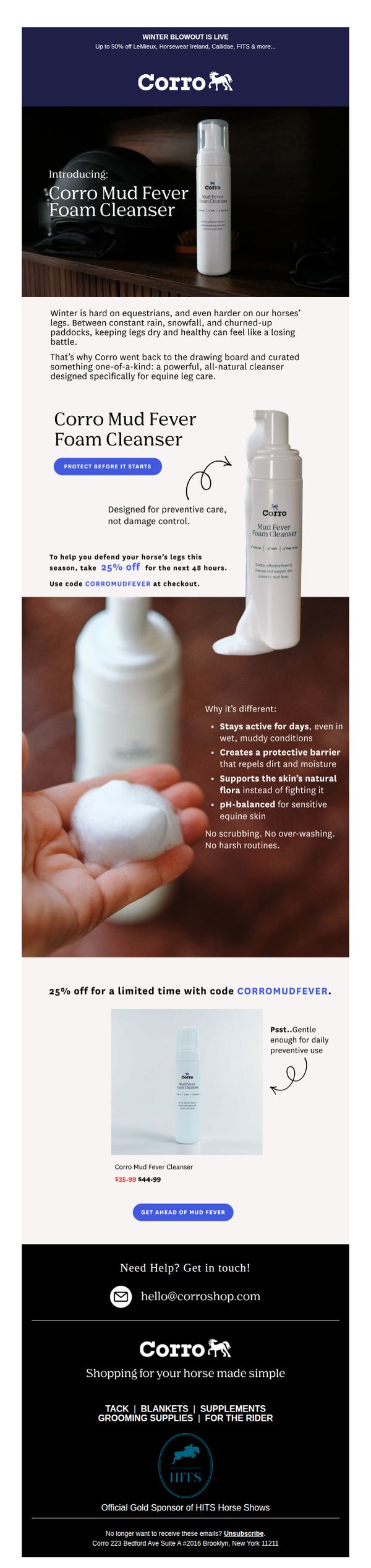
This email aims to introduce Corro’s new Mud Fever Foam Cleanser as a preventive solution for equine leg care during winter, while driving immediate sales through a limited-time 25% discount. It positions the product as a unique, all-natural alternative designed to protect before damage occurs.
Why this works
The email brilliantly frames the product as a preventive tool rather than a reactive cure, aligning with equestrian pain points around seasonal leg care and subtly shifting the customer’s mindset from treatment to proactive protection.
How to implement
By emphasizing the product’s unique benefits, like staying active in muddy conditions and supporting natural skin flora, it builds credibility through science-backed differentiation, making the product feel indispensable rather than just another grooming item.
Pro Tip
Add a countdown timer near the CTA to visually reinforce the 48-hour urgency of the discount, which would increase conversion pressure without requiring additional text or clutter. • Include a short customer testimonial or vet endorsement in the education section to build social proof, especially since the product is new and targets a niche audience that values expert validation.
7. Minnesota Monthly: Preferred Readers! Fall Junk Bonanza Coming Soon
Objective
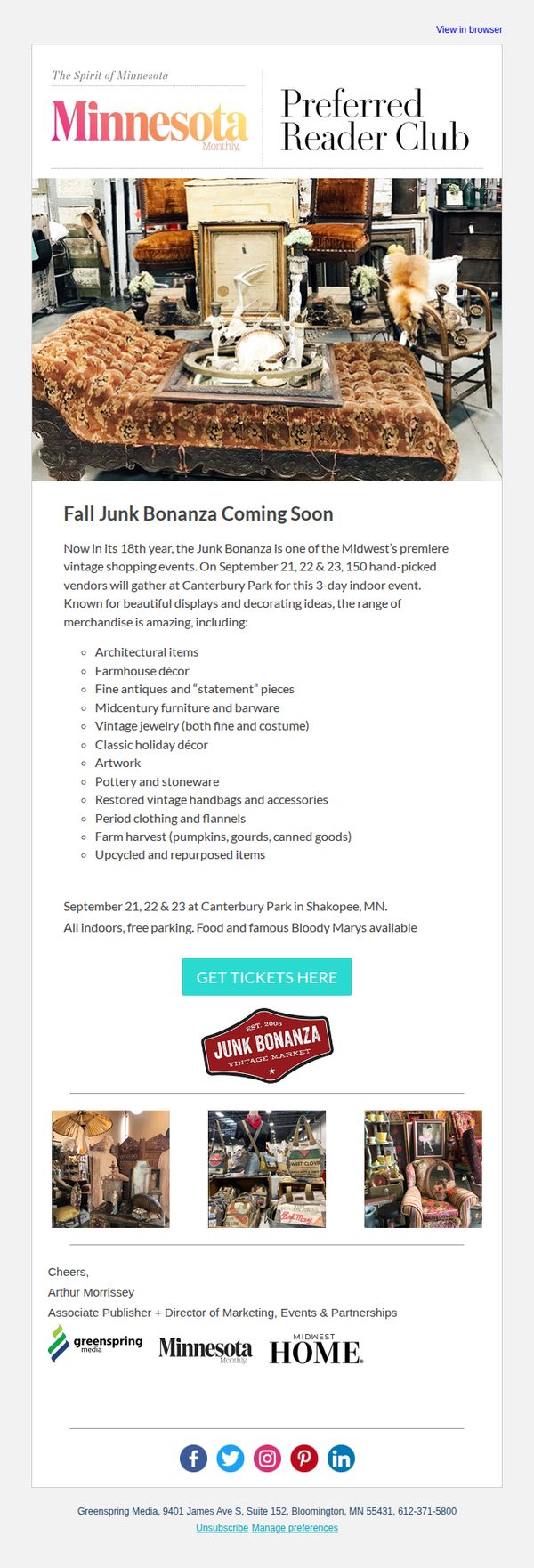
This email aims to excite and mobilize Minnesota Monthly’s preferred readers to attend the 18th annual Fall Junk Bonanza by highlighting its curated vendor selection, diverse merchandise, and unique indoor shopping experience, while driving ticket sales through a clear, prominent CTA.
Why this works
The email leverages exclusivity by addressing readers as 'Preferred Readers,' creating a sense of insider access that boosts engagement and makes the event feel like a curated experience rather than a generic market.
How to implement
It strategically lists specific, evocative categories of merchandise, from 'restored vintage handbags' to 'farm harvest' goods, which paints a vivid picture of the event’s offerings and helps readers mentally visualize their shopping journey.
Pro Tip
Add a countdown timer above the CTA to create urgency, since the event is time-bound and ticket sales benefit from FOMO, this would visually reinforce the 'coming soon' message and nudge procrastinators to act. • Include a short testimonial or quote from a past attendee near the product list to humanize the experience and validate the event’s appeal, social proof would strengthen persuasion beyond just listing categories.
8. Caraway: Our Spring Savings Event ends tomorrow
Objective
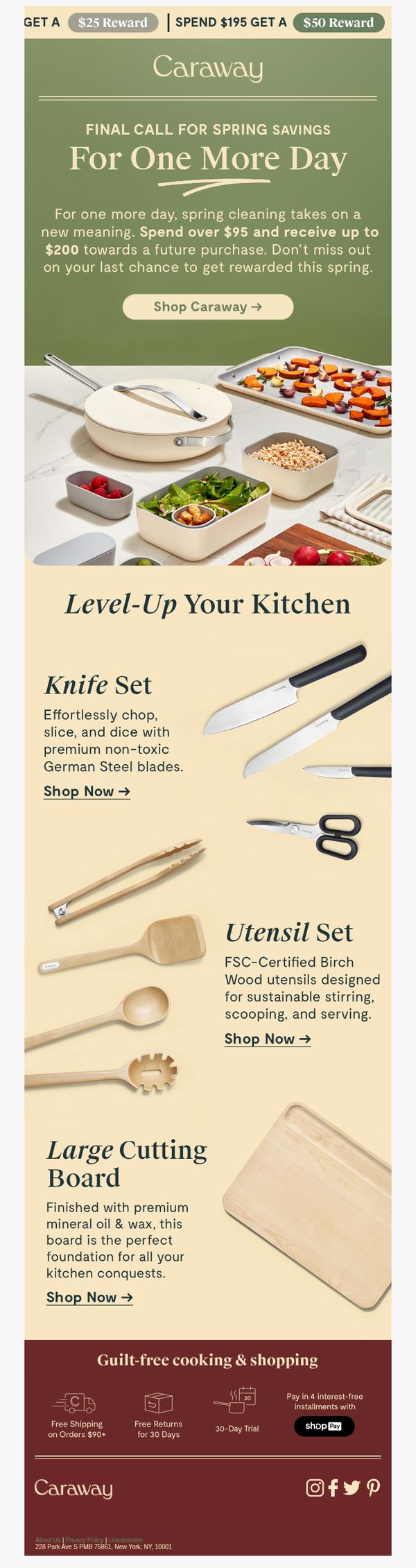
This email aims to drive last-minute purchases by creating urgency around the end of Caraway’s Spring Savings Event, encouraging customers to spend over $95 to earn rewards toward future purchases while showcasing complementary kitchen essentials.
Why this works
The email brilliantly frames the promotion as a final opportunity to earn rewards, turning a seasonal sale into a personal incentive that encourages immediate action without sounding pushy or desperate.
How to implement
By featuring curated kitchen upgrades like knife sets and cutting boards alongside the main offer, the campaign subtly cross-sells high-margin items while reinforcing the brand’s lifestyle positioning as a holistic kitchen solution.
Pro Tip
Add a countdown timer in the hero section to visually reinforce urgency and trigger FOMO, especially since the subject line and headline both emphasize the event ends tomorrow. • Include a customer testimonial or star rating near the product grid to build social proof around the featured items, which would strengthen trust and reduce perceived risk for first-time buyers.
9. Astley Clarke: Unlock up to £300* off with our Autumn Event

Objective
This email aims to drive immediate sales by incentivizing customers to spend more through a tiered discount structure during a limited-time Autumn Event, while showcasing key product categories to guide purchasing decisions.
Why this works
The tiered discount structure creates a powerful psychological nudge, customers are motivated to spend more to unlock higher savings, turning a simple sale into a strategic spending game that boosts average order value.
How to implement
Each product category is visually anchored with lifestyle imagery and paired with a direct 'Shop Now' CTA, making navigation intuitive and reducing friction between interest and purchase decision for time-sensitive shoppers.
Pro Tip
Add a countdown timer near the hero section to reinforce urgency and encourage immediate action, since the 'limited time offer' is mentioned but not visually emphasized with time pressure. • Include customer testimonials or star ratings next to featured products in the product grid to build social proof and reduce perceived risk for high-value items like lockets and bracelets.
10. Buffy: Shop The Spring Event
Objective
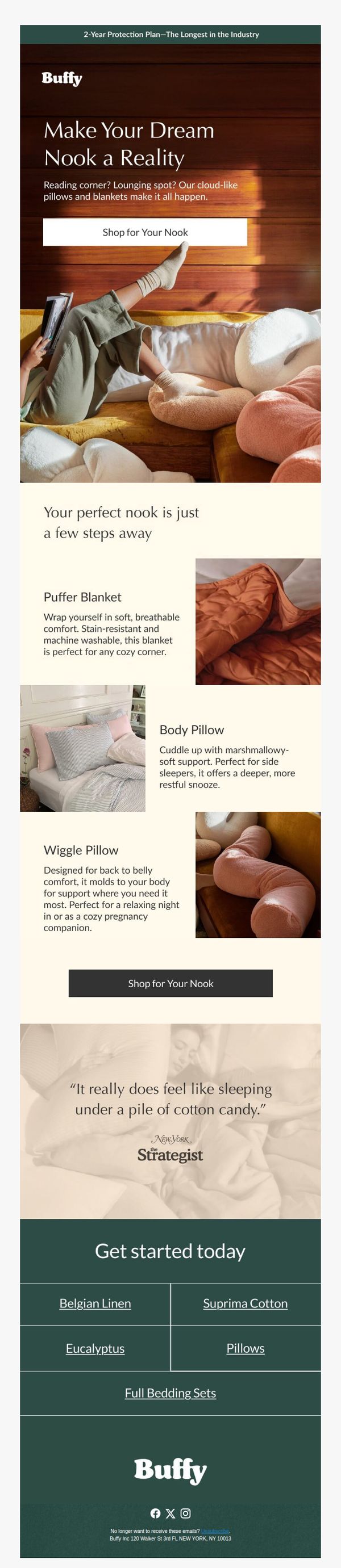
This email aims to drive sales during Buffy’s Spring Event by showcasing cozy, lifestyle-oriented bedding products that transform everyday spaces into dreamy nooks, encouraging immediate browsing and purchase through emotionally resonant visuals and clear product benefits.
Why this works
The email brilliantly frames products not as commodities but as experiences, turning a reading corner or lounging spot into a ‘dream nook’ invites emotional ownership before the customer even clicks through.
How to implement
Each product is paired with a specific use case and benefit, such as the Wiggle Pillow being ‘perfect for a relaxing night in or as a cozy pregnancy companion,’ which builds relatability and justifies purchase through real-life relevance.
Pro Tip
Add a limited-time discount or urgency cue (e.g., ‘Spring Event Ends Soon’) near the hero CTA to boost conversion by leveraging FOMO without disrupting the cozy, unhurried tone of the email. • Reposition the second ‘Shop for Your Nook’ CTA to appear immediately after the product grid, rather than below it, to reduce friction and capitalize on product interest while the customer is still engaged.