How Newsweek does media email campaigns



1. The Bulletin: Inside DNC chair's plan to turn Democratic momentum into power
Objective
This email aims to inform subscribers of breaking political and global news while subtly encouraging membership through value-driven content and a clear call to action. It positions Newsweek as a trusted, ad-free source for in-depth analysis and timely updates.
Why this works
The email opens with a powerful, emotionally resonant headline about Jesse Jackson’s passing, immediately anchoring the reader in a moment of cultural and political significance that draws them into the full narrative of the newsletter.
How to implement
By embedding a membership CTA within the editorial flow, not just at the top or bottom, Newsweek frames subscription as a natural extension of the reader’s desire for deeper, ad-free journalism, making the ask feel earned rather than interruptive.
Pro Tip
The CTA 'Join now for just $4.99' appears only once in the header and lacks visual reinforcement later in the email; adding a secondary sticky or mid-content CTA button would capture readers who scroll past the initial offer. • The 'World in Brief' section uses a generic photo of a crowd that doesn’t visually connect to the listed stories; replacing it with a collage or rotating thumbnails of the actual topics would increase visual relevance and click-through intent.
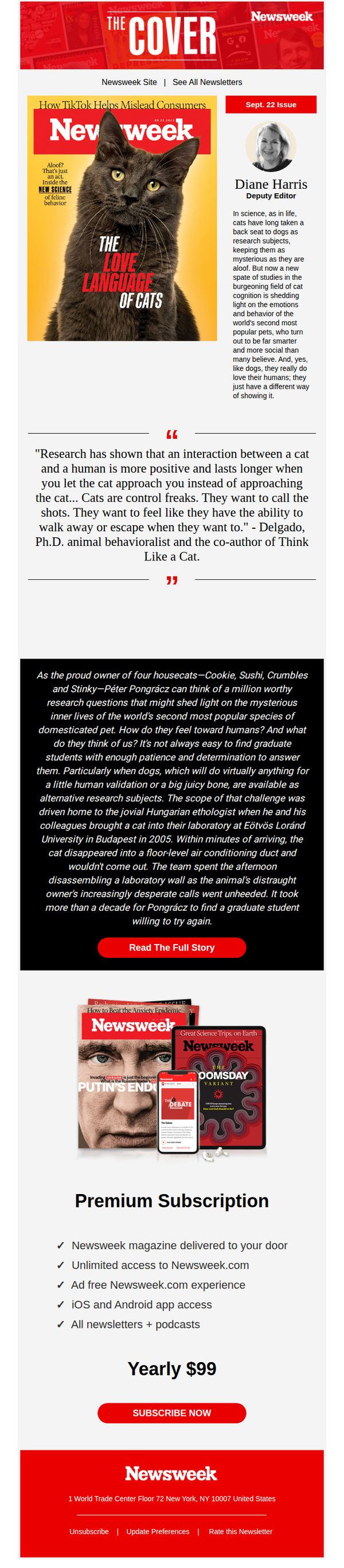
2. The love language of cats
Objective
To engage cat-loving readers with a compelling, science-backed story about feline behavior while subtly promoting a premium subscription to Newsweek through emotional resonance and curiosity-driven storytelling.
Why this works
By leading with a quirky, emotionally resonant headline like 'The Love Language of Cats,' the email instantly hooks readers who identify as cat lovers, turning a niche scientific topic into a relatable, shareable narrative that builds brand affinity.
How to implement
The inclusion of a vivid personal anecdote about a researcher’s chaotic lab experience with a runaway cat adds humor and humanity, making abstract scientific research feel accessible and memorable without sacrificing credibility or depth.
Pro Tip
Add a visual countdown timer or limited-time discount badge near the 'SUBSCRIBE NOW' CTA to create urgency and increase conversion, especially since the email’s emotional hook already primes readers for action. • Include a short, bold testimonial quote from a current subscriber about how Newsweek’s science or culture coverage changed their perspective, placed just above the subscription section to reinforce social proof.
3. The Bulletin: North Korea’s nuclear gamble pays off
Objective
This email aims to deliver timely, high-impact global news with a focus on North Korea’s nuclear advancements and U.S. political developments, while subtly encouraging readers to join Newsweek’s membership for ad-free, in-depth coverage and direct access to editors.
Why this works
The email opens with a bold, provocative headline that immediately frames North Korea’s nuclear activity as a strategic ‘gamble’, a narrative hook that invites curiosity and positions the reader as someone who understands geopolitical stakes, not just a passive consumer of headlines.
How to implement
By embedding membership prompts within editorial content, like the ‘Go Ad-Free!’ section placed after a cultural commentary, it transforms subscription from a sales pitch into a natural extension of the reader’s desire for deeper, uninterrupted insight, making the CTA feel earned rather than interruptive.
Pro Tip
The primary CTA ‘Join now for just $4.99’ appears only in the header and once in the middle; adding a sticky or repeated CTA button near the end of the email, especially after the ‘One Deeper Read’ section, would capture readers who’ve engaged deeply and are most primed to convert. • The ‘World in Brief’ section uses bullet points with inconsistent link styling, some are blue underlined, others are plain text, creating visual noise and reducing scannability; standardizing all ‘Read more’ links with consistent color and underline would improve UX and encourage more clicks.
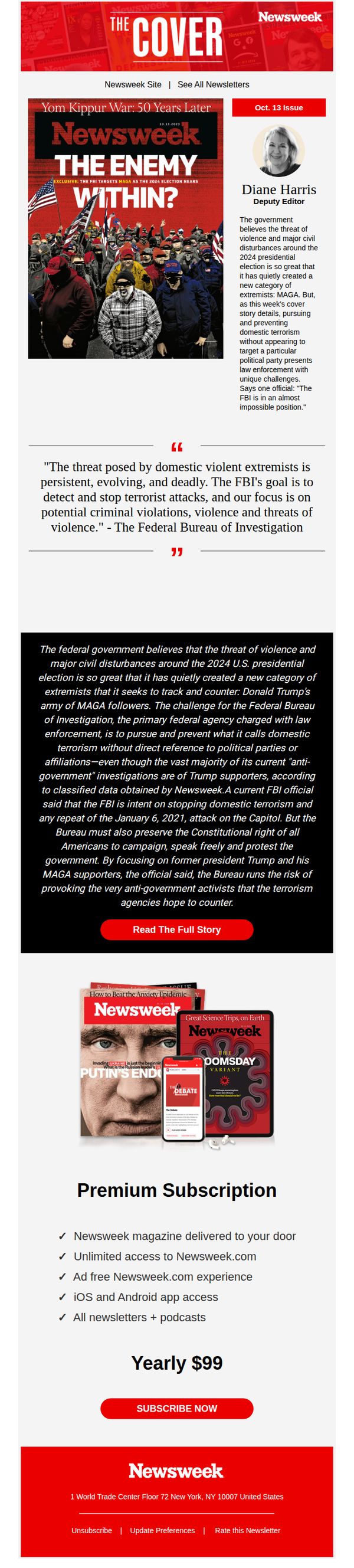
4. Exclusive: The FBI Targets Trump Followers as the 2024 Election Nears
Objective
This email aims to drive urgency and engagement around Newsweek’s exclusive political coverage ahead of the 2024 election while converting readers into premium subscribers through a compelling narrative and value-driven offer.
Why this works
The email masterfully leverages timely, high-stakes political drama to position Newsweek as an essential source for readers seeking behind-the-scenes intelligence on national security threats ahead of the 2024 election.
How to implement
By embedding a powerful quote from the FBI within the body copy, the campaign builds credibility and emotional gravity without relying solely on sensational headlines, making the content feel authoritative rather than alarmist.
Pro Tip
Add a secondary CTA above the subscription section, such as 'Download the PDF' or 'Share This Story', to capture engaged readers who aren’t ready to subscribe yet, increasing overall interaction without disrupting the primary funnel. • Include a short testimonial or subscriber stat (e.g., 'Join 500K+ informed readers') near the subscription CTA to reinforce social proof and reduce perceived risk for new subscribers.
5. Debating Trump without him, Cuba’s growing pains, Humanity could reach Earth’s limit, your morning Bulletin from Newsweek
Objective
This email aims to deliver a concise, high-impact morning news digest that keeps subscribers informed on breaking global and U.S. political stories while subtly encouraging subscription conversion through embedded CTAs and value-driven content curation.
Why this works
The email opens with a punchy 'World in Brief' bullet list that immediately delivers value by summarizing top stories in under 10 seconds, making it irresistible for time-poor readers to keep scrolling for deeper dives.
How to implement
Each article is structured with a TL;DR quote, a clear headline, and a 'What happens now?' forward-looking analysis, which transforms passive reading into an engaging, predictive experience that builds trust in Newsweek’s editorial foresight.
Pro Tip
The 'What to Watch in the Days Ahead' section at the bottom is visually underwhelming and buried; it should be elevated with a bold header, iconography, or countdown-style formatting to match the urgency of the content and drive forward-looking engagement. • The 'Talking Points' section uses dense, unbroken bullet text that disrupts the email’s clean rhythm; adding subheadings, pull quotes, or speaker attribution icons would improve scannability and reinforce the credibility of each quoted source.
6. For the Culture: FCC puts ‘The View’ under review

Objective
This email aims to engage culturally aware readers by spotlighting timely media controversies and celebrity narratives, while subtly encouraging membership through ad-free content access and deeper cultural analysis.
Why this works
The email masterfully frames a politically charged media moment as cultural commentary, inviting readers to lean into the drama while positioning Newsweek as the thoughtful interpreter of pop culture’s most volatile intersections.
How to implement
By embedding a high-profile celebrity profile within a broader cultural critique, the campaign transforms a news hook into an emotional narrative arc that rewards curiosity and rewards deeper engagement through strategically placed CTAs.
Pro Tip
Add a visual countdown timer or progress bar near the 'Become a Newsweek Member' CTA to create urgency and reinforce the value of ad-free access before the reader scrolls past the hero section. • Integrate a short, embedded video clip or audio snippet from H. Alan Scott’s podcast within the author bio section to deepen credibility and convert passive readers into engaged listeners or subscribers.
7. Biden's impeachment falls apart, Zelenksy's U.N. plea, Azerbaijan and Armenia reportedly agree to ceasefire, your morning Bulletin from Newsweek.

Objective
This email aims to deliver a concise, high-impact morning news digest to keep subscribers informed on breaking global and domestic stories while reinforcing Newsweek’s authority as a trusted source for timely, in-depth political and economic analysis.
Why this works
The email opens with a tightly curated 'World in Brief' section that delivers maximum context in minimal space, giving readers a quick pulse check on global events without overwhelming them, a perfect model for time-pressed audiences seeking credible, bite-sized updates.
How to implement
Each major story is framed with a TL;DR summary followed by deeper analysis, which respects the reader’s time while still offering substance, this layered approach builds trust by making complex political developments feel accessible without sacrificing journalistic depth.
Pro Tip
The 'What to Watch in the Day Ahead' section at the bottom is visually buried and lacks a clear CTA; repositioning it higher with a time-sensitive prompt like 'Stay Ahead: Get Today’s Key Events Delivered' would better leverage its predictive value to drive engagement. • The 'Featured Content' section on hybrid work feels disconnected from the rest of the political-heavy content; either integrate it with a stronger editorial bridge (e.g., 'How Work Trends Are Shaping Policy') or replace it with a more timely, thematically aligned story to maintain narrative cohesion.
8. The Bulletin: MAGA proxy war that could determine 2028

Objective
This email aims to engage subscribers with urgent, high-impact political and global news while subtly promoting membership by highlighting ad-free access and exclusive content. It positions Newsweek as a trusted, real-time source for readers seeking depth beyond headlines.
Why this works
The email opens with a strong narrative hook, 'Good morning. We begin in Ohio', which immediately grounds the reader in a specific, timely story, creating urgency and emotional investment before diving into broader coverage.
How to implement
By embedding the membership offer within the editorial flow rather than relegating it to the footer, the campaign cleverly frames subscription as a natural extension of the reader’s desire for uninterrupted, high-quality journalism, not just a sales pitch.
Pro Tip
The CTA 'Go Ad-Free for Just $1!' appears twice but lacks visual hierarchy; adding a contrasting button color or animation near the hero section would increase click-through by anchoring the offer to the most engaged part of the reader’s journey. • The 'Today’s Top Five' section uses portrait images without captions or context, which may confuse readers; adding brief headlines or labels under each photo would clarify relevance and improve scannability for time-pressed audiences.
9. Geoscape: The Iran war threat is real

Objective
This email aims to drive paid subscriptions to Newsweek’s Geoscape newsletter by highlighting urgent global security threats, particularly the risk of war with Iran, while positioning the publication as a trusted, distraction-free source for high-stakes international analysis.
Why this works
The email opens with a bold, urgent headline, 'The Iran war threat is real', that immediately signals high-stakes relevance, leveraging fear of missing out on critical global developments to hook readers before they scroll further.
How to implement
By introducing the editor by name and credentials upfront, the email builds instant authority and personalizes the experience, making subscribers feel they’re getting direct access to a seasoned global affairs analyst rather than generic news aggregation.
Pro Tip
Add a countdown timer or urgency indicator next to the $4.99 offer to increase conversion pressure, since the current CTA lacks temporal scarcity despite the high-stakes geopolitical framing. • Include a short testimonial or subscriber stat (e.g., 'Join 120,000+ readers who rely on Geoscape for early warnings') near the CTA to reinforce social proof and reduce perceived risk for new subscribers.
10. For the Culture: My thoughts on 'Stranger Things'? Honestly...

Objective
This email aims to engage readers with culturally relevant commentary and breaking entertainment news while subtly promoting Newsweek’s ad-free membership. It leverages timely pop culture moments to drive clicks, build brand authority, and convert casual readers into subscribers.
Why this works
The email opens with a personal, conversational hook about 'Stranger Things' that immediately resonates with fans, turning a cultural moment into a relatable entry point that invites readers to share their own opinions and stay engaged.
How to implement
By blending high-profile celebrity drama with hard-hitting entertainment journalism, like the Will Smith lawsuit and Clooney-Trump feud, the email positions Newsweek as both culturally savvy and editorially rigorous, appealing to readers who want depth alongside drama.
Pro Tip
The 'Read More' buttons are visually identical across sections, which reduces visual hierarchy; differentiate them with color or iconography to guide users toward the most strategically important stories based on engagement goals. • The footer’s Trust Project disclaimer, while important, competes for attention with social links and copyright info; reposition it above the social icons or collapse it into a 'Learn More' toggle to preserve visual clarity and brand trust without clutter.