TIME Media email designs from top brands


1. Trump tries to reinstate Columbus Day, which was never canceled
Objective
This email aims to inform readers about President Trump’s attempt to reinstate Columbus Day, clarifying that it was never officially canceled, while also highlighting the cultural and political tensions surrounding historical narratives and national holidays. It seeks to drive engagement through provocative analysis and encourage newsletter subscriptions.
Why this works
The email masterfully reframes a seemingly trivial political gesture into a broader cultural commentary, using historical context and sharp irony to deepen reader engagement beyond surface-level outrage or partisan reaction.
How to implement
By embedding a bold visual contrast, juxtaposing Trump’s declaration with an ad for $25/month phone plans, the campaign subtly critiques the commodification of political messaging while keeping the reader visually anchored in the moment.
Pro Tip
Replace the repetitive Boost Mobile ad with a dynamic element like a poll or interactive timeline comparing past presidential stances on Columbus Day to increase reader participation and reduce visual fatigue. • Add a clear secondary CTA after the main article summary, such as 'Sign up for our Politics Brief', to capture interest from readers who may not click through but are engaged enough to subscribe for more context-driven analysis.
2. When Americans viewed taxes as patriotic
Objective
This email aims to educate readers on the historical context of American taxation as a civic duty while promoting TIME’s partnership with 1440 and encouraging newsletter signups through curated historical content and archival magazine covers.
Why this works
By framing tax history as a patriotic narrative, this campaign successfully transforms a dry policy topic into an emotionally resonant story that connects modern fiscal debates with America’s foundational values and collective identity.
How to implement
The inclusion of vintage TIME magazine covers from pivotal cultural moments creates instant nostalgia and credibility, turning archival material into compelling visual anchors that invite deeper exploration without overwhelming the reader.
Pro Tip
Add a subtle countdown timer or urgency cue near the 'Join for free today!' CTA to nudge procrastinators, especially since the newsletter is positioned as a daily ritual for time-sensitive, intellectually curious readers. • Reposition the 'Subscribe to TIME' button higher in the footer or duplicate it near the top-right of the hero section to improve conversion pathways for users who skim quickly and may miss the bottom call-to-action.
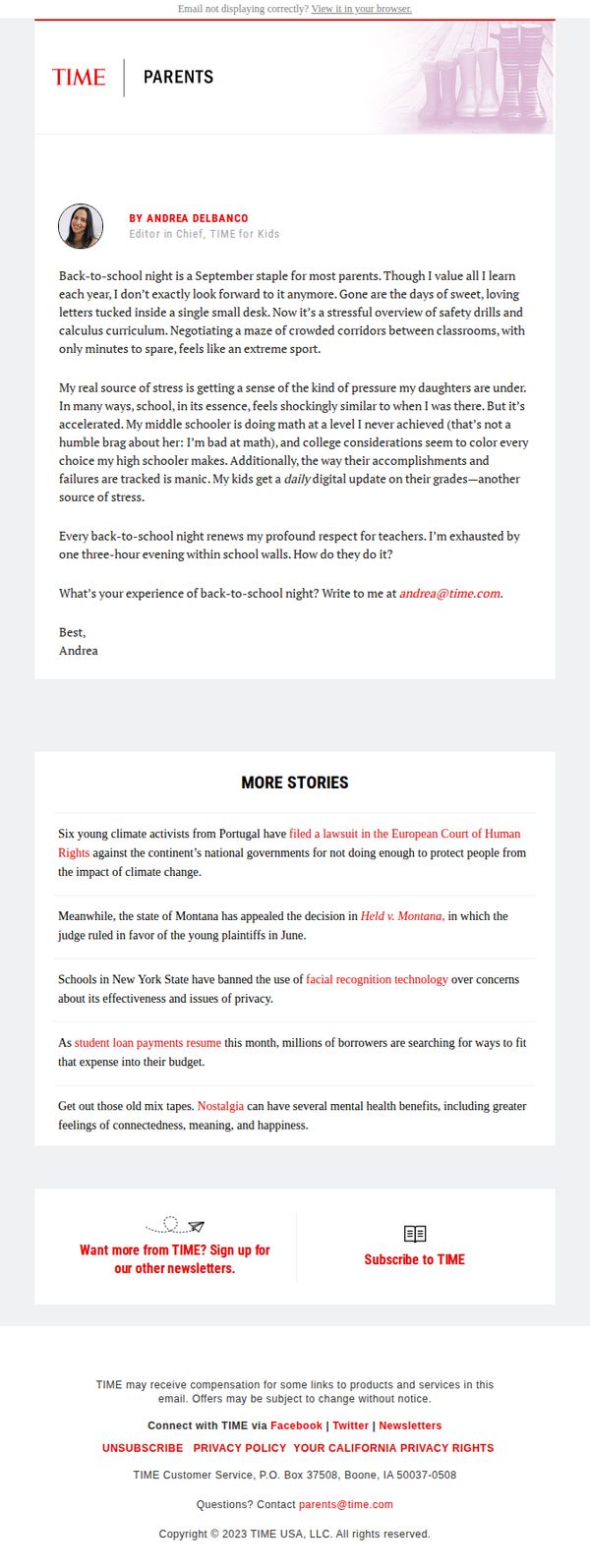
3. A Day in Their Lives
Objective
This email aims to connect with parents by sharing a relatable, emotionally resonant personal essay about the stress of back-to-school season, while subtly reinforcing TIME’s authority on parenting topics and encouraging newsletter engagement.
Why this works
The email opens with a vulnerable, first-person narrative that immediately validates the reader’s emotional experience, making the content feel personal and trustworthy rather than promotional.
How to implement
By framing school stress as a universal parental struggle, the message builds community and positions TIME as a compassionate, insightful guide, not just a news source, deepening reader loyalty.
Pro Tip
Add a secondary CTA above the footer, such as 'Read the full story' or 'Explore more parenting insights', to guide readers deeper into TIME’s content before they scroll away. • Include a small visual element or icon next to the 'MORE STORIES' section to break up text density and draw attention to related content, improving scanability and click-through potential.
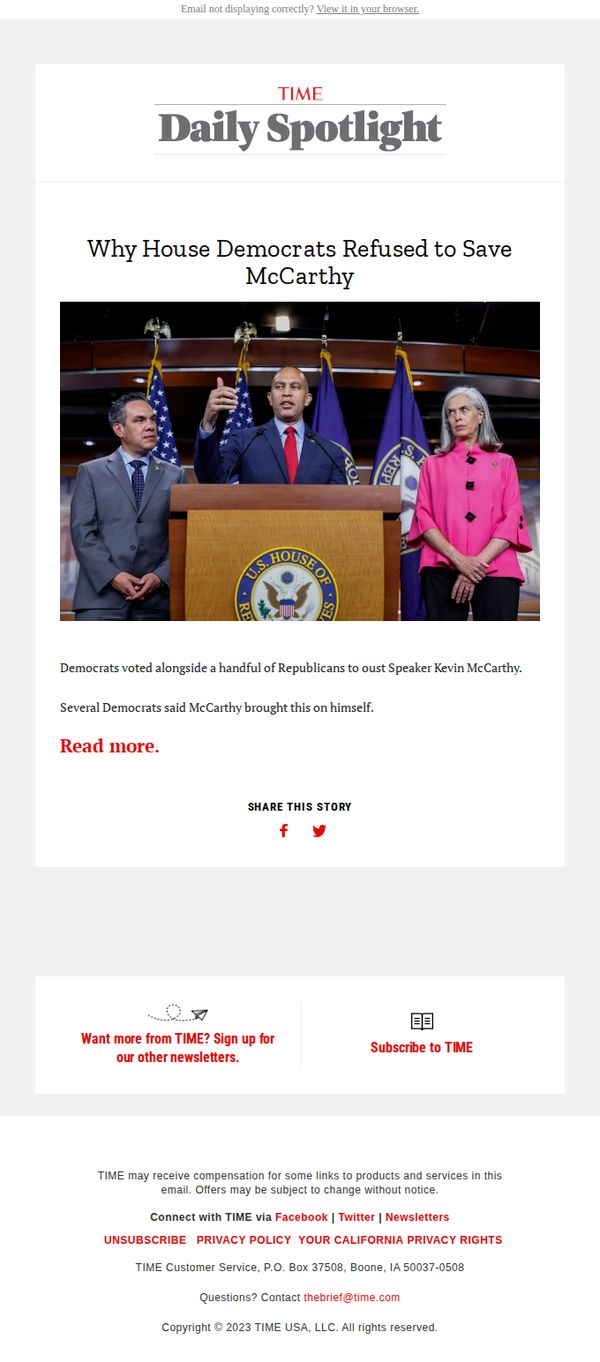
4. Why House Democrats refused to save McCarthy
Objective
This email aims to drive immediate engagement with a breaking political story by highlighting the dramatic ousting of Speaker Kevin McCarthy, while subtly encouraging newsletter subscriptions through a secondary CTA at the bottom.
Why this works
The email leverages high-stakes political drama with a provocative subject line and headline that immediately signals conflict and consequence, making readers feel they’re accessing insider context on a pivotal moment in Congress.
How to implement
By placing a bold, minimal CTA, 'Read more.', directly beneath a compelling summary and image, the email creates a frictionless path to deeper engagement without overwhelming the reader with options or distractions.
Pro Tip
Add a brief sub-headline or pull quote under the main headline to reinforce why this story matters now, for example, 'What this means for bipartisan legislation and the 2024 elections', to increase perceived urgency and relevance. • Include a small visual indicator (like a red 'BREAKING' tag or timestamp) near the headline to signal immediacy, helping the email stand out in crowded inboxes and reinforcing the time-sensitive nature of the political development.
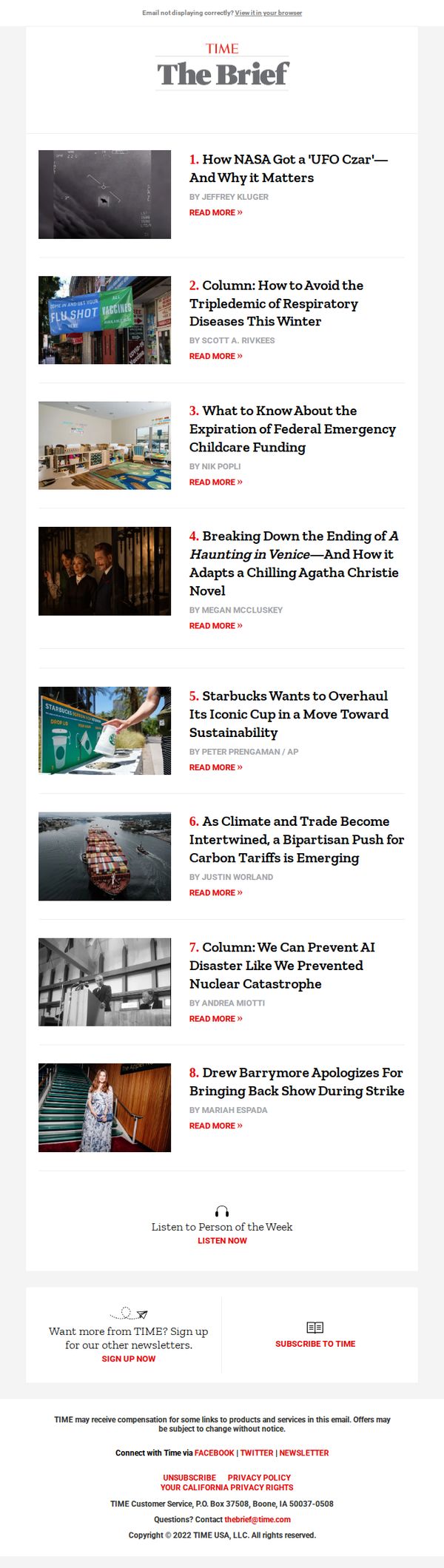
5. How NASA got a 'UFO Czar'—and why it matters
Objective
This email aims to drive engagement with TIME’s daily newsletter by highlighting the most compelling, timely stories of the day, particularly the top story about NASA’s ‘UFO Czar’, to encourage readers to click through, read more, and ultimately subscribe to additional newsletters or the main TIME publication.
Why this works
The email leads with a provocative, curiosity-driven headline about NASA’s ‘UFO Czar’, a smart editorial choice that leverages mystery and institutional credibility to immediately hook readers who might otherwise scroll past routine news digests.
How to implement
Each story is paired with a relevant, high-contrast image and a concise byline, creating visual rhythm and credibility cues that help readers quickly assess relevance without overwhelming them, perfect for skimmers who value speed and substance in equal measure.
Pro Tip
Add a subtle visual indicator, like a red dot or ‘NEW’ badge, next to the top story to signal urgency or exclusivity, reinforcing why this article should be prioritized over the others in the list. • Reposition the ‘Listen to Person of the Week’ audio CTA higher in the email, perhaps after the first three stories, to capitalize on early engagement momentum and promote multimedia content before reader attention wanes.
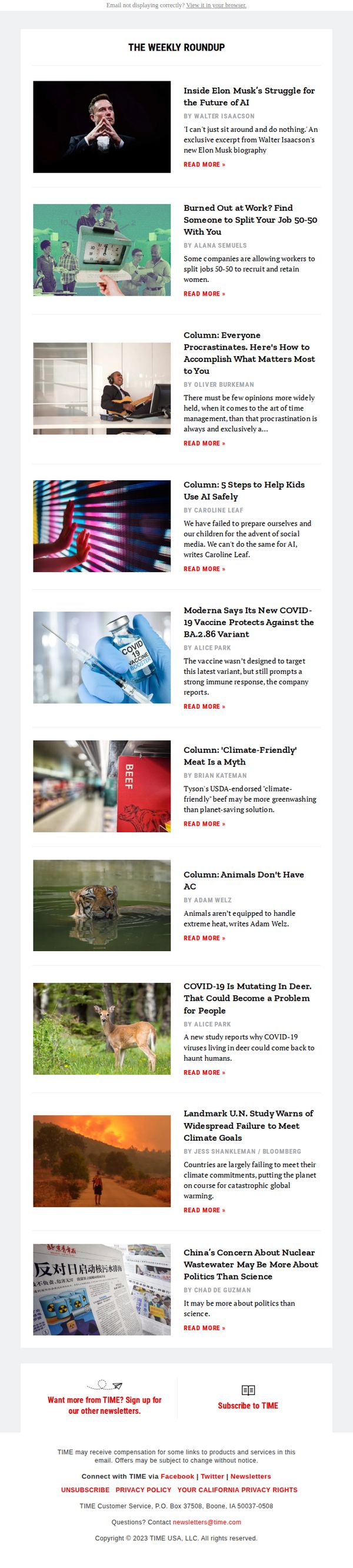
6. Burned out at work? Job sharing could be the answer
Objective
This email aims to engage readers by highlighting timely, thought-provoking articles that address current workplace stress and broader societal issues, while subtly encouraging newsletter signups and brand loyalty through curated content.
Why this works
The email opens with a relatable pain point, burnout at work, and immediately offers a novel, solution-oriented article, creating instant emotional resonance and encouraging readers to click through for relief and insight.
How to implement
By leading with a high-profile subject like Elon Musk and following with practical, everyday topics like job sharing and AI safety, the email balances prestige with accessibility, keeping a broad audience engaged across different interests.
Pro Tip
Add a visual hierarchy to the article list using subtle dividers or alternating background shades to reduce visual fatigue and help readers scan more efficiently, especially since the current layout blends all articles into a uniform block. • Include a short teaser sentence under each article headline to clarify value and increase click-through rates, especially for less obvious topics like 'Animals Don’t Have AC', to better communicate relevance and urgency.
7. The surprising roots of white Christian nationalism

Objective
This email aims to drive engagement with TIME’s historical content by highlighting a provocative new book excerpt on white Christian nationalism, while also promoting deeper exploration of related historical articles and archival covers to reinforce TIME’s authority on cultural and political history.
Why this works
The email opens with a bold, intellectually provocative hook that frames a contemporary political issue through a historical lens, immediately signaling depth and relevance to readers who value context over clickbait.
How to implement
By embedding a compelling book excerpt with a direct CTA, the campaign transforms passive readers into active explorers, leveraging intellectual curiosity as a conversion driver rather than relying on discounts or urgency.
Pro Tip
Add a visual hierarchy to the 'History on TIME.com' section by using subtle dividers or card shadows to distinguish each article, reducing visual clutter and helping readers scan content more efficiently. • Include a secondary CTA beneath the main excerpt, such as 'Explore more historical analysis', to guide readers toward the archival content without requiring them to scroll past multiple sections.
8. How Mitt Romney found his authentic self

Objective
This email aims to engage readers with a compelling political narrative about Mitt Romney’s personal and political evolution, positioning TIME as a source for in-depth, character-driven journalism that reveals the human side of public figures. It encourages readers to click through to read the full story and stay subscribed for more nuanced political coverage.
Why this works
The email masterfully frames Mitt Romney’s political journey as a redemption arc, transforming public perception from a flawed candidate into a principled elder statesman, this emotional storytelling elevates a political profile into a human drama that readers can’t ignore.
How to implement
By anchoring the narrative in specific, vivid moments, like Romney’s Senate vote against Trump or his quiet pivot on abortion, the email gives readers tangible proof of his authenticity, making abstract political evolution feel personal, credible, and emotionally resonant.
Pro Tip
Add a brief, bold pull quote from the article near the top, such as 'I’ve got to live with that', to immediately humanize Romney and create an emotional hook before the reader scrolls, increasing scroll depth and engagement. • Include a small, non-intrusive visual cue (like a subtle arrow or 'Continue Reading' banner) just above the CTA to guide the eye downward, reinforcing the narrative flow and reducing the chance readers miss the 'READ THE STORY' link.
9. The museums destroyed in the Maui wildfires

Objective
To inform readers about the cultural and historical losses caused by the Maui wildfires, while encouraging engagement with TIME’s history coverage and prompting support for wildfire victims through donation links.
Why this works
The email opens with a powerful, emotionally resonant hook that immediately conveys the gravity of loss, not just lives, but irreplaceable cultural heritage, making readers feel the urgency to learn more and act.
How to implement
By embedding a direct donation link alongside the narrative, the campaign smartly bridges storytelling with actionable compassion, turning empathy into tangible support without disrupting the reader’s emotional journey.
Pro Tip
Add a visual countdown or progress bar near the donation link to create urgency and show how much has been raised, which could increase conversion by tapping into social proof and scarcity. • Reposition the 'Subscribe to TIME' CTA higher in the email, perhaps after the main story, to capture engaged readers while their interest is highest, rather than burying it at the bottom.
10. Who to watch at the 2026 Olympics

Objective
This email aims to engage readers by spotlighting Eileen Gu as a must-watch athlete at the 2026 Winter Olympics, while also driving newsletter signups and subscriptions through curated content and promotional offers. It blends editorial storytelling with audience growth tactics.
Why this works
The email masterfully uses a high-profile athlete’s cultural and geopolitical complexity to elevate a sports preview into a compelling human-interest story that goes beyond the podium, making readers feel like they’re getting insider context, not just stats.
How to implement
By anchoring the entire message around a single cover story with a bold visual and clear byline, the email creates immediate editorial authority and focus, which helps cut through inbox noise and positions TIME as the definitive source for Olympic insight.
Pro Tip
The CTA 'READ THE STORY »' is buried below a long article preview and lacks visual prominence; repositioning it as a bold button directly under the hero image would increase click-through rates by reducing friction for interested readers. • The ad for Boost Mobile interrupts the editorial flow and feels tonally mismatched; replacing it with a TIME-branded subscription offer or a related Olympic content teaser would maintain brand cohesion and better serve the campaign’s engagement goal.