Proven Home NPS email designs you can use
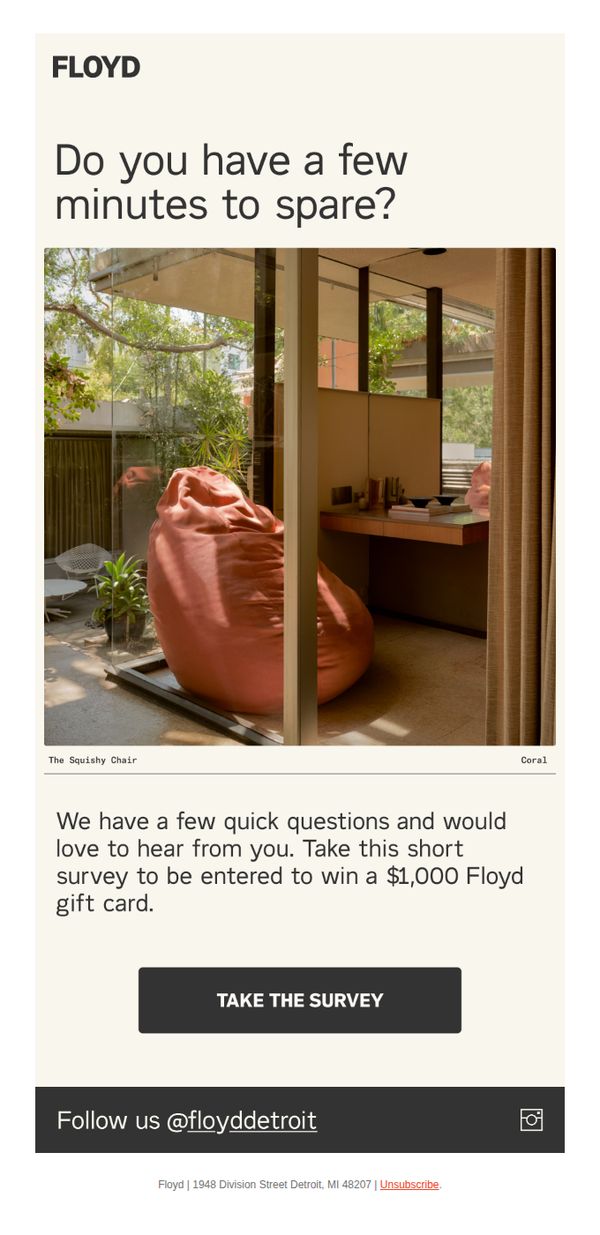
1. Floyd Detroit: Take the survey for a chance to win $1,000!
Objective
The email aims to encourage recipients to complete a short customer survey by offering a $1,000 Floyd gift card as an incentive, thereby gathering valuable feedback while increasing brand engagement.
Why this works
The email opens with a warm, conversational question, 'Do you have a few minutes to spare?', which lowers psychological resistance and invites participation without sounding demanding or transactional.
How to implement
By featuring a high-quality lifestyle image of 'The Squishy Chair' in a serene, sunlit space, the email subtly reinforces brand aesthetic and product desirability while anchoring the survey in a tangible, aspirational context.
Pro Tip
Add a subtle countdown timer or urgency cue near the CTA to encourage immediate action, since the survey incentive lacks a time-bound element that could boost conversion rates. • Include a brief testimonial or social proof (e.g., 'Over 5,000 customers have already shared their thoughts') to build trust and reduce perceived effort, making the survey feel more worthwhile and widely participated in.
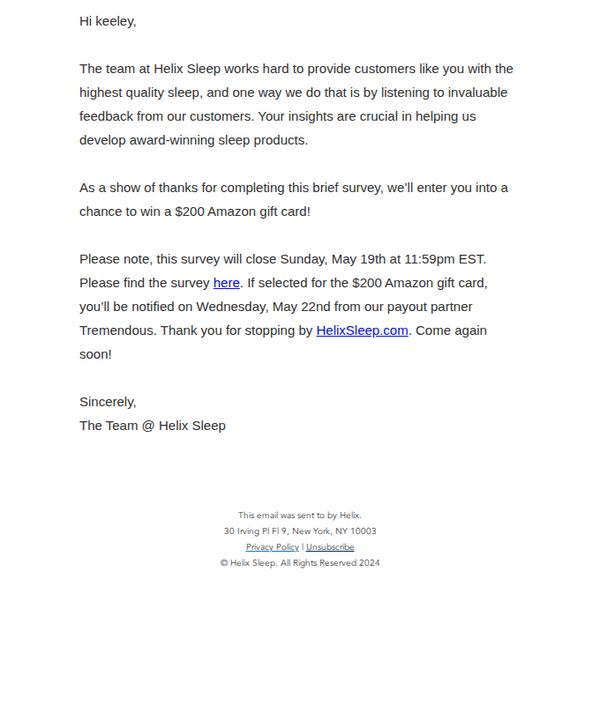
2. Helix Sleep: Take our 1 question survey for a chance to win $200
Objective
This email aims to encourage customer participation in a one-question survey by offering an incentive, a chance to win a $200 Amazon gift card, while reinforcing Helix Sleep’s commitment to product improvement through customer feedback.
Why this works
Helix Sleep smartly ties customer feedback to product excellence, making respondents feel their opinion directly shapes award-winning sleep solutions, a powerful emotional hook that elevates a simple survey into a mission-driven act.
How to implement
The email leverages scarcity and urgency by clearly stating the survey deadline and prize notification date, which creates a gentle but effective nudge for immediate action without overwhelming the reader with pressure.
Pro Tip
The CTA 'Please find the survey here' is passive and buried in the body; it should be rewritten as an action-oriented button like 'Take the 1-Question Survey & Win $200' and placed above the fold for higher visibility and click-through. • The email lacks visual hierarchy and branding elements, adding the Helix Sleep logo, a hero image of a mattress or happy sleeper, and subtle color accents would reinforce brand identity and increase perceived value of the offer.
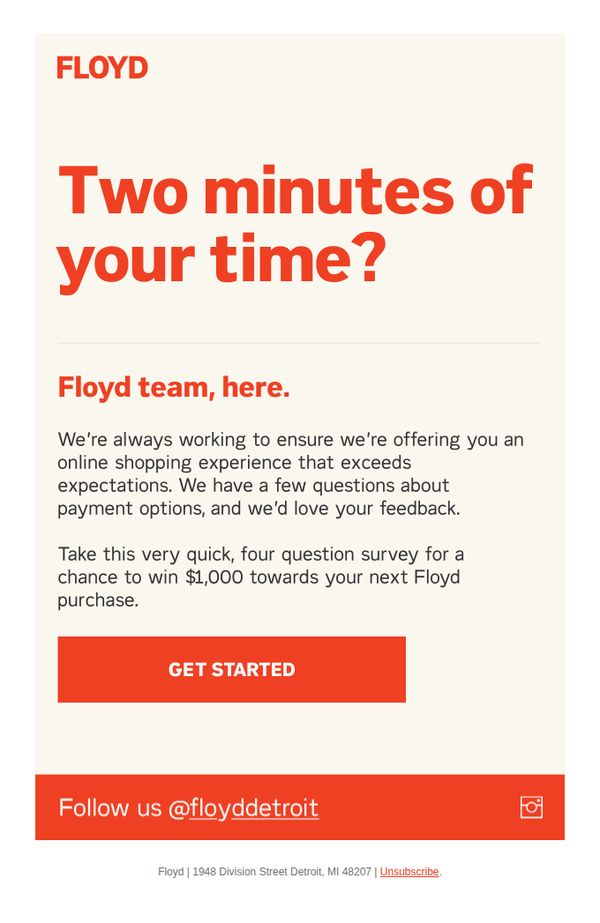
3. Floyd Detroit: Take a quick survey for a chance to win.
Objective
The email aims to encourage recipients to complete a brief four-question survey about payment options in exchange for a chance to win $1,000 toward their next Floyd purchase, thereby gathering customer insights while incentivizing engagement.
Why this works
The email opens with a time-sensitive hook, 'Two minutes of your time?', which immediately lowers the perceived effort barrier and frames participation as a quick, low-commitment win for the customer.
How to implement
By positioning the survey as a tool to improve the online shopping experience, Floyd subtly aligns customer feedback with brand improvement, making respondents feel valued rather than simply surveyed.
Pro Tip
Add a subtle progress indicator or visual cue near the CTA to reinforce that the survey is truly 'four questions' and takes 'two minutes,' reducing perceived friction and boosting completion rates. • Include a brief testimonial or social proof near the offer section, e.g., 'Over 85% of customers who took this survey said it improved their next Floyd experience', to build credibility and urgency.
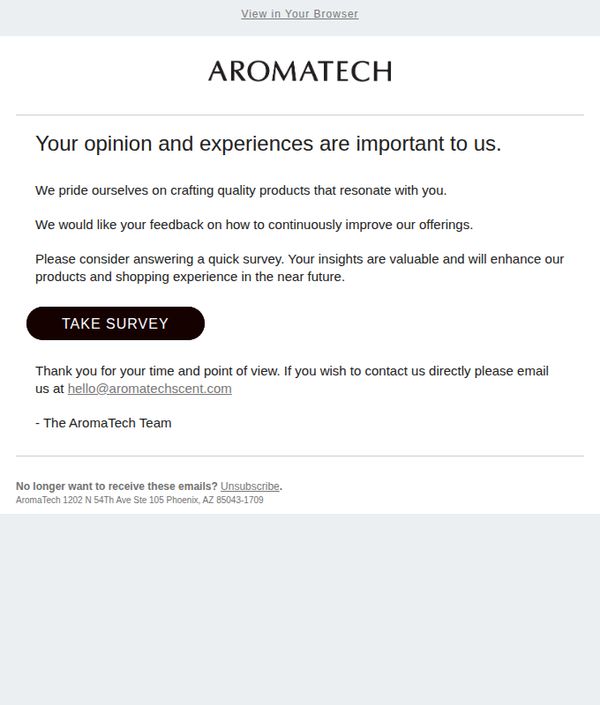
4. AromaTech: Tell us what you really think
Objective
This email aims to collect honest customer feedback through a survey to help AromaTech refine its product offerings and improve the overall shopping experience, reinforcing customer-centric values while encouraging engagement.
Why this works
AromaTech positions the survey not as a chore but as a meaningful contribution, framing customer feedback as essential to product evolution and future shopping experiences, which elevates the perceived value of participation.
How to implement
The email opens with a warm, human tone that acknowledges the customer’s perspective as vital, building emotional rapport before asking for action, a subtle but powerful trust-building technique that increases response likelihood.
Pro Tip
Add a brief preview or teaser of the survey’s length (e.g., 'Takes 2 minutes') or one sample question to reduce perceived effort and increase click-through on the CTA. • Include a subtle visual cue or icon next to the 'TAKE SURVEY' button, such as a checkmark or speech bubble, to reinforce the action’s purpose and improve visual hierarchy for skimmers.
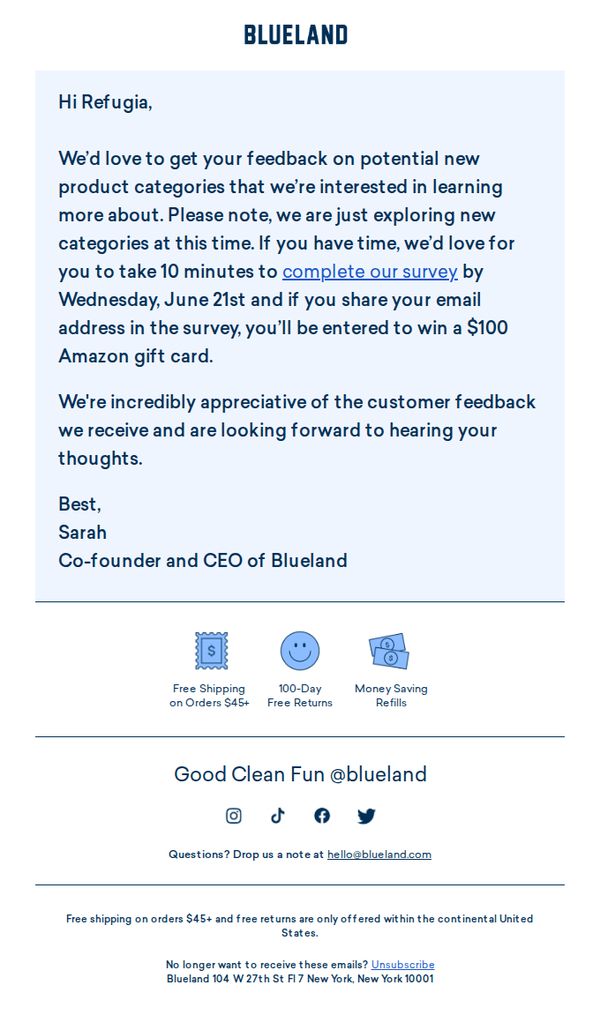
5. Blueland: Refugia, we’d love your thoughts
Objective
Blueland aims to gather customer insights on potential new product categories by inviting Refugia to complete a 10-minute survey, incentivized with a $100 Amazon gift card entry, to inform future product development while reinforcing brand appreciation.
Why this works
Blueland personalizes the outreach by addressing the recipient by name and positions the survey as a collaborative exploration rather than a transactional request, which builds emotional investment and increases response likelihood.
How to implement
The email strategically ties the incentive, a $100 Amazon gift card, directly to sharing an email address within the survey, creating a dual benefit for the brand: feedback plus lead capture, without compromising perceived generosity.
Pro Tip
Add a visual countdown timer or bold deadline reminder near the CTA to create urgency around the June 21st survey cutoff, which could increase completion rates by leveraging time-sensitive motivation. • Include a brief teaser or example of the new product categories being explored, even as bullet points, to spark curiosity and help recipients visualize their impact, making the survey feel more relevant and engaging.
6. Made In: shenna, there's still time to get your $25
Objective
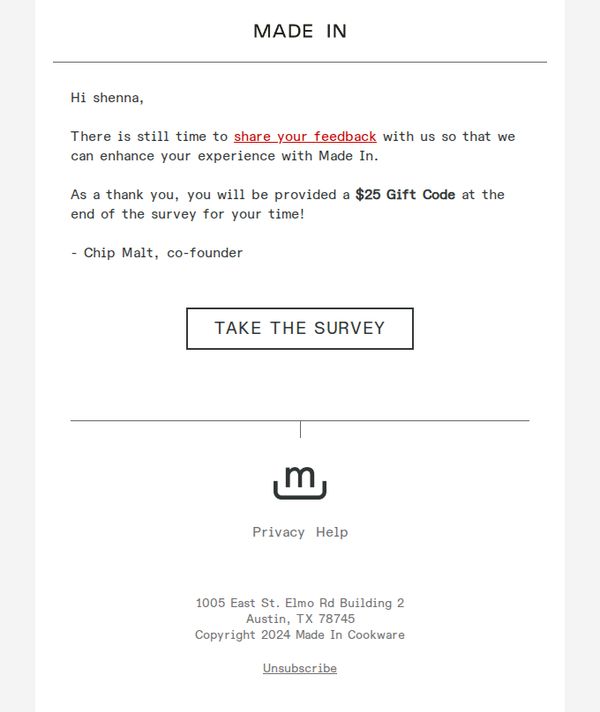
This email aims to encourage the recipient to complete a customer feedback survey by offering a $25 gift code as an incentive, while reinforcing brand trust through a personal note from the co-founder.
Why this works
The email personalizes the outreach by addressing the recipient by name and ties feedback directly to experience improvement, making the request feel collaborative rather than transactional, which increases willingness to participate.
How to implement
Offering a tangible $25 gift code as a thank-you, not a bribe, frames the survey as a valued exchange of time for reward, subtly elevating the perceived worth of the customer’s input while driving conversion.
Pro Tip
Add a subtle countdown timer or deadline indicator near the CTA to create urgency, since the subject line implies time sensitivity but the body lacks any visual or textual reinforcement of that constraint. • Include a brief preview of the survey length (e.g., 'Takes 2 minutes') or one sample question to reduce perceived effort and increase completion rates, especially since the recipient may be hesitant to click without knowing the time commitment.
7. Our Place: Can we chat? ☕
Objective
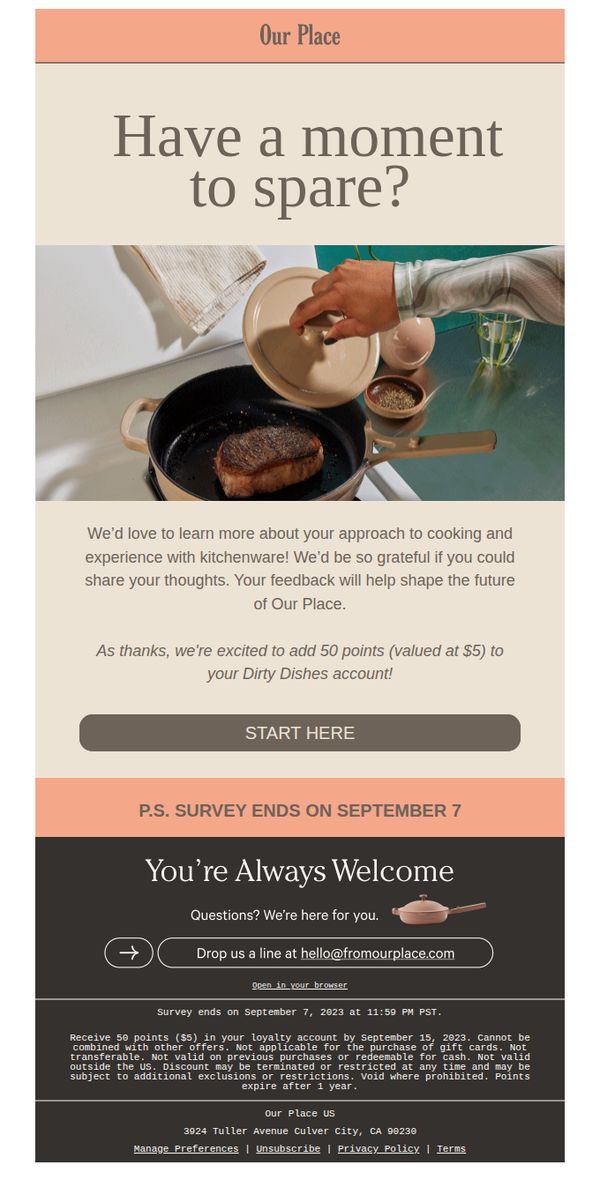
Our Place aims to gather customer insights about cooking habits and kitchenware experiences to inform future product development, while incentivizing participation with 50 loyalty points to strengthen engagement and brand loyalty.
Why this works
By framing the survey as a personal conversation over coffee, Our Place reduces friction and makes participation feel warm and collaborative rather than transactional, which increases the likelihood of customer response.
How to implement
The brand smartly ties customer feedback directly to product evolution, making respondents feel like co-creators, a powerful psychological lever that transforms passive users into invested brand advocates.
Pro Tip
Add a progress bar or estimated completion time near the CTA to reduce perceived effort and increase conversion, many users abandon surveys if they feel uncertain about time commitment. • Include a short testimonial or quote from a past survey participant who saw their feedback implemented, to build social proof and reinforce that customer input truly shapes product decisions.
8. Carolina Creekhouse: What's one thing our customers want more of?
Objective
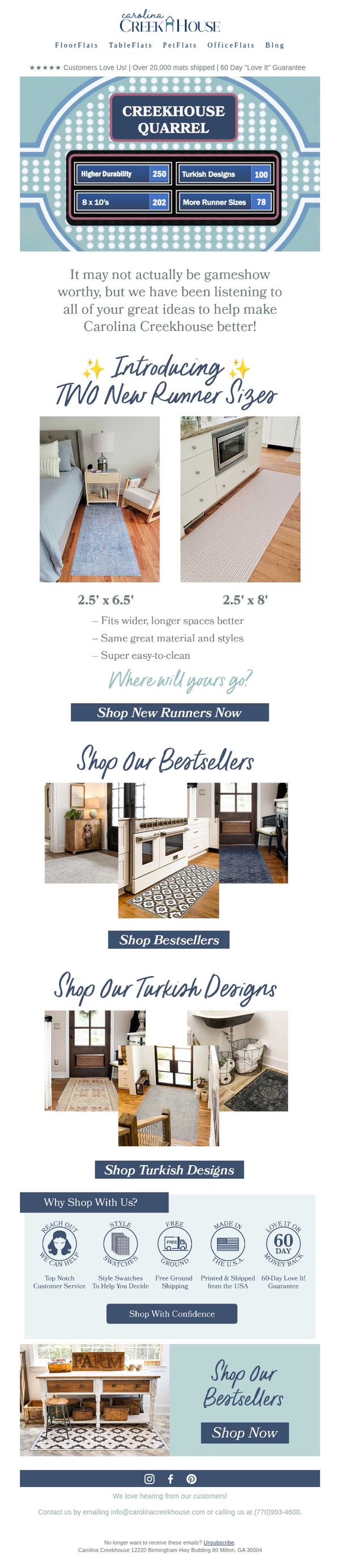
This email aims to announce and drive sales of two new runner sizes by highlighting customer feedback and product benefits, while reinforcing brand trust through social proof and guarantees to encourage immediate purchases.
Why this works
The email opens with a playful, data-driven 'Creekhouse Quarrel' graphic that turns customer feedback into a fun, visual narrative, making product development feel collaborative and transparent, which builds emotional connection and trust.
How to implement
By introducing new runner sizes with clear dimensions and real-room context, the email answers the unspoken question of 'where will this fit?', reducing purchase hesitation and helping customers visualize the product in their own homes.
Pro Tip
Add a subtle countdown timer or limited-availability tag near the 'Shop New Runners Now' CTA to create urgency, since the email introduces new products that could benefit from perceived scarcity to drive faster decisions. • Include a short customer testimonial or quote directly under the new runner sizes to reinforce the 'customers asked for this' message, adding social proof that validates the product update and strengthens emotional appeal.
9. Ecosa: 85% Find Back Pain Relief: Survey Insights
Objective
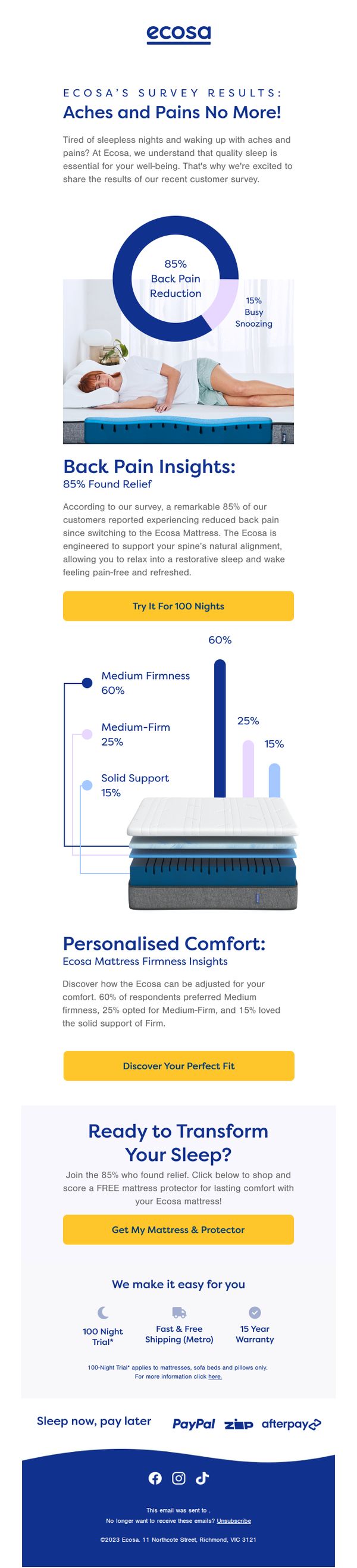
This email aims to build trust and drive conversions by showcasing survey data that proves Ecosa mattresses reduce back pain for 85% of users, while encouraging recipients to try the product risk-free with a 100-night trial and bonus protector offer.
Why this works
The email opens with a powerful, data-driven hook, 85% of users found back pain relief, which immediately positions the product as a credible solution rather than just another mattress, making the emotional and physical payoff instantly clear to the reader.
How to implement
By visually layering survey insights with product visuals, like the firmness preference chart over the mattress cutaway, the email transforms abstract data into tangible, relatable benefits, helping customers imagine how the product will feel and function in their own lives.
Pro Tip
Add a short testimonial quote or star rating near the 85% back pain relief stat to humanize the data and reinforce social proof, making the claim feel more personal and trustworthy to skeptical readers. • Include a small countdown timer or urgency indicator near the 'Get My Mattress & Protector' CTA to nudge procrastinators, especially since the offer includes a free protector, a limited-time perceived bonus that benefits from time-sensitive framing.
10. Schoolhouse: Take This Survey For A Chance To Win $1,000!
Objective
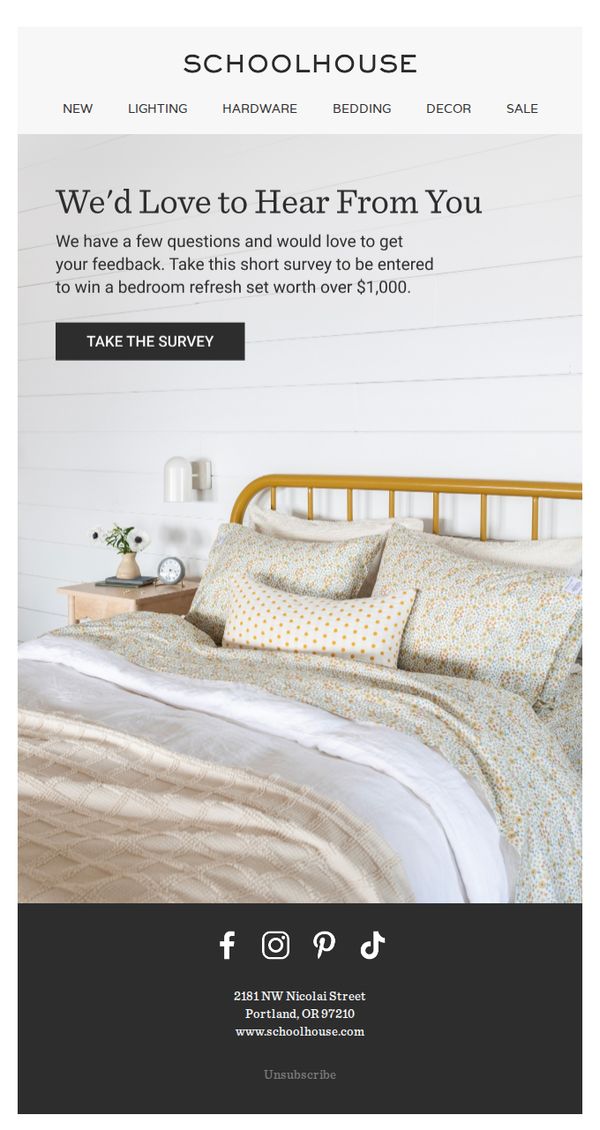
The email aims to encourage recipients to complete a short customer feedback survey by offering an enticing incentive: a chance to win a bedroom refresh set valued at over $1,000. This drives engagement while gathering valuable insights to improve the brand’s offerings.
Why this works
The email brilliantly pairs customer feedback collection with a high-value reward, turning a routine survey into a compelling, emotionally resonant opportunity that feels like a gift rather than a chore.
How to implement
By featuring a beautifully styled bedroom in the hero image, the campaign visually reinforces the prize’s desirability, allowing customers to instantly imagine themselves enjoying the reward and increasing conversion likelihood.
Pro Tip
Add a subtle countdown timer near the CTA to create urgency, since the survey incentive is time-sensitive, this would nudge procrastinators to act before the chance to win expires. • Include a brief testimonial or stat like ‘92% of past winners loved their bedroom refresh’ to build social proof and credibility around the prize, reducing skepticism and increasing perceived value.