The complete data promotional campaign email collection
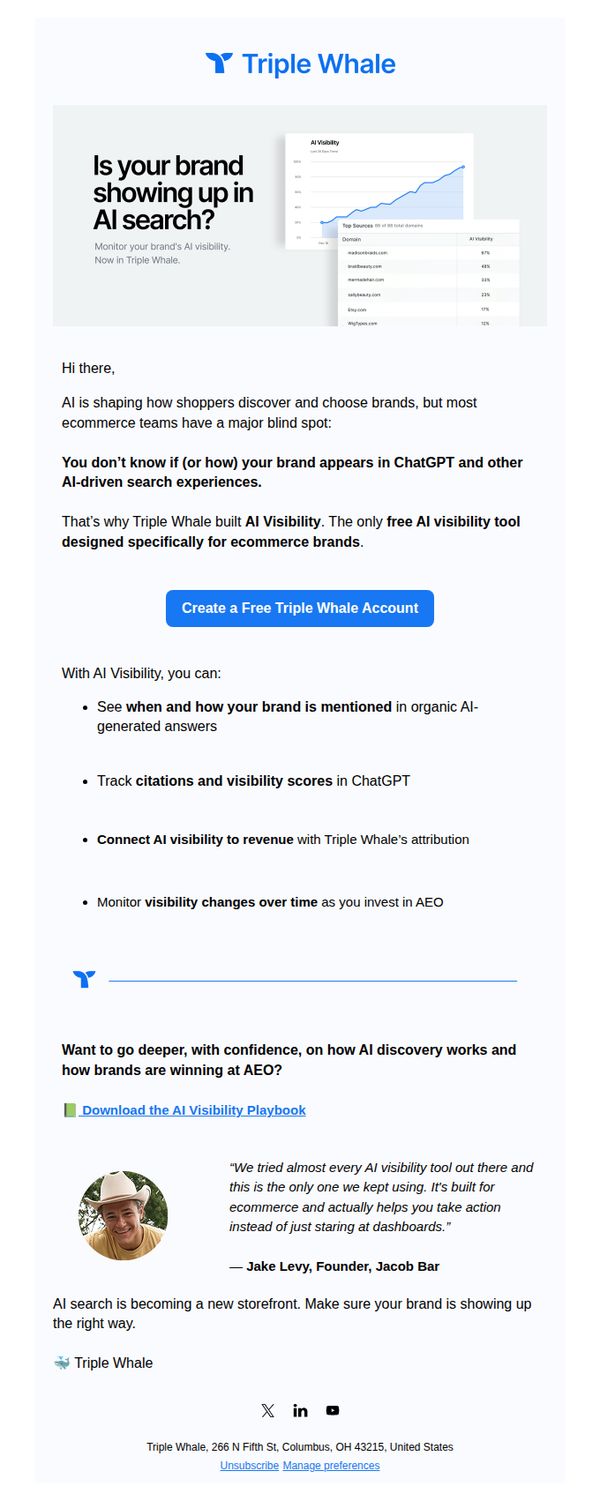

1. Triple Whale: 👀 A free look at how ChatGPT talks about your brand
Objective
This email aims to drive sign-ups for Triple Whale’s free AI Visibility tool by highlighting the critical gap in how ecommerce brands understand their presence in AI-driven search results like ChatGPT, positioning the tool as the essential solution for data-driven decision-making in the AI era.
Why this works
The email brilliantly frames AI search visibility as a blind spot for ecommerce teams, transforming an abstract tech trend into a tangible business risk that demands immediate attention and action through Triple Whale’s tool.
How to implement
By anchoring the value proposition in real-world outcomes, like connecting AI visibility to revenue and tracking citations in ChatGPT, the email moves beyond generic features to show concrete, measurable business impact that resonates with growth-focused marketers.
Pro Tip
Add a subtle countdown timer or urgency indicator near the CTA to increase conversion pressure, especially since the offer is free and time-sensitive urgency can nudge hesitant users to act immediately. • Include a mini visual preview or animated GIF of the AI Visibility dashboard in action beneath the bullet points to reduce cognitive load and help users instantly visualize the tool’s interface and value before clicking.
2. Nutanix: This Month in Cloud: Key Trends & Solutions
Objective
This email aims to position Nutanix as a thought leader in cloud innovation by delivering curated, high-value content to prospects, while driving engagement through event registration, product exploration, and migration offers. It seeks to nurture leads by aligning educational content with strategic business outcomes.
Why this works
The email smartly opens with a high-impact event announcement to capture attention early, then layers in customer success stories and educational content to build credibility without overwhelming the reader with sales pressure.
How to implement
Each content block is tightly themed around solving real enterprise pain points, like AI scalability, cloud outages, and migration complexity, making the value proposition feel relevant and urgent rather than generic or promotional.
Pro Tip
Add a subtle countdown timer or urgency indicator near the .NEXT 2026 registration CTA to increase conversion by leveraging FOMO, especially since the event date is months away and prospects may delay action. • Include a short testimonial quote or stat from the London Gatwick Airport case study directly in the preview text to boost credibility and click-through rates, rather than relying solely on the 'Learn More' button.
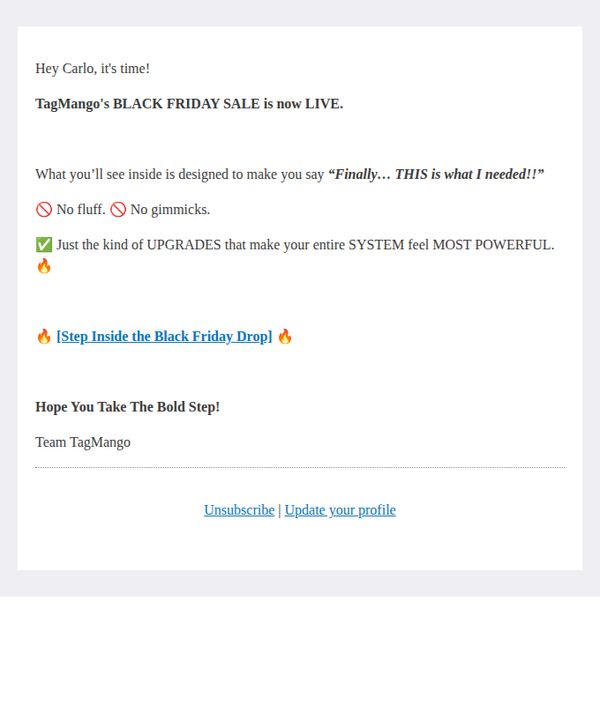
3. TagMango : 🔥 Black Friday Sale is LIVE!
Objective
The email aims to create urgency and excitement around TagMango’s Black Friday sale by positioning it as a no-nonsense, high-value upgrade opportunity that empowers the user’s system, encouraging immediate engagement with the sale.
Why this works
The email cuts through marketing noise by explicitly promising ‘no fluff, no gimmicks,’ which builds instant credibility and appeals to users tired of overhyped sales that deliver little real value.
How to implement
By framing the sale as ‘upgrades that make your entire system feel most powerful,’ it ties the offer to the user’s existing workflow, making the purchase feel like a strategic investment rather than an impulse buy.
Pro Tip
Add a visual hero banner or product preview below the CTA to immediately show what’s on sale, currently, the email lacks any visual anchor, which reduces conversion potential for users who skim. • Include a time-sensitive element like a countdown timer or ‘limited stock’ indicator near the CTA to reinforce urgency and drive faster action, since the current message relies solely on emotional appeal.
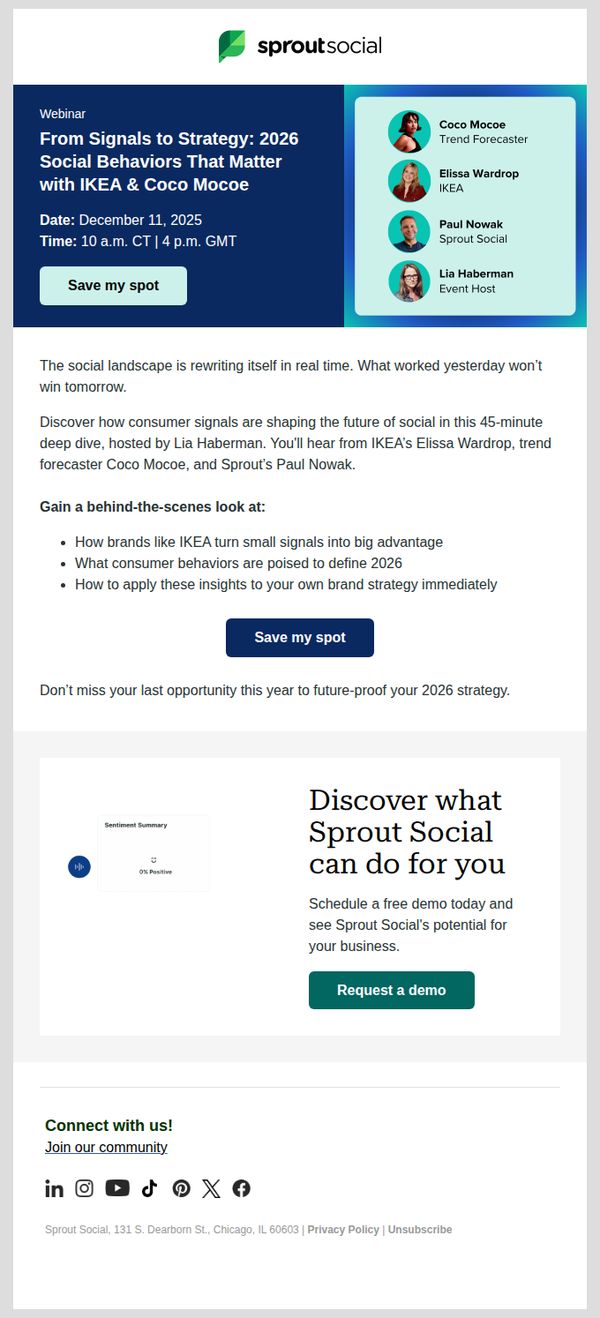
4. Sprout Social: [Invite] Power your 2026 social strategy with tips from IKEA & Coco Mocoe
Objective
This email aims to drive registrations for a Sprout Social webinar that promises actionable insights into 2026 social media trends, leveraging credibility from IKEA and trend forecaster Coco Mocoe to position Sprout as a strategic partner for future-proofing social strategies.
Why this works
The email smartly anchors its value proposition in future-focused urgency by tying 2026 social behaviors to immediate brand strategy, making the webinar feel essential rather than optional for forward-thinking marketers.
How to implement
By featuring recognizable names like IKEA and Coco Mocoe alongside Sprout’s own expert, the email builds instant credibility and social proof, reducing skepticism and increasing perceived authority without overloading the reader with jargon.
Pro Tip
Add a countdown timer or urgency indicator near the 'Save my spot' button to reinforce the 'last opportunity this year' message and reduce procrastination among hesitant registrants. • Include a short, bulleted list of tangible takeaways or tools attendees will receive (e.g., 'Downloadable 2026 Trend Playbook') to clarify immediate value and reduce perceived risk of attending.
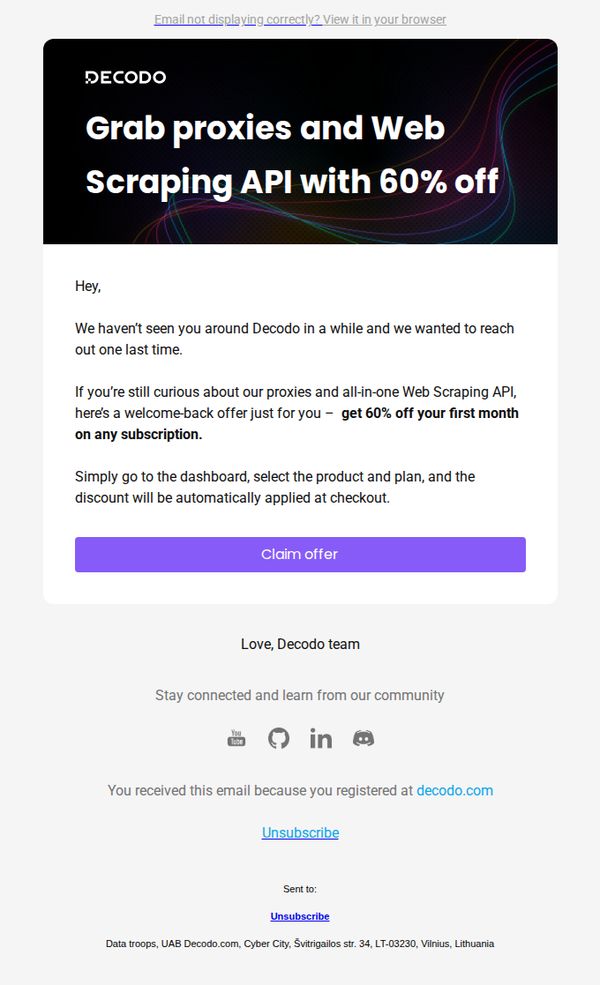
5. Smartproxy : Your special access code is here
Objective
This email aims to re-engage inactive users by offering a time-sensitive 60% discount on their first month of service, encouraging them to return and convert by highlighting the value of proxies and the Web Scraping API. It seeks to reignite interest through personalized outreach and a frictionless redemption process.
Why this works
The email opens with a warm, personalized tone that acknowledges user inactivity without sounding accusatory, which helps lower resistance and builds emotional rapport before introducing the offer.
How to implement
By embedding the discount directly into the checkout flow, 'automatically applied at checkout', the campaign removes friction and reduces decision fatigue, making conversion feel effortless and immediate.
Pro Tip
Add a countdown timer or expiration notice near the CTA to amplify urgency, since the current version lacks any time-bound pressure that could motivate faster action from hesitant users. • Include a brief testimonial or social proof snippet, even one sentence, near the offer to reinforce credibility and reduce perceived risk for users who may be unfamiliar with the product’s value.
6. Zapier : Three updates to automate and use AI like a pro

Objective
This email aims to inform subscribers about Zapier’s latest product updates and AI-powered features, encouraging them to explore new tools and templates that streamline workflows and improve automation efficiency across teams and platforms.
Why this works
Zapier positions each new feature as a strategic solution to a common enterprise pain point, like AI pilot purgatory or disconnected form data, making technical updates feel immediately relevant and urgent to decision-makers.
How to implement
The email uses color-coded visual blocks and consistent iconography to segment complex updates into digestible, scannable modules, helping busy users quickly identify what’s relevant to their role without overwhelming cognitive load.
Pro Tip
Add a subtle progress indicator or checklist under the 'What’s new' section to help users track which updates they’ve explored, increasing engagement depth and reducing bounce from information overload. • Replace the generic 'Explore deals' CTA in the Spotlight section with a more benefit-driven phrase like 'Automate your ad ROI now' to better align with the section’s goal of driving conversion signal optimization.
7. Zapier : What's new for Zapier Interfaces, Tables & Chatbots

Objective
This email aims to inform Zapier users about recent product enhancements across Interfaces, Tables, and Chatbots while encouraging immediate engagement through clear CTAs. It also highlights new app integrations to reinforce Zapier’s expanding ecosystem and drive deeper platform adoption.
Why this works
Zapier brilliantly positions each new feature as a time-saving superpower, like building forms with AI or auto-enriching Tables, making technical upgrades feel instantly valuable and accessible to non-technical users.
How to implement
The email uses consistent visual metaphors and iconography to translate complex product updates into digestible, emotionally resonant benefits, helping users quickly grasp how each feature solves real-world workflow pain points.
Pro Tip
Add a subtle countdown timer or urgency indicator near the 'Try it now' and 'Jump back in' CTAs to nudge users toward immediate action, especially since these features are tied to paid plans or trials. • Include a short testimonial or customer quote under each major feature update to build social proof and demonstrate real-world impact, which would strengthen persuasion without cluttering the layout.
8. Slack: ⏱️Time’s running out! Get 25% off a Slack paid plan
Objective
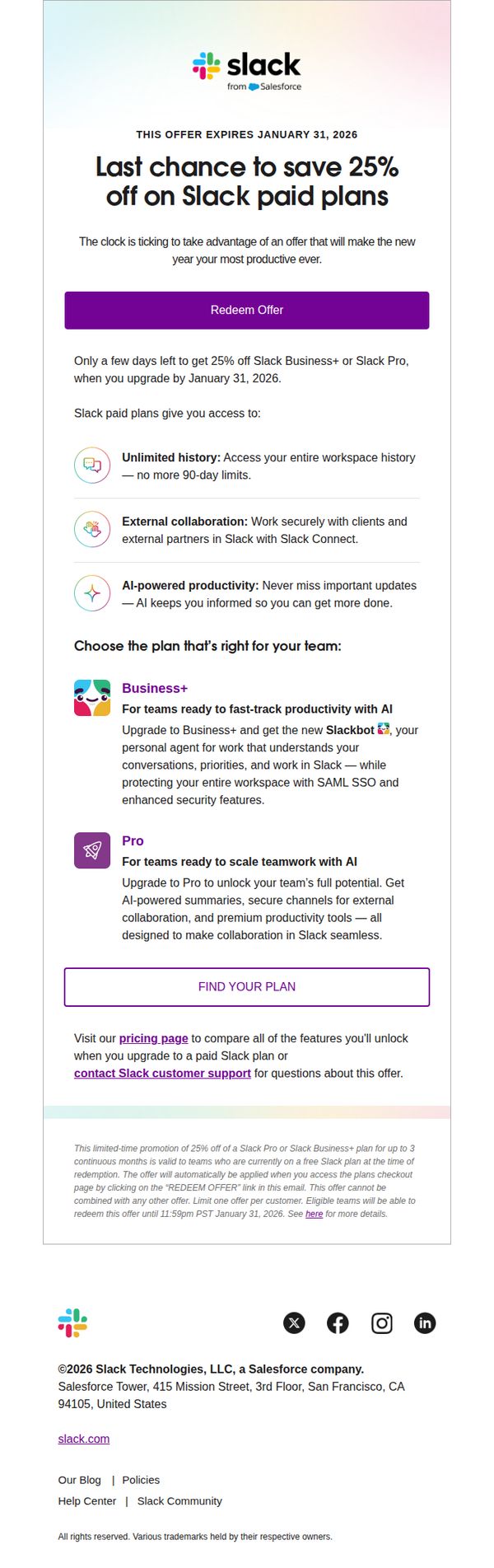
This email aims to drive urgency and conversion by encouraging free-plan users to upgrade to a paid Slack plan before the 25% discount expires on January 31, 2026, positioning the offer as a productivity-boosting opportunity for the new year.
Why this works
The email masterfully combines time-sensitive urgency with a productivity-focused value proposition, framing the discount not as a sale but as a strategic investment in the team’s efficiency for the new year.
How to implement
By clearly differentiating Business+ and Pro plans with icon-driven bullet points and concise benefit summaries, the email reduces cognitive load and helps users self-select the right plan without overwhelm.
Pro Tip
Add a countdown timer beneath the headline to visually reinforce urgency and reduce the cognitive effort required to calculate remaining days until expiration. • Include a short testimonial or social proof near the plan comparison section to build trust and demonstrate real-world ROI from upgrading, especially for teams hesitant to commit.
9. TagMango : ⚠️ Bookmark this. Seriously.
Objective
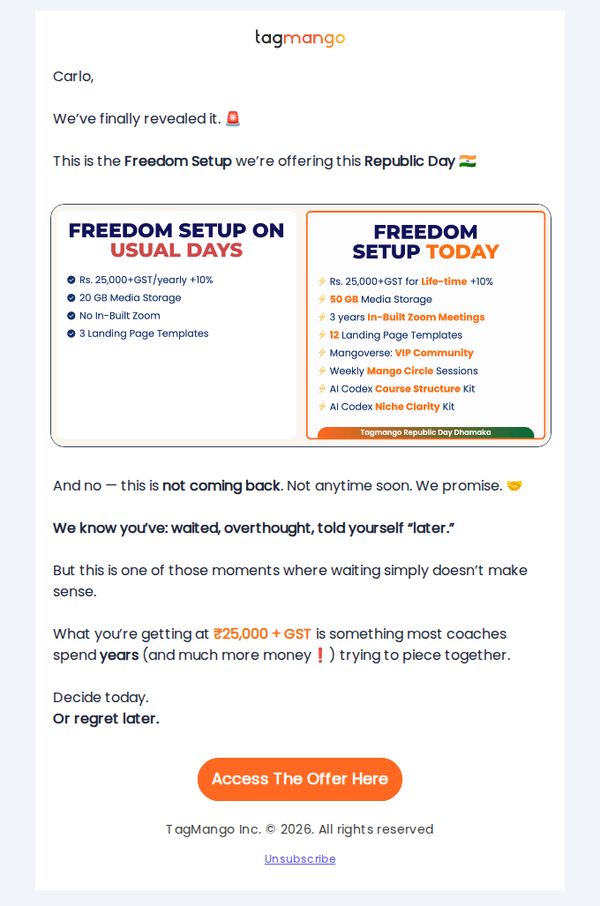
This email aims to create urgency and drive immediate sign-ups for TagMango’s limited-time 'Freedom Setup' offer by positioning it as a rare, high-value opportunity that won’t return, leveraging emotional triggers like regret and FOMO to convert hesitant prospects.
Why this works
The email brilliantly frames the offer as a once-in-a-lifetime deal by explicitly stating it won’t return, turning passive interest into urgent action through psychological scarcity that resonates with decision-fatigued entrepreneurs.
How to implement
By comparing the Rs.25,000+ value to what coaches spend years assembling, the copy elevates perceived worth and positions the offer as a shortcut to professional credibility, making the price feel like a steal rather than a cost.
Pro Tip
Add a countdown timer or 'X spots left' indicator near the CTA to visually reinforce urgency and reduce decision latency, since the current text-based scarcity lacks real-time pressure. • Include a short testimonial or social proof snippet from a past user who benefited from the Freedom Setup to validate the claim that this is a game-changing offer, especially since the audience may be skeptical of 'too good to be true' deals.
10. Semrush: Is your site built to be seen?
Objective
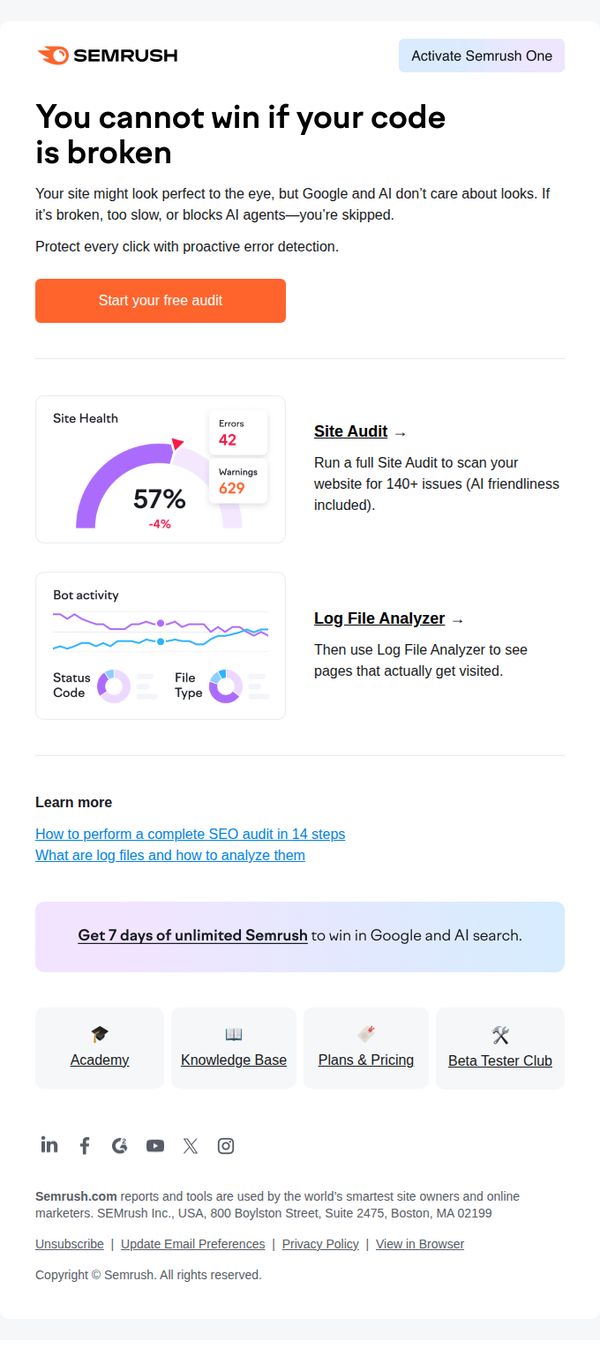
The email aims to drive immediate action by convincing site owners that technical SEO issues are invisible but critical barriers to visibility, prompting them to start a free audit before losing traffic to competitors. It positions Semrush as the essential tool to diagnose and fix these hidden problems.
Why this works
The email opens with a bold, confrontational headline that immediately reframes the reader’s perception of website quality, it’s not about looks, but about whether Google and AI can even see or index the site, which creates urgency and relevance for technical marketers.
How to implement
By pairing a visual health score with specific error counts and a downward trend, the email transforms abstract SEO concerns into tangible, measurable problems that demand immediate attention, making the audit feel less like a suggestion and more like a diagnostic necessity.
Pro Tip
Add a countdown timer or urgency indicator next to the 'Start your free audit' CTA to reinforce the time-sensitive nature of technical SEO fixes and reduce hesitation in clicking. • Include a short testimonial or case study snippet near the Site Audit section showing how a real user recovered traffic or rankings after fixing errors, to build social proof and reduce perceived risk.