Sales promotional campaign email examples & ideas


1. Squarespace: 20% off ends today
Objective
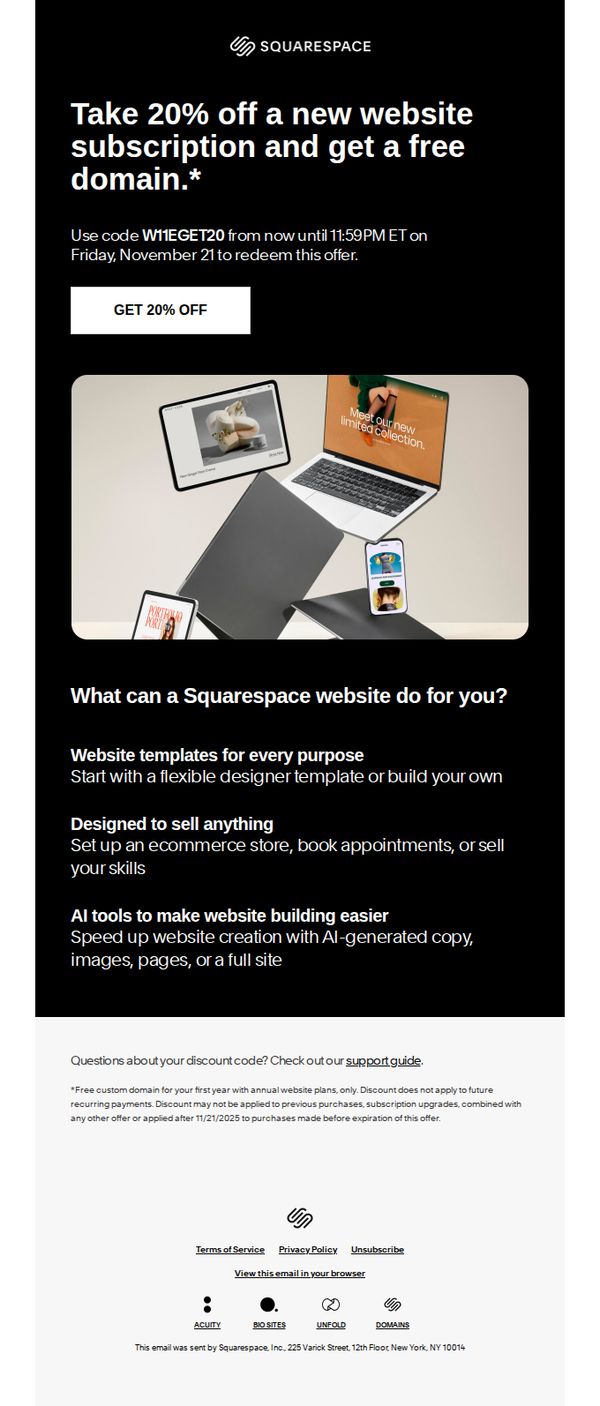
This email aims to drive immediate sign-ups for new Squarespace website subscriptions by offering a time-sensitive 20% discount and a free domain, creating urgency to convert prospects before the offer expires.
Why this works
The email masterfully combines a limited-time discount with a high-value freebie, a custom domain, to increase perceived value and motivate immediate action without overwhelming the reader with options.
How to implement
By visually anchoring the offer with a clean, device-responsive hero image and bold headline, Squarespace instantly communicates versatility and modernity, subtly reassuring prospects that their website will look professional across all platforms.
Pro Tip
Add a countdown timer beneath the CTA to visually reinforce urgency and reduce the cognitive load of calculating time remaining, which could increase conversion rates among hesitant users. • Include a short customer testimonial or social proof near the CTA to validate the offer’s credibility and reduce perceived risk, especially for first-time website builders who may be skeptical of discounts.
2. HubSpot: The unlikely winner of the US's wine wars
Objective
This email aims to inform readers about the unexpected economic and cultural ripple effects of U.S.-Canada trade tensions on the wine industry, while positioning HubSpot’s media arm as a source of insightful, data-driven business storytelling. It also subtly reinforces brand authority by aligning with timely, complex global trade narratives.
Why this works
The email masterfully turns a niche trade dispute into a compelling human story by spotlighting individual winemakers and regional economic shifts, making complex policy feel personal and urgent to a broad business audience.
How to implement
By embedding data visualizations directly into the narrative flow, like the wine glass chart showing export losses, the email transforms dry statistics into emotionally resonant moments that reinforce the stakes without overwhelming the reader.
Pro Tip
The primary CTA 'Check out all of our prizes here' feels disconnected from the article’s serious tone and subject matter; it should be rephrased to align with the content, such as 'Explore how global trade shapes local industries' to maintain thematic consistency. • The email lacks a clear secondary CTA or content upgrade (e.g., downloadable report, webinar invite) that could deepen engagement after the story, adding one would help convert informed readers into leads without disrupting the editorial experience.
3. Klaviyo: Your self-serve toolkit
Objective
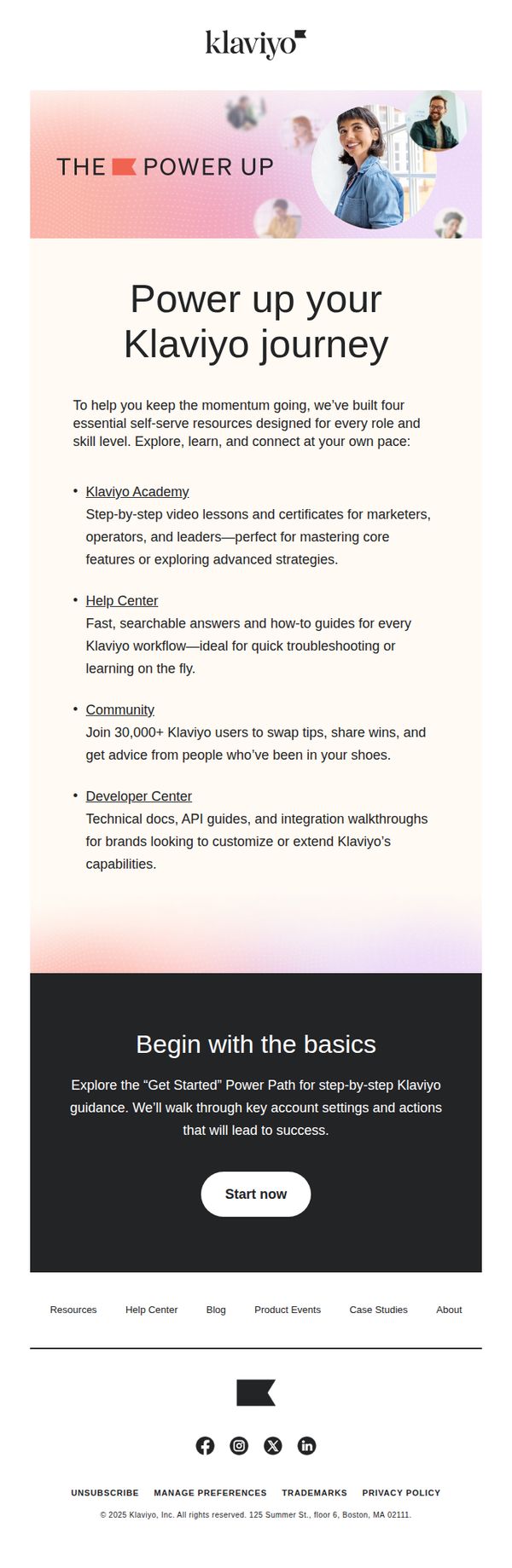
This email aims to empower Klaviyo users by introducing them to self-serve educational resources tailored to their role and skill level, encouraging continued engagement and mastery of the platform through guided learning paths and community support.
Why this works
The email brilliantly segments its value proposition by role and skill level, making each recipient feel personally addressed and supported in their unique Klaviyo journey, which increases relevance and reduces overwhelm for new users.
How to implement
By listing four distinct self-serve resources with clear, benefit-driven descriptions, the email transforms abstract support into tangible tools, helping users visualize exactly how each resource solves their specific pain points or goals.
Pro Tip
Add a brief testimonial or user stat near the CTA to reinforce social proof, e.g., '92% of users who start the Power Path complete their first campaign within 3 days', to reduce hesitation and boost conversion. • Include a visual icon or small graphic next to each resource bullet point to improve scannability and help users quickly distinguish between learning, troubleshooting, community, and developer paths.
4. HubSpot: ☎️ The 2 types of top cold callers (according to new data)
Objective
This email aims to engage sales professionals by revealing data-driven insights into the psychological profiles of top cold callers, while positioning HubSpot as a thought leader in sales strategy and driving interest in their sales playbook and related content.
Why this works
The email brilliantly reframes cold calling from a dreaded chore into a data-backed science by spotlighting two distinct psychological profiles, intellectual curiosity and analytical detachment, making the content feel both fresh and deeply actionable for sales leaders.
How to implement
By anchoring insights in real survey data from 300+ sales leaders and citing Panopli as the source, the email builds instant credibility and positions HubSpot as a trustworthy authority, which subtly primes readers to trust their recommended playbook and resources.
Pro Tip
Add a visual progress bar or checklist under the 'What can you do with this insight?' section to help reps and managers quickly map the advice to their own workflows, increasing perceived value and actionability. • Include a short video testimonial or quote snippet from a sales leader who implemented these insights, even if fictionalized, to strengthen social proof and make the data feel more immediately applicable to the reader’s context.
5. Evaboot: evaboot + clay
Objective
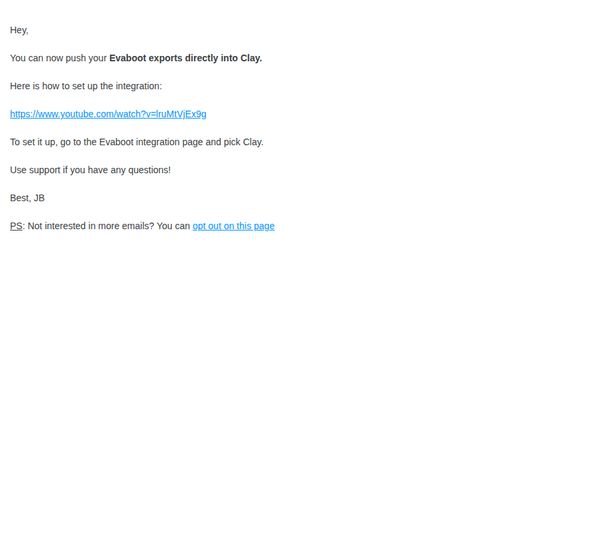
To inform existing Evaboot users about the new integration with Clay and guide them to set it up, while offering support and an easy opt-out option to maintain trust and reduce friction.
Why this works
The email opens with a clear, benefit-driven announcement that immediately tells users what’s new and why it matters, reducing cognitive load and increasing engagement by focusing on immediate utility.
How to implement
Including a direct YouTube tutorial link as the primary setup guide leverages visual learning preferences and reduces support burden, making the onboarding process feel effortless and user-friendly.
Pro Tip
Add a secondary CTA button or bolded link next to the YouTube URL to visually reinforce the action step, users may miss the plain text link in a minimalist layout. • Include a brief 1–2 sentence explanation of what Clay does or why this integration matters, users unfamiliar with Clay may not understand the value without context.
6. Zendesk: We’re only getting 3-5% out of AI’s full potential, Reid Hoffman shares his insights
Objective
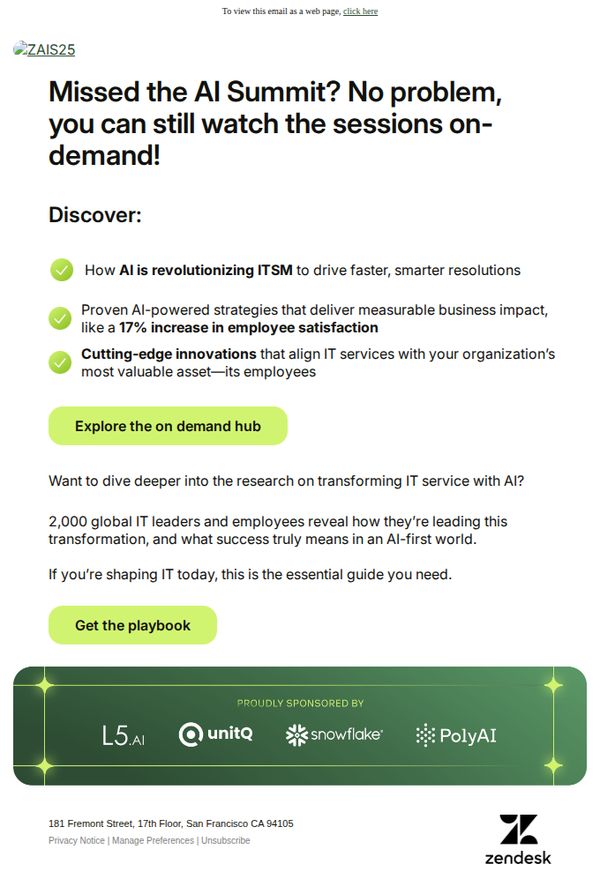
This email aims to re-engage attendees who missed the AI Summit by offering on-demand access to sessions, while positioning Zendesk as a thought leader in AI-driven IT service transformation through expert insights and tangible business outcomes.
Why this works
The email immediately validates the recipient’s FOMO by acknowledging they missed the event, then instantly reassures them with a frictionless solution, on-demand access, turning regret into opportunity without requiring extra effort.
How to implement
By anchoring value in specific, quantifiable outcomes like a 17% increase in employee satisfaction, the email transforms abstract AI hype into concrete business ROI, making the content feel essential rather than optional for IT decision-makers.
Pro Tip
Add a short video thumbnail or animated GIF of Reid Hoffman speaking to humanize the content and increase click-through by leveraging visual curiosity and social proof directly in the hero section. • Include a micro-testimonial or quote from a known IT leader who watched the on-demand sessions to reinforce credibility and reduce perceived risk for recipients unsure if the content is worth their time.
7. Klaviyo: Create and send targeted campaigns in minutes
Objective
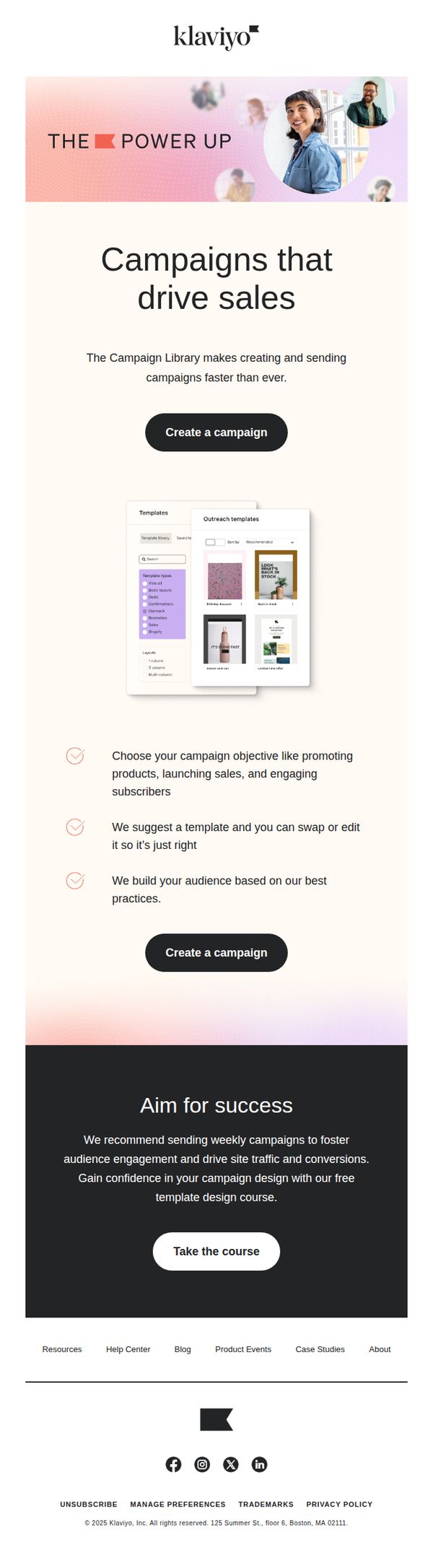
This email aims to encourage users to create and send high-impact marketing campaigns quickly by showcasing Klaviyo’s intuitive Campaign Library and template-driven workflow. It also promotes ongoing skill development through a free design course to boost user confidence and campaign frequency.
Why this works
By framing campaign creation as a fast, template-driven process, Klaviyo reduces perceived friction and positions itself as the go-to tool for time-strapped marketers who need results without complexity.
How to implement
The email smartly pairs product functionality with educational support, offering a free course to build confidence, which turns a feature demo into a long-term value proposition that nurtures user loyalty.
Pro Tip
Add a subtle countdown or progress bar near the 'Create a campaign' CTA to create urgency or guide users through the setup journey, reinforcing the 'minutes' promise in the subject line. • Include a short testimonial or stat (e.g., '87% of users send their first campaign within 24 hours') in the hero section to build social proof and validate the speed claim.
8. HubSpot: 🥶 Training reps to be colder on cold calls? (original data)

Objective
This email aims to engage sales leaders by presenting data-driven insights on cold calling effectiveness, while inviting them to reflect on their team’s current practices and consider adopting a more strategic, resilient approach to outreach. It positions HubSpot as a thought leader and subtly promotes its cold calling playbook.
Why this works
The email opens with a provocative, conversational question that immediately grabs attention and frames the entire message as a peer-to-peer dialogue rather than a sales pitch, making the data feel more relatable and less intimidating.
How to implement
By highlighting a surprising 15-point gap between what sales leaders value and what they actually train for, rejection resilience, the email creates a compelling knowledge gap that motivates readers to seek solutions through the offered playbook.
Pro Tip
The CTA 'Sales call secrets' is vague and underwhelming; it should be rewritten to reflect the email’s core insight, such as 'Download the Cold Calling Playbook to Fix Your Team’s Biggest Blind Spot,' to better align with the data-driven narrative and increase conversion intent. • The email lacks a sense of urgency or exclusivity around the offer; adding a subtle time-sensitive element (e.g., 'Download before Friday to unlock bonus scripts') or social proof (e.g., 'Used by 500+ sales leaders') would strengthen the psychological pull toward action.
9. Squarespace: Have a dream? Get a domain for it.
Objective
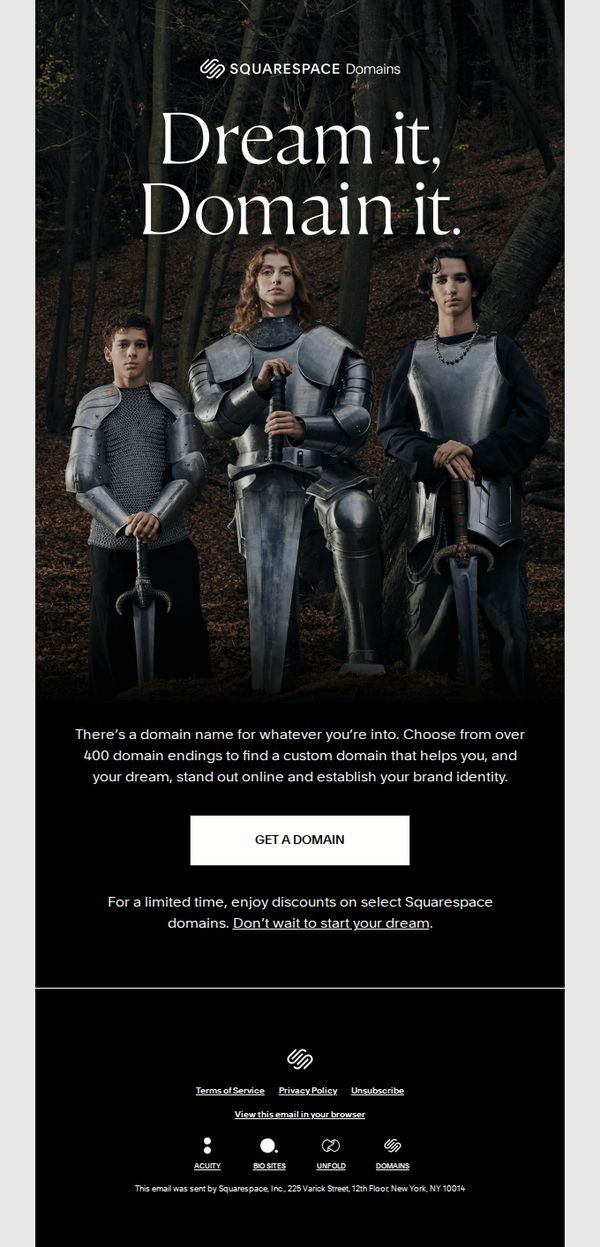
The email aims to inspire users to turn their creative visions into reality by securing a custom domain through Squarespace, positioning domain ownership as the foundational step toward building a unique online identity and brand presence.
Why this works
Squarespace brilliantly ties emotional aspiration to a practical action by framing domain registration as the first heroic step toward realizing a dream, making a technical task feel empowering and deeply personal.
How to implement
The use of medieval armor imagery subtly conveys strength, legacy, and ownership, aligning the act of claiming a domain with the timeless narrative of building something enduring and worthy of protection.
Pro Tip
Add a subtle countdown timer or urgency indicator near the CTA to reinforce the limited-time discount and nudge immediate action without disrupting the email’s elegant tone. • Include a micro-testimonial or social proof element, such as '10,000+ creators launched their dream sites this month', to validate the offer and reduce perceived risk for hesitant users.
10. Square: Try out your POS with a test payment
Objective
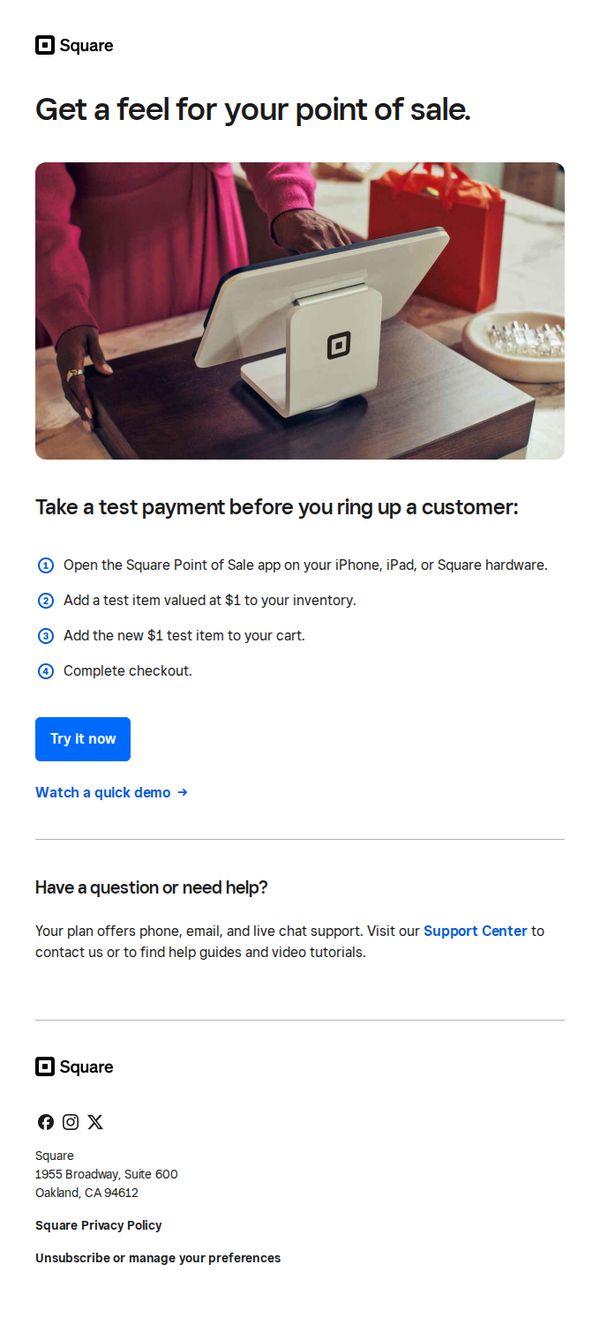
This email aims to encourage new users to experience Square’s point-of-sale system firsthand by simulating a real transaction, reducing hesitation through hands-on familiarity before committing to live use.
Why this works
The email brilliantly lowers the barrier to entry by inviting users to simulate a real transaction with a $1 test item, making the unfamiliar feel safe and intuitive without requiring financial risk or setup complexity.
How to implement
By visually anchoring the message with a warm, real-world photo of a customer interacting with the Square terminal, the email builds emotional trust and subtly positions the product as part of a natural retail experience, not just software.
Pro Tip
Add a subtle countdown or urgency cue near the CTA, like 'Start your test before [date]', to nudge procrastinators, since the current design lacks time-based motivation despite the low-friction offer. • Include a short testimonial or stat (e.g., '92% of users complete their first test payment within 5 minutes') near the steps to reinforce social proof and reduce perceived effort, making the action feel even more effortless and widely adopted.