Relational Campaign email designs from top brands




1. The Spending Power Model To Set Real Budget Caps
Objective
This email aims to educate ecommerce operators on setting data-driven budget caps using the Spending Power Model while promoting two high-value resources: a video episode and a downloadable benchmark report. It also drives applications to a premium accelerator program for scaling brands to 8 figures.
Why this works
The email brilliantly frames budgeting as a strategic lever rather than a constraint, using the phrase 'Stop Guessing Your Ecommerce Budget' to immediately reframe the reader’s mindset and position the content as a decision-making system, not just advice.
How to implement
By embedding a video preview with a clear value proposition, 'how to spot when additional ad spend becomes a bad trade', the campaign leverages visual storytelling to reduce friction and build trust before asking for a deeper commitment like downloading a report or applying to a program.
Pro Tip
The 'RESERVE YOUR SPOT' CTA for the accelerator program appears too late in the flow and lacks urgency or scarcity cues, adding a countdown timer or noting 'Only 3 spots left' would better convert readers already primed by the video and report content. • The email lacks a clear visual hierarchy between the video CTA and the report CTA, using contrasting button colors or spacing to visually separate the two offers would help users choose without confusion and reduce decision fatigue.
2. Wait... consumer confidence is at its lowest since when? 🤔
Objective
This email aims to inform DTC marketers about the disconnect between consumer confidence surveys and actual purchasing behavior, while highlighting how major platforms like Meta, Google, and OpenAI are reshaping digital advertising through AI-driven content and intent-based targeting. It positions Common Thread Collective as a strategic thought leader helping brands adapt.
Why this works
The email brilliantly reframes consumer confidence by contrasting official survey data with real-world spending behavior, creating immediate intrigue and positioning the brand as a counterintuitive truth-teller in a noisy industry.
How to implement
By spotlighting Meta’s AI-generated Vibe app and OpenAI’s Facebook-style ChatGPT redesign, the email ties platform shifts directly to tactical implications for marketers, making abstract AI trends feel urgent and actionable for daily strategy.
Pro Tip
Add a visual timeline or annotated graphic in the 'Market Performance' section to show the divergence between survey sentiment and actual spending, making the paradox more digestible and memorable for skimmers. • Reposition the sponsor CTA 'Get started.' to appear after the sponsor’s value proposition and performance stats, rather than buried mid-paragraph, to improve conversion flow and reduce cognitive friction.
3. Why coordination is killing your speed advantage
Objective
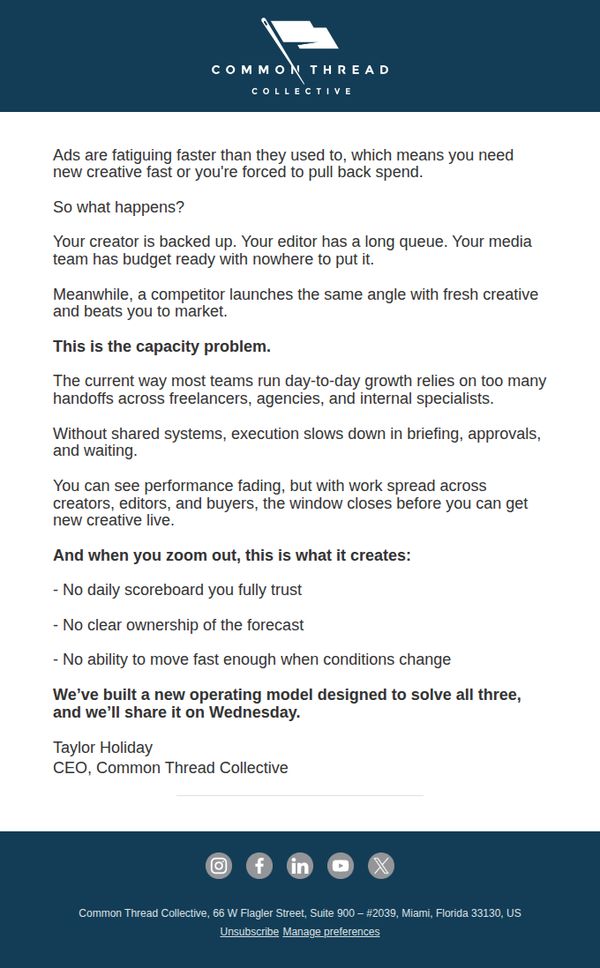
This email aims to position Common Thread Collective as a strategic solution for marketing teams struggling with creative bottlenecks, by highlighting the hidden costs of coordination overhead and teasing a new operating model that restores speed and agility to growth execution.
Why this works
The email brilliantly reframes a common operational pain point, creative delays, as a strategic vulnerability, making the reader feel the urgency of solving it before competitors exploit the gap with faster, fresher content.
How to implement
By naming the problem ‘the capacity problem’ and listing its three concrete symptoms, no trusted scoreboard, no ownership of forecast, no speed to adapt, the message transforms abstract frustration into a diagnosable, solvable business issue.
Pro Tip
Add a subtle visual hierarchy or iconography next to each of the three symptoms (no scoreboard, no ownership, no speed) to make them scannable and emotionally resonant, right now they blend into the text and lose impact. • Include a micro-CTA before the signature, like ‘Reply with “Model” to get early access’, to capture intent from engaged readers who may not wait until Wednesday, turning passive interest into active qualification.
4. Consumers Love the Brand They Are With
Objective
This email aims to demonstrate the power of customer loyalty and repeat purchases by showcasing year-over-year revenue growth, particularly among returning customers, while positioning the DTC Index as an essential tool for data-driven brand strategy.
Why this works
The email brilliantly ties emotional consumer behavior, like Valentine’s Day gifting, to hard revenue metrics, proving that brand love translates directly into repeat purchase growth and measurable ROI for DTC brands.
How to implement
By isolating the 9-day window before Valentine’s Day and showing an 18.80% YoY revenue spike, the email creates a compelling narrative that strategic timing and customer re-engagement can drive outsized results even in saturated markets.
Pro Tip
Add a visual timeline or annotation directly on the returning customer revenue chart to highlight the Jan 31–Feb 8 peak, making the Valentine’s Day correlation instantly obvious without requiring the reader to parse text first. • Reposition the 'UPGRADE MY SUBSCRIPTION' CTA higher in the email, perhaps after the first key insight, to capture attention while the reader is most engaged, rather than burying it after multiple charts and explanations.
5. 25+ DTC Leaders: Growth Summit
Objective
This email aims to drive registrations for the '25+ DTC Leaders: Growth Summit' by highlighting the caliber of speakers, the exclusive nature of the event, and the added incentive of giveaways, all to position it as a must-attend, high-value experience for ecommerce operators.
Why this works
The email brilliantly leverages social proof by featuring recognizable DTC brand logos and executive headshots early, instantly signaling prestige and credibility to the target audience of growth-focused operators.
How to implement
By explicitly calling out the event isn’t a ‘webinar’ and emphasizing live Q&A, the email creates urgency and positions the summit as an interactive, high-touch experience worth prioritizing over passive content.
Pro Tip
The CTA 'Save Your Spot' appears twice but lacks visual hierarchy, consider making the second CTA larger or adding a countdown timer to reinforce urgency, especially since the event date is over a week away. • The section listing all 25+ speakers is text-heavy and risks being skimmed, consider visually grouping them by session type or using collapsible accordions to improve scannability without sacrificing credibility.
6. Media says it’s creative. Creative says it’s media.
Objective
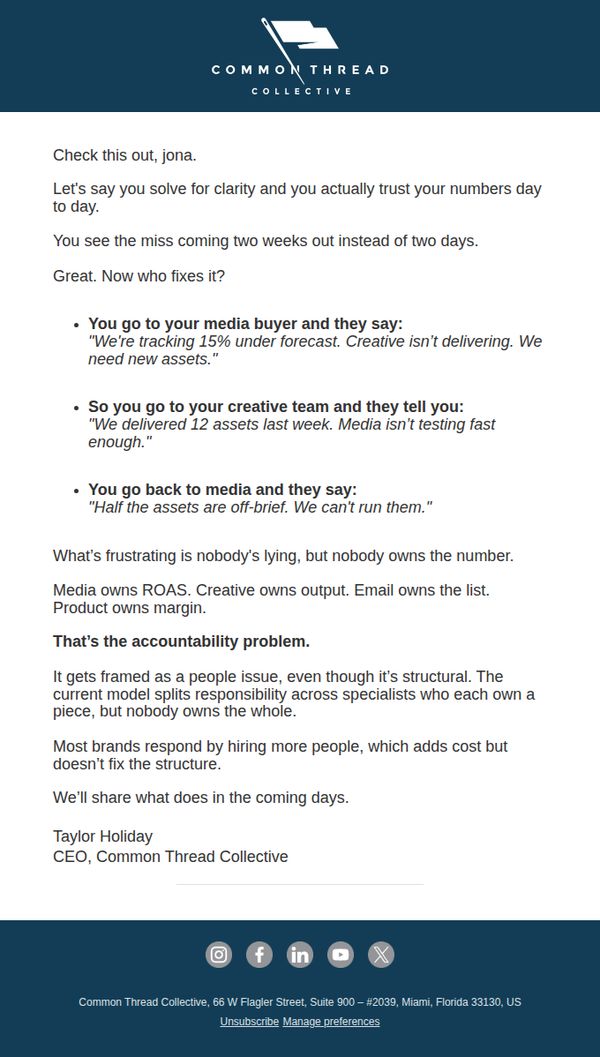
This email aims to position Common Thread Collective as a strategic partner that resolves the accountability gap between media and creative teams, while subtly prompting the recipient to engage further with their upcoming insights or solutions.
Why this works
The email brilliantly reframes a common industry pain point, the blame game between media and creative teams, as a structural accountability failure, making the brand feel like a trusted insider who understands the real problem beneath the surface.
How to implement
By using a conversational, story-driven approach that mimics a real executive’s internal frustration, the message builds emotional resonance and positions Common Thread Collective not as a vendor, but as a strategic ally who speaks the language of C-suite decision-makers.
Pro Tip
Add a secondary CTA button or link near the bottom that says 'Get the Framework' or 'See How We Solve This' to give readers a clear next step instead of relying solely on passive anticipation. • Include a short testimonial or client result snippet after the problem statement to reinforce credibility and show that Common Thread Collective has already solved this for others, reducing perceived risk for the reader.
7. Valentines Day
Objective
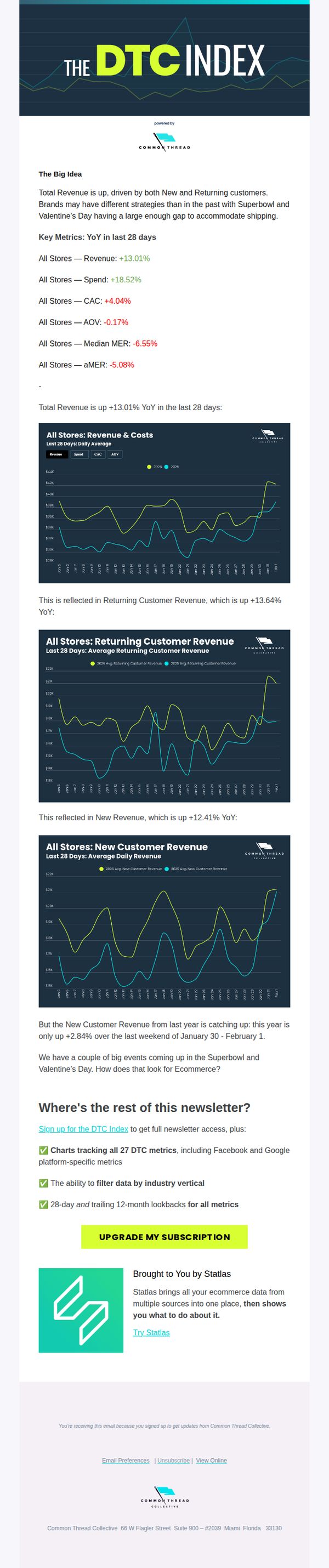
This email aims to inform subscribers about recent ecommerce performance trends leading up to Valentine’s Day and the Superbowl, highlighting revenue growth driven by both new and returning customers while encouraging deeper engagement through a newsletter upgrade.
Why this works
The email smartly frames Valentine’s Day not just as a romantic occasion but as a strategic ecommerce moment, positioning it alongside the Superbowl to emphasize its commercial weight and urgency for brands preparing campaigns.
How to implement
By breaking down revenue metrics into returning versus new customer segments, the email delivers actionable insights that help marketers understand which audiences are driving growth, making data feel personal and relevant to their own strategies.
Pro Tip
Add a visual countdown or event marker near the mention of Valentine’s Day and Superbowl to create urgency and reinforce the time-sensitive nature of the upcoming sales window. • Include a short testimonial or quote from a brand that successfully leveraged these metrics during past holidays to add social proof and make the data more relatable to readers’ real-world decisions.
8. Do you trust this month’s forecast?
Objective
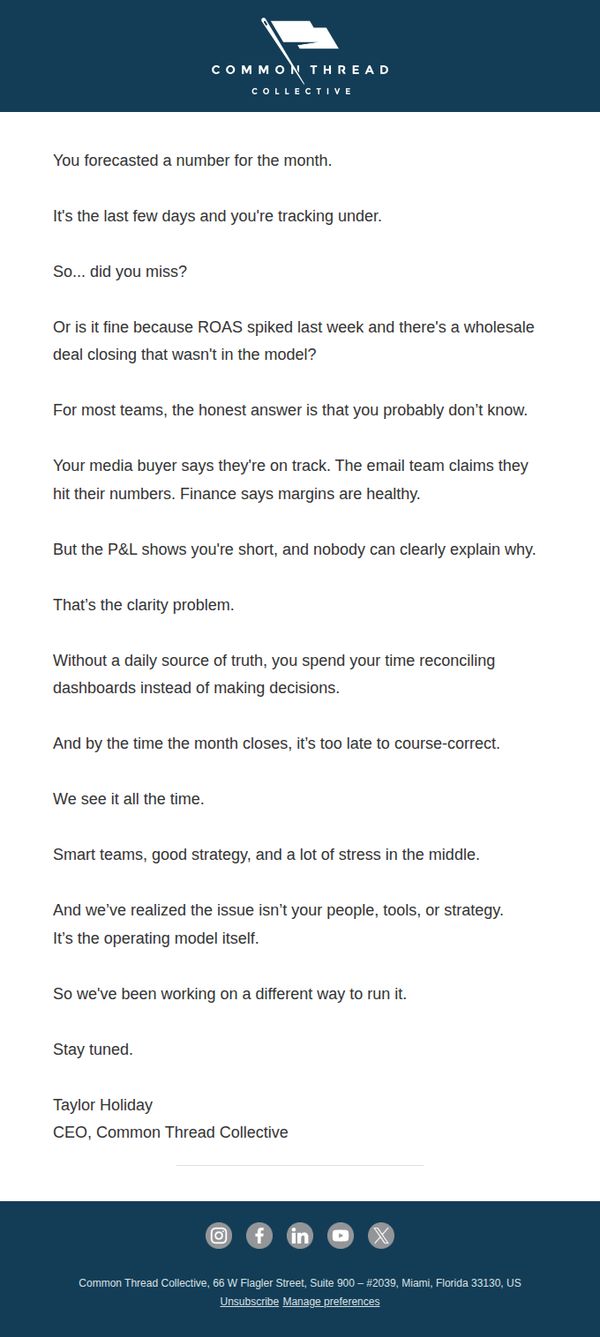
This email aims to create urgency and curiosity around a recurring business problem, forecasting inaccuracies, and position Common Thread Collective as the solution by teasing a new operating model that resolves the 'clarity problem' teams face at month-end.
Why this works
The email opens with a provocative, relatable question that immediately hooks the reader by tapping into a universal pain point, forecasting uncertainty, making the message feel personal and urgent rather than promotional.
How to implement
It masterfully builds tension by contrasting departmental optimism with financial reality, creating a narrative arc that positions the brand as the only one willing to name the problem and offer a structural fix, not just a tool.
Pro Tip
Add a subtle visual cue, like a progress bar or calendar icon, next to the phrase 'last few days' to reinforce urgency and help readers mentally anchor the time sensitivity of the forecast gap. • Include a micro-testimonial or data point (e.g., '87% of teams we work with face this same clarity gap') to validate the problem’s prevalence and strengthen the emotional hook before introducing the solution.
9. It All Starts to Click

Objective
This email aims to demonstrate the value of the DTC Index by showcasing real, data-driven growth insights from top channels like Google and Meta, persuading subscribers to upgrade their access for deeper analytics and industry-specific metrics.
Why this works
The email masterfully uses YoY performance comparisons across Google and Meta to create a compelling narrative of growth, making abstract metrics feel tangible and urgent for DTC marketers seeking competitive advantage.
How to implement
By anchoring revenue spikes to real-world events like Super Bowl weekend, the email transforms dry data into a story that resonates emotionally and contextually, helping readers visualize how timing and cultural moments impact performance.
Pro Tip
Add a brief testimonial or quote from a current DTC Index subscriber above the CTA to build social proof and reinforce the value of upgrading, especially since the email relies heavily on data without human validation. • Include a visual indicator, such as a progress bar or badge, showing how much more data or insight the upgraded version unlocks, to make the upgrade benefit more tangible and reduce perceived friction.
10. Big Love for the Big Channels

Objective
This email aims to inform subscribers about recent performance trends in DTC revenue, highlighting the outsized impact of Google and Meta channels while encouraging them to upgrade their subscription for deeper analytics access. It positions Common Thread Collective as a data-driven authority while driving conversion through value-driven content.
Why this works
The email masterfully uses comparative year-over-year data to spotlight Google and Meta as revenue drivers, making abstract metrics feel tangible and urgent by anchoring them to specific dates and percentage shifts that signal momentum.
How to implement
By juxtaposing declining Google spend with rising revenue, the campaign creates a compelling narrative of efficiency gains that positions the brand as insightful and data-savvy, subtly reinforcing the value of the full subscription for deeper analysis.
Pro Tip
Add a brief visual summary or infographic at the top that highlights the 3 key takeaways (revenue growth, Google efficiency, Meta ROAS) to help skimmers grasp value before diving into charts. • Reposition the 'Upgrade My Subscription' CTA to appear after the first major insight (e.g., after the Google revenue chart) to capture momentum when the reader is most convinced of the data’s value.