The complete relational campaign email collection for data brands
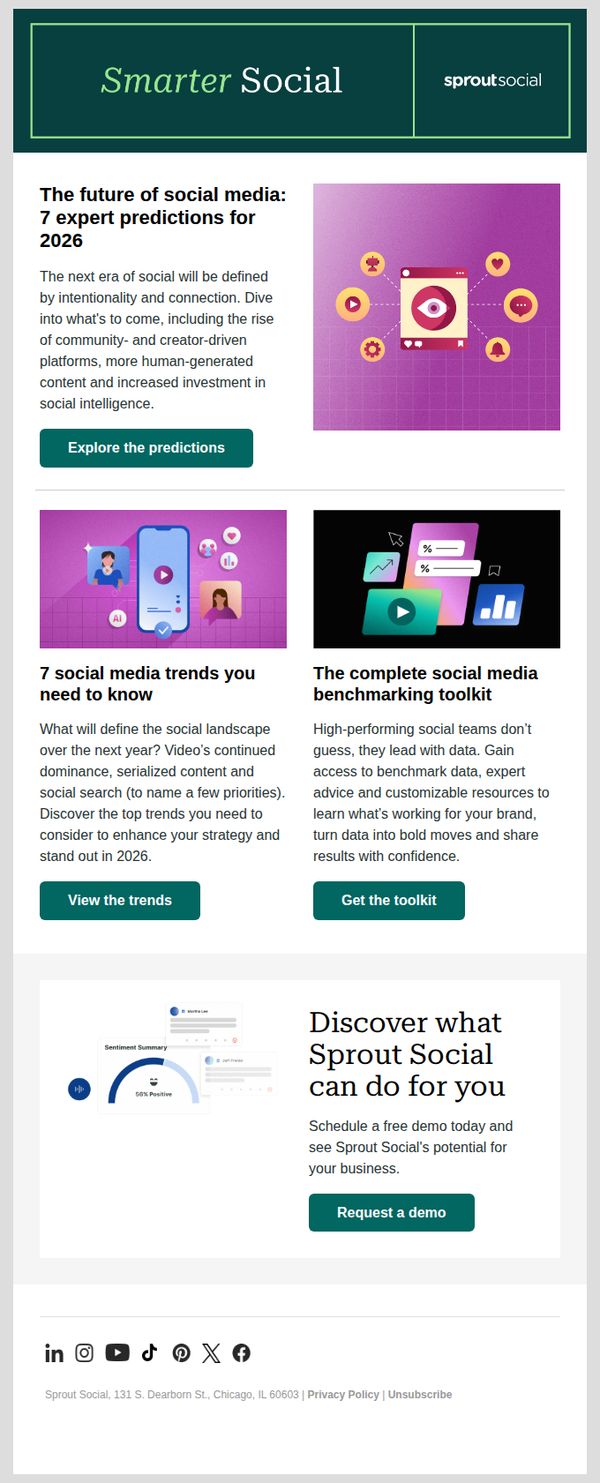
1. Sprout Social: 7 expert predictions for social media in 2026
Objective
This email aims to position Sprout Social as a forward-thinking authority in social media strategy by sharing expert predictions for 2026, while guiding readers toward deeper engagement through trend insights, benchmarking tools, and a demo request to convert interest into product consideration.
Why this works
By framing future social media trends as expert predictions rather than generic forecasts, the email builds credibility and positions Sprout Social as a thought leader worth following for strategic direction in an evolving digital landscape.
How to implement
The email smartly layers value by offering not just predictions but also actionable tools and benchmarks, subtly guiding readers from curiosity to consideration without overwhelming them with a hard sales pitch too early in the journey.
Pro Tip
Add a subtle countdown or urgency indicator near the 'Request a demo' CTA to nudge procrastinators, since the content is future-focused and may feel less time-sensitive without a behavioral trigger. • Include a short testimonial or client result snippet under the 'Discover what Sprout Social can do for you' section to reinforce social proof and reduce perceived risk before the demo request.
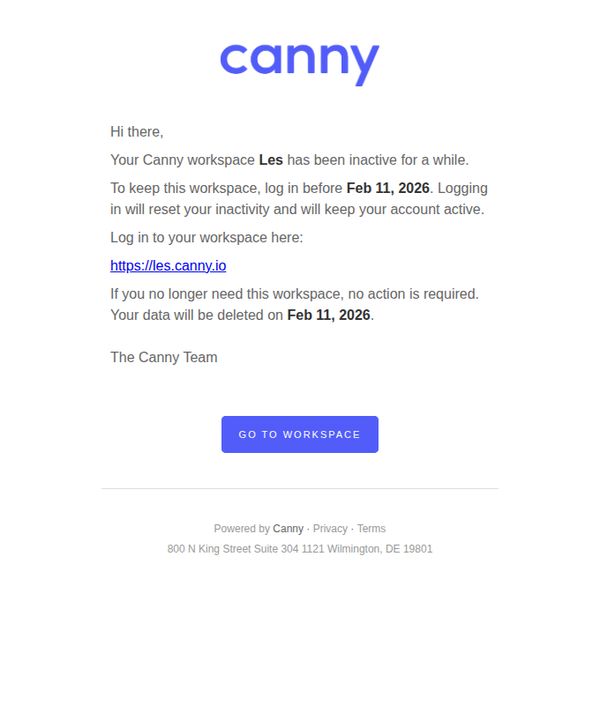
2. Canny: Your Canny workspace "Les" is scheduled for deletion
Objective
To alert the user that their Canny workspace 'Les' is scheduled for deletion due to inactivity and to encourage them to log in before the deadline to preserve their data.
Why this works
The email uses urgency effectively by clearly stating the deletion date upfront, creating a time-sensitive reason for the user to act without sounding alarmist or pushy.
How to implement
It balances empathy and clarity by offering two paths, reactivation or graceful exit, which reduces friction and makes the user feel in control rather than penalized for inactivity.
Pro Tip
Add a brief explanation of what data will be lost (e.g., feedback, votes, comments) to strengthen emotional urgency and help users weigh the consequence of inaction. • Include a secondary CTA or link offering to export data before deletion, giving users a graceful exit path that still engages them with the platform’s value.
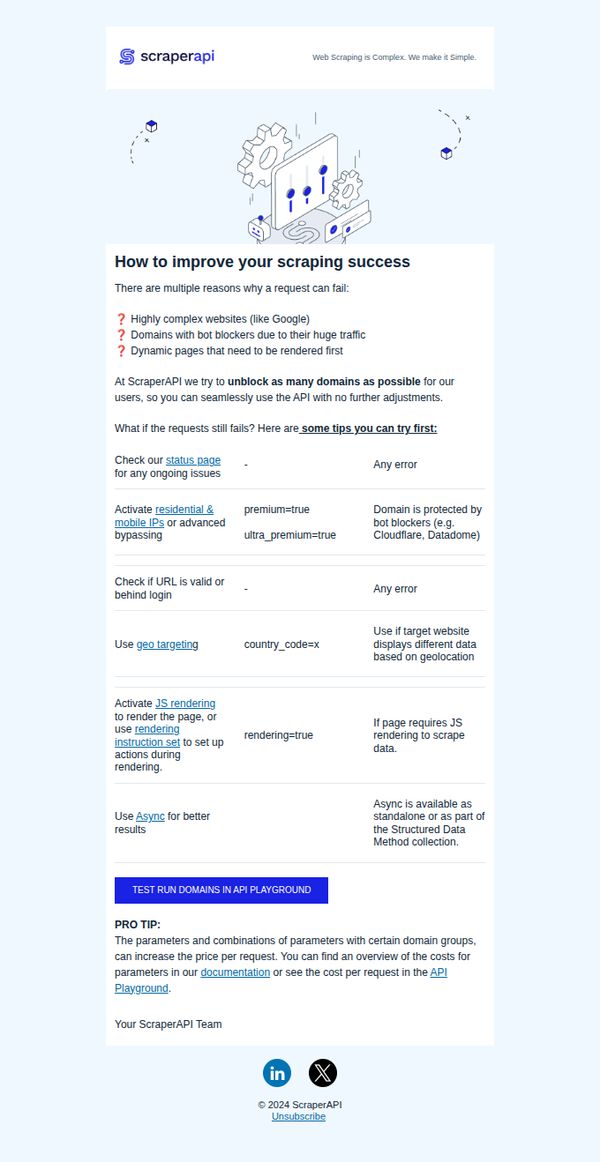
3. ScraperAPI: Use parameters for more successful scraping
Objective
This email aims to educate users on how to improve scraping success by leveraging specific API parameters, while subtly encouraging deeper engagement with ScraperAPI’s tools and documentation to reduce friction and increase conversion through self-service troubleshooting.
Why this works
The email brilliantly transforms a potential pain point, failed scraping requests, into an educational opportunity, guiding users toward actionable parameter adjustments that empower them to solve problems independently while reinforcing product value.
How to implement
By structuring troubleshooting advice as a clean, scannable table with clear parameter names and use cases, the email lowers cognitive load and turns technical complexity into digestible, confidence-building guidance that encourages experimentation without overwhelm.
Pro Tip
Add a visual indicator or small icon next to each parameter suggestion (e.g., a checkmark or warning symbol) to help users quickly distinguish between foundational fixes versus advanced optimizations, improving scanability and reducing decision fatigue. • Include a short video or animated GIF in the Hero Section demonstrating one parameter tweak in action, such as geo-targeting changing results, to provide immediate visual proof of concept and increase emotional resonance before users reach the CTA.
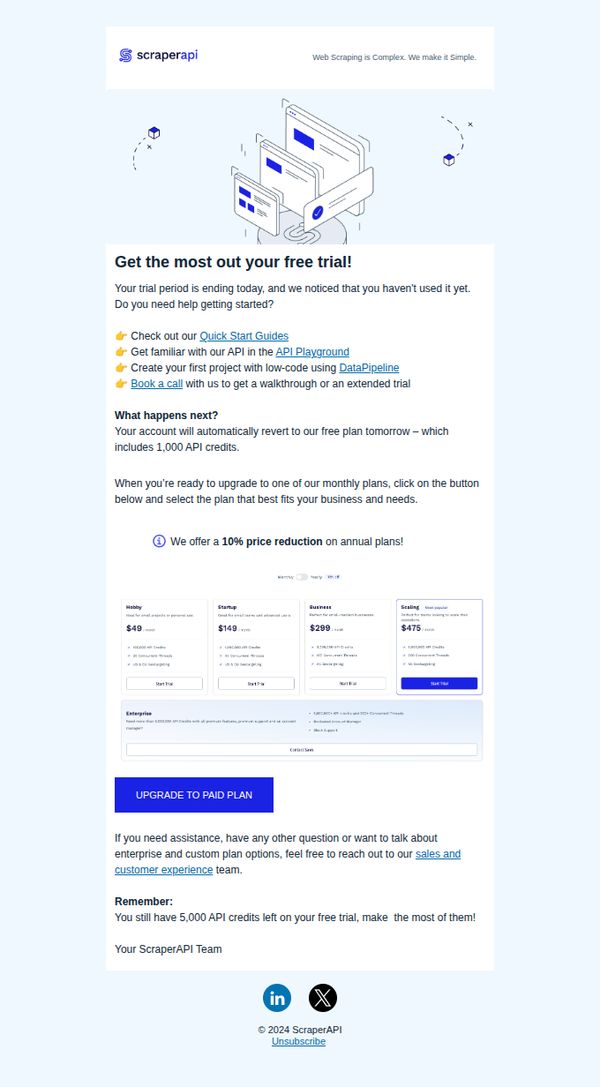
4. ScraperAPI: How can we help you to get started?
Objective
This email aims to re-engage users who haven’t started their free trial by offering actionable onboarding resources and nudging them toward upgrading before their trial expires. It also incentivizes annual commitments with a discount to improve conversion and reduce churn.
Why this works
The email brilliantly reframes trial expiration as an opportunity rather than a penalty, using empathetic language like 'Do you need help getting started?' to reduce friction and invite engagement instead of triggering abandonment.
How to implement
By offering multiple onboarding pathways, Quick Start Guides, API Playground, and DataPipeline, the email caters to diverse user learning styles and technical comfort levels, increasing the likelihood that at least one resource will resonate and drive activation.
Pro Tip
Add a countdown timer or visual indicator near the top to emphasize urgency around the trial ending today, this would strengthen the emotional nudge without cluttering the layout or diluting the supportive tone. • Include a brief testimonial or social proof near the pricing section to reinforce trust and reduce perceived risk, for example, 'Join 5,000+ developers who scaled their scraping with ScraperAPI' would validate the upgrade decision.
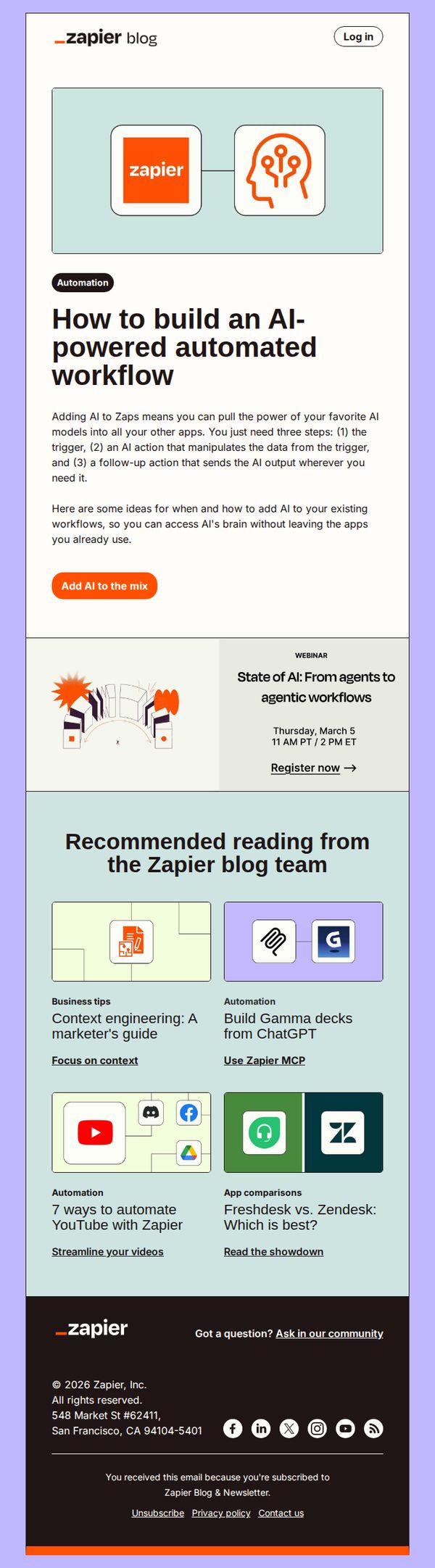
5. Zapier : Add AI to your workflows
Objective
This email aims to educate Zapier users on integrating AI into their existing automation workflows, encouraging them to explore AI-powered actions without leaving their current tools. It also promotes a related webinar and curated blog content to deepen engagement and drive adoption.
Why this works
The email brilliantly simplifies AI integration by breaking it into three digestible steps, trigger, AI action, follow-up, which lowers the mental barrier for users unfamiliar with AI workflows and makes automation feel instantly achievable.
How to implement
By anchoring the AI message in existing user behavior, 'without leaving the apps you already use', the email reassures users that AI isn’t a disruptive overhaul but a seamless enhancement to their current Zapier experience.
Pro Tip
The primary CTA 'Add AI to the mix' is visually prominent but lacks urgency or benefit-driven language; rephrasing it to 'Start building AI workflows in minutes' would better align with user motivation and reduce friction. • The webinar section is visually separated and lacks a strong visual cue or benefit statement; adding a short value-driven headline like 'Learn how AI agents can automate your work' would increase click-through rates.
6. Zapier : Automate project management
Objective
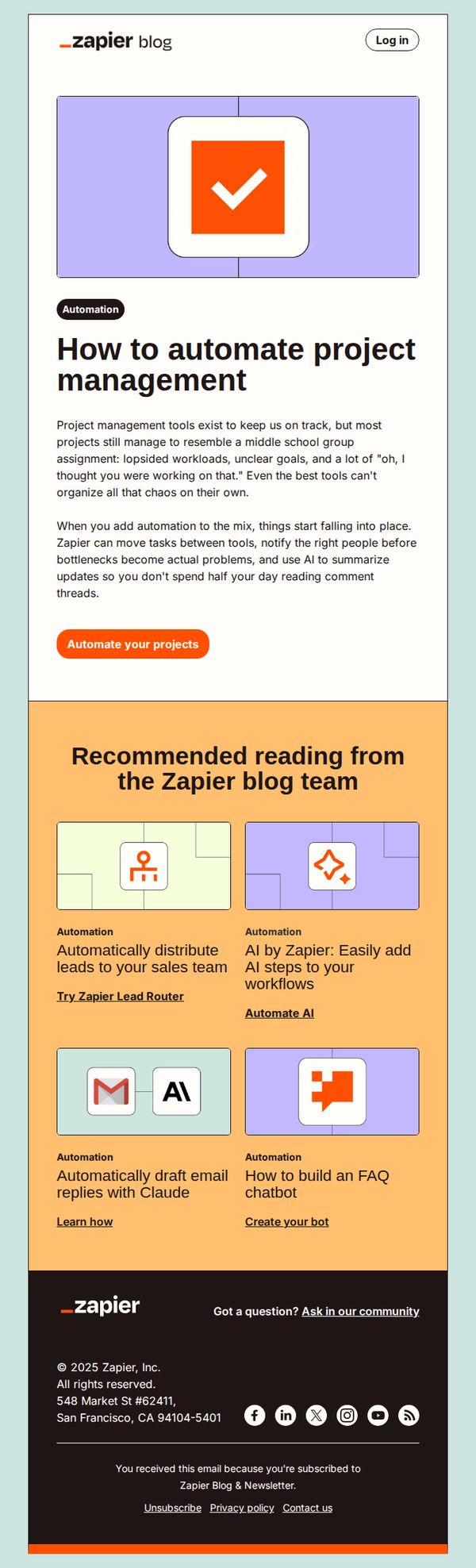
This email aims to educate subscribers on how Zapier can streamline project management by automating repetitive tasks and reducing manual oversight, ultimately encouraging them to start automating their own workflows with a clear next step.
Why this works
The email opens with a relatable pain point, chaotic, disorganized projects, then immediately positions Zapier as the solution that brings order through automation, making the value proposition instantly clear and emotionally resonant.
How to implement
By framing automation as a way to prevent bottlenecks and reduce time spent on comment threads, the copy speaks directly to productivity-focused professionals who feel overwhelmed by collaboration tools, increasing perceived relevance and urgency.
Pro Tip
Add a visual progress indicator or mini-case study showing before/after automation in project management to strengthen social proof and make the abstract benefit more tangible for skeptical readers. • Reposition the CTA button to appear both above and below the educational content to capture attention at multiple scroll points, especially since the current single CTA may be missed by users who skim or read quickly.
7. Tableau Software : Make your business logic AI-ready with Tableau Semantics
Objective
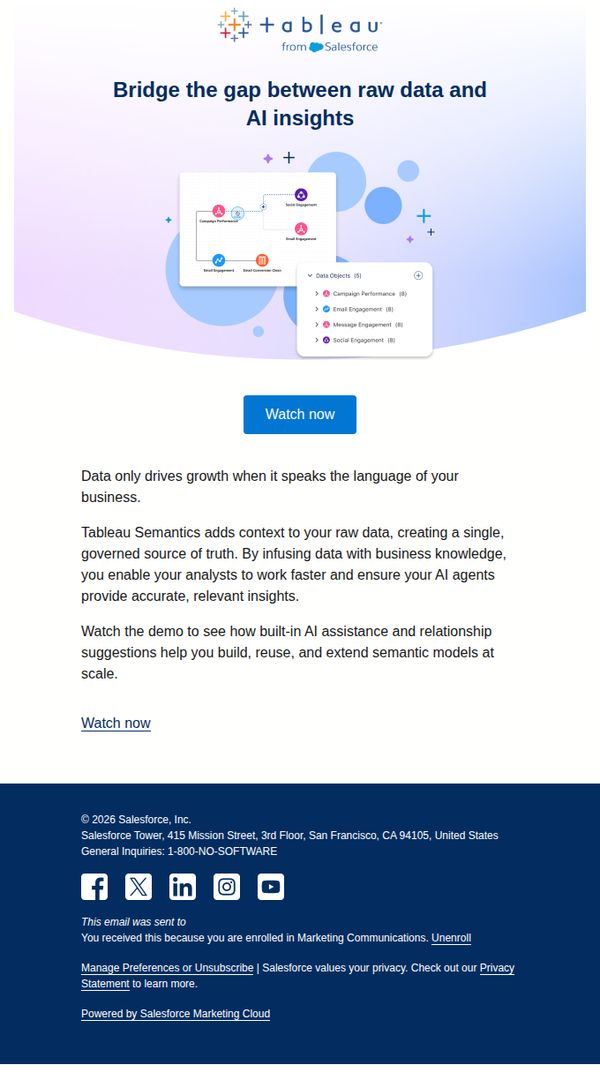
This email aims to drive engagement with Tableau Semantics by positioning it as the essential layer that translates raw data into business-aligned AI insights, encouraging recipients to watch a demo that showcases its AI-assisted modeling capabilities.
Why this works
The email brilliantly frames data not as a technical asset but as a business language, making the value of Tableau Semantics instantly relatable to non-technical decision-makers who need AI to speak their operational dialect.
How to implement
By emphasizing 'governed source of truth' and 'AI agents providing relevant insights,' the copy taps into enterprise anxieties around data chaos and AI hallucinations, positioning Tableau Semantics as the trusted bridge between raw inputs and trustworthy outputs.
Pro Tip
Add a brief testimonial or customer logo near the CTA to build social proof, since this is an enterprise product, seeing a peer organization’s endorsement would significantly reduce perceived risk and increase demo sign-ups. • Include a short bullet list or icon-driven feature highlights under the main paragraph to visually break up text and quickly communicate key capabilities like 'AI relationship suggestions' or 'semantic model reuse' for skimmers.
8. Attest: Still need your 2026 consumer trends briefing?
Objective
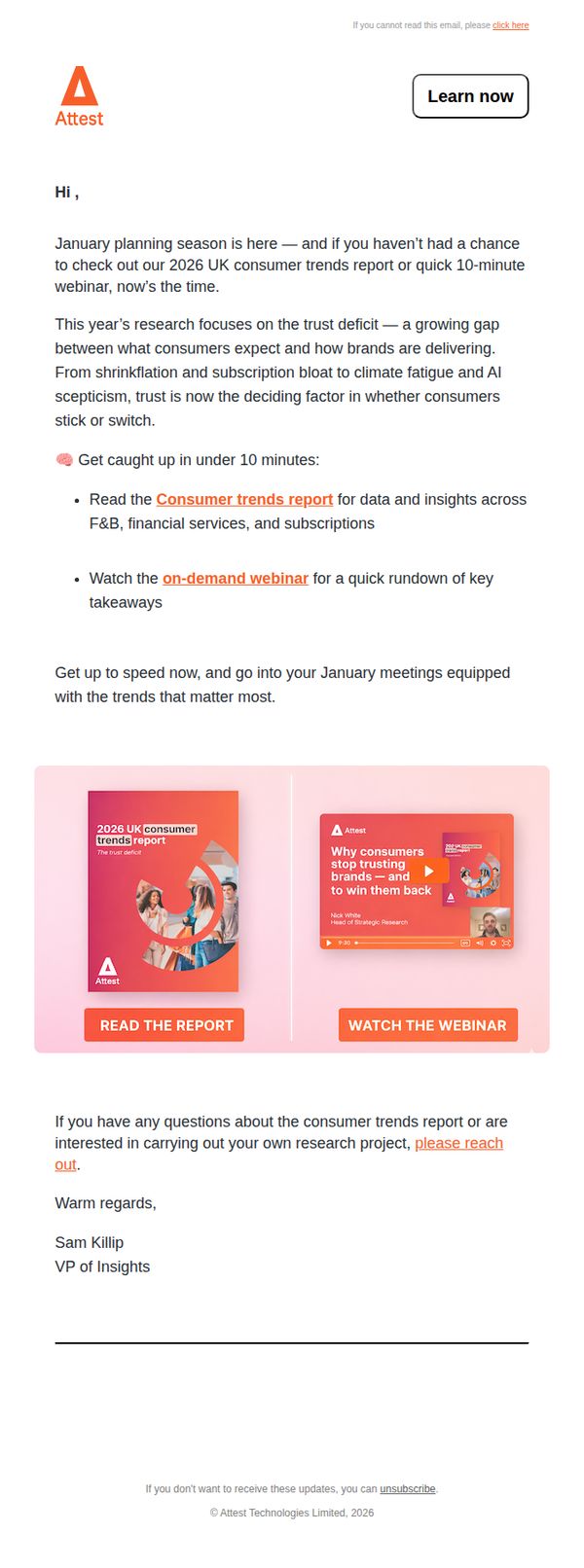
The email aims to re-engage recipients who haven’t yet accessed Attest’s 2026 UK consumer trends report or webinar, positioning the content as essential for January planning by highlighting the critical role of consumer trust in brand loyalty and decision-making.
Why this works
The email frames the 2026 consumer trends report as mission-critical for January planning, creating urgency by tying it directly to real-time business decisions rather than treating it as optional reading.
How to implement
By spotlighting the ‘trust deficit’ as the central theme, the email taps into a timely, emotionally resonant pain point that marketers and strategists are actively grappling with, making the content feel indispensable.
Pro Tip
Add a subtle countdown timer or urgency indicator near the CTA to reinforce the ‘January planning season’ context and nudge procrastinators toward immediate action. • Include a short testimonial or client quote beneath the product grid to build social proof and validate the report’s impact, especially since trust is the core theme of the content.
9. Loganix: SEO tactics that matter
Objective
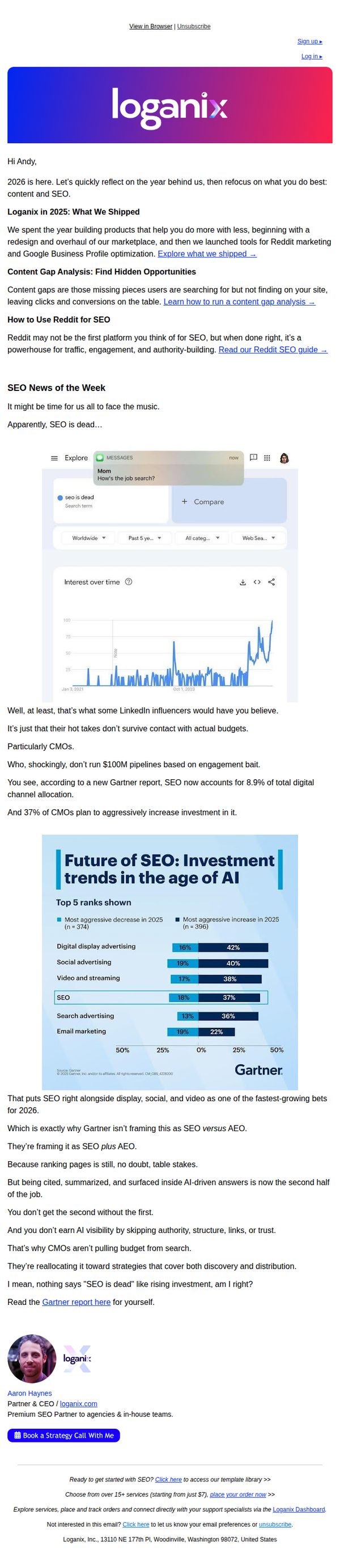
This email aims to reposition SEO as a high-growth, AI-aligned marketing channel by leveraging Gartner data and industry trends, while encouraging readers to book a strategy call with Loganix’s CEO to explore actionable next steps.
Why this works
The email brilliantly reframes the tired 'SEO is dead' narrative by anchoring its argument in authoritative Gartner data, transforming skepticism into strategic urgency for CMOs managing tight budgets and AI-driven expectations.
How to implement
By positioning SEO not as a standalone tactic but as part of an integrated 'SEO plus AEO' framework aligned with discovery and distribution, the message speaks directly to modern marketers who need holistic, budget-justifiable strategies.
Pro Tip
Add a subtle countdown timer or urgency indicator near the CTA to increase conversion pressure, especially since the email references 2026 planning cycles and budget allocation windows that are time-sensitive. • Include a short bullet list or icon-based summary after the Gartner chart highlighting 2–3 key takeaways (e.g., 'SEO investment up 37%', 'CMOs reallocating budgets') to reinforce the data without requiring full chart interpretation.
10. Similarweb: Everyone has an opinion about Gen AI. We have the data.
Objective
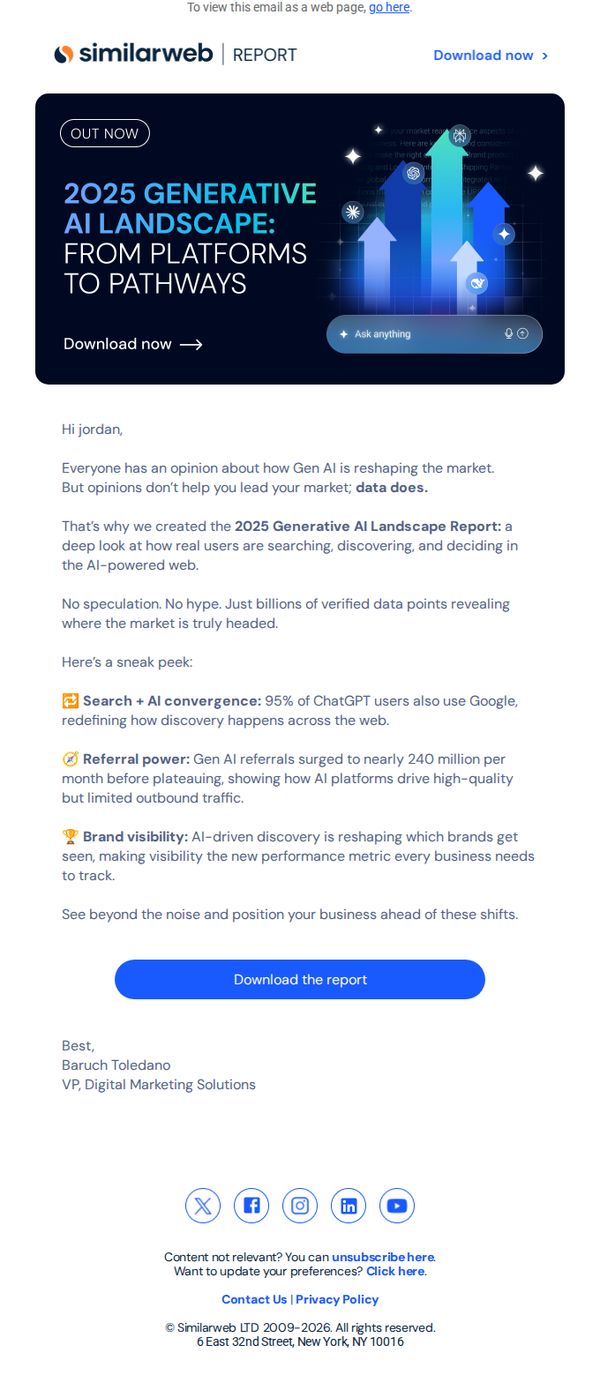
This email aims to position Similarweb as a data-driven authority in the generative AI space by offering a high-value report that helps marketers cut through opinion and make decisions based on real user behavior and verified metrics.
Why this works
The email opens by contrasting subjective opinions with objective data, immediately establishing credibility and positioning the report as the antidote to market noise, a powerful psychological hook for data-driven decision-makers.
How to implement
It teases three specific, surprising data points, like 95% of ChatGPT users also using Google, which creates curiosity and demonstrates the report’s depth without giving everything away, encouraging the download.
Pro Tip
Add a subtle countdown timer or limited-time badge near the CTA to create urgency, since the report is positioned as timely and market-shifting, this would leverage FOMO without compromising the data-driven tone. • Include a short testimonial or logo of a recognizable brand that used the report to make a strategic decision, this would strengthen social proof and reduce perceived risk for downloading a gated asset.