Mental Health relational campaign email examples & ideas





1. Jay Shetty: An exciting announcement
Objective
This email aims to introduce Jay Shetty’s new production company, Perfect Strangers, while reinforcing his core message of human connection through storytelling. It invites readers to reflect on shared experiences and aligns the brand’s expansion with its long-standing mission of making wisdom accessible and emotionally resonant.
Why this works
Jay Shetty masterfully ties his personal origin story to the launch of Perfect Strangers, making the announcement feel like a natural evolution rather than a corporate pivot, which deepens emotional investment from his audience.
How to implement
By framing strangers as potential sources of connection rather than isolation, the email transforms a potentially abstract concept into a relatable, actionable insight that invites readers to rethink everyday interactions with curiosity and compassion.
Pro Tip
Add a clear, visually distinct CTA button labeled 'Learn More About Perfect Strangers' near the announcement paragraph to guide readers toward the next step instead of relying on a small, buried hyperlink. • Include a short embedded video or audio clip from the Perfect Strangers podcast to immediately demonstrate the tone and value of the new content, reducing cognitive load and increasing emotional resonance.
2. Jay Shetty: Say no with confidence
Objective
This email aims to empower subscribers to set healthy personal boundaries by reframing 'no' as an act of self-respect and integrity, while encouraging engagement through reflection and interaction. It also promotes Jay Shetty’s podcast and partners with Proton Mail to offer value beyond the core message.
Why this works
The email brilliantly reframes saying 'no' not as rejection but as an act of self-respect and long-term anxiety reduction, transforming a guilt-inducing behavior into a powerful tool for personal integrity and peace.
How to implement
By embedding a reflective self-assessment question with clickable options, the campaign invites personal introspection in a low-pressure, interactive way that deepens emotional resonance without demanding immediate action or purchase.
Pro Tip
Add a subtle visual cue or icon next to the CTA button to draw attention, the current green button blends into the footer’s tone and risks being overlooked despite its importance for engagement. • Include a short, time-bound incentive (e.g., 'Reply within 24 hours and get a free boundary-setting guide') to boost reply rates by creating urgency and reinforcing the value of immediate action.
3. Jay Shetty: “Here’s to Tim Duncan”
Objective
This email aims to inspire daily reflection and personal growth by sharing a story of humility and gratitude through the lens of Tim Duncan and Coach Popovich, while subtly promoting Jay Shetty’s podcast and a sponsored AI productivity guide from HubSpot.
Why this works
The email masterfully uses a sports story to illustrate a universal emotional truth, that true leadership thrives in humility, making abstract wisdom feel personal, relatable, and instantly memorable for readers across all walks of life.
How to implement
By embedding a sponsored offer within a narrative about gratitude and legacy, the campaign avoids sounding transactional; instead, it positions the product as a natural extension of the reader’s journey toward self-improvement and mindful productivity.
Pro Tip
The CTA 'Download the free guide' is buried after a long narrative and lacks visual emphasis; repositioning it as a bold, colored button directly beneath the HubSpot ad banner would increase conversion by reducing friction and aligning with the reader’s peak interest. • The podcast section lacks a clear visual hierarchy, adding a thumbnail image or play icon next to each platform button would make the listening options more intuitive and increase click-through rates by signaling interactivity.
4. Jay Shetty: 3 Things to Do When Life Doesn’t Go As Planned
Objective
This email aims to comfort and guide readers through unexpected life setbacks by reframing them as feedback, not failure, and offering actionable steps to restore clarity and momentum. It encourages self-reflection and emotional resilience through a structured journaling activity.
Why this works
The email masterfully reframes setbacks as feedback rather than failure, giving readers psychological permission to pause, reflect, and redirect without self-judgment, a powerful emotional reset for overwhelmed audiences.
How to implement
By offering a simple, time-bound journaling activity with specific prompts, the email transforms abstract advice into tangible, actionable self-care, making wisdom feel accessible and immediately useful, not just inspirational.
Pro Tip
Add a subtle visual cue or icon next to each of the three steps to enhance scannability and reinforce the structure, this would help readers quickly anchor to the core framework without rereading dense paragraphs. • Include a micro-CTA after the journaling section, such as 'Share your insight with us' or 'Save this prompt for later,' to encourage immediate interaction and create a feedback loop that strengthens reader commitment.
5. Jay Shetty: Stop letting money manage you
Objective
This email aims to help readers reframe their emotional and psychological relationship with money by offering six actionable mindset shifts, encouraging self-reflection and intentional financial behavior, not just tactical budgeting or investing.
Why this works
The email brilliantly reframes money as an emotional and identity-driven force, not just a numbers game, making financial advice feel deeply personal and psychologically resonant, which increases reader buy-in and long-term behavioral change.
How to implement
Each of the six tips is paired with a micro-action that’s immediately doable, turning abstract financial wisdom into tangible, low-barrier habits that build momentum without overwhelming the reader, which is key for sustained engagement.
Pro Tip
The CTA 'Create Financial Momentum' is vague and doesn’t clearly signal the next step, consider rephrasing to 'Get Your 0% Intro APR Card Now' or 'Start Your Financial Reset' to better align with the offer’s value and drive conversion. • The 'How often do you intentionally learn about finances?' poll feels disconnected from the rest of the content and doesn’t lead to a follow-up action, either remove it or tie it to a personalized resource or next-step recommendation based on the user’s answer.
6. Jay Shetty: When you're stuck, start here

Objective
This email aims to help subscribers reconnect with their true selves by guiding them to identify and release internal 'dust', distractions and false identities, that obscure their purpose. It pairs personal storytelling with actionable reflection to foster emotional clarity and community engagement.
Why this works
The email masterfully uses a vivid, personal metaphor, cleaning dust off a mirror, to make abstract self-discovery feel tangible and actionable, helping readers visualize their inner clutter and feel empowered to remove it.
How to implement
By embedding a practical 'Dust List' exercise and inviting replies, the campaign transforms passive reading into active participation, deepening emotional investment and creating a feedback loop that strengthens community trust and loyalty.
Pro Tip
The CTA 'Click to reply and let me know' is buried near the bottom and lacks visual urgency; repositioning it higher with a contrasting button color and adding microcopy like 'Join 1,200+ readers who cleared their dust this week' would boost response rates. • The BetterHelp sponsorship section interrupts the emotional flow of the wisdom narrative; integrating it as a soft sidebar or post-script with a clearer value bridge, like 'Need extra support cleaning your mental mirror? Try BetterHelp with 25% off', would preserve tone while honoring the partnership.
7. AusRehab: Early 2026 Injury Insights
Objective
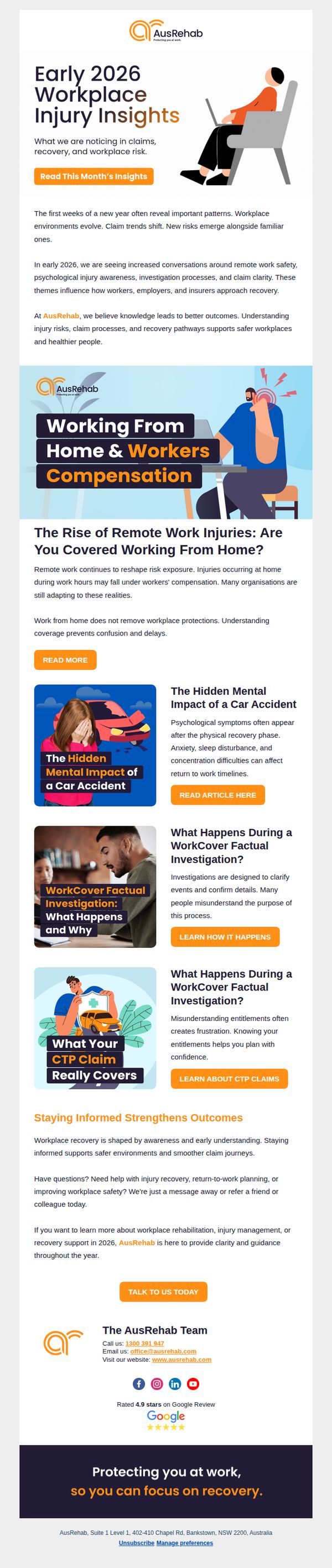
This email aims to position AusRehab as a thought leader in workplace injury prevention and recovery by sharing early 2026 insights, while encouraging readers to engage with educational content and initiate contact for personalized support. It seeks to build trust through timely, relevant information that addresses emerging workplace risks.
Why this works
By framing early 2026 workplace injury trends as actionable insights rather than abstract data, the email transforms passive readers into engaged stakeholders who feel equipped to address emerging risks before they escalate into costly claims.
How to implement
The strategic use of emotionally resonant visuals, like the stressed remote worker and the car accident aftermath, creates immediate empathy, making complex topics like psychological injury and claim investigations feel personal and urgent to the reader.
Pro Tip
Add a subtle countdown or time-sensitive language near the 'Talk to Us Today' CTA to create urgency, e.g., 'Schedule your 2026 risk review before March 31', to convert passive interest into immediate action. • Reorder the article cards to lead with the most emotionally compelling topic (e.g., 'The Hidden Mental Impact of a Car Accident') to capture attention faster, as the current top card on remote work may feel less urgent to non-remote audiences.
8. Jay Shetty: Own what you’re good at—and what you’re not

Objective
This email aims to inspire self-awareness and daily confidence practice by encouraging readers to acknowledge both strengths and weaknesses, while subtly promoting a wellness product through a time-sensitive discount. It also fosters community engagement by inviting personal reflection and replies.
Why this works
The email brilliantly reframes confidence not as a fixed trait but as a daily practice, making self-improvement feel accessible and actionable rather than intimidating or reserved for the naturally gifted.
How to implement
By openly admitting personal shortcomings, like not being good at surfing, the sender builds authentic connection and lowers the reader’s guard, making the message about self-acceptance far more persuasive and relatable.
Pro Tip
The CTA button appears twice but lacks visual hierarchy, consider making the first CTA more prominent or adding a subtle animation to draw attention, since the second CTA is buried after lengthy content. • The email includes two nearly identical sponsor sections for Beam, which creates redundancy; consolidate into one stronger section with clearer benefit-driven copy and a single, more urgent CTA to avoid diluting the message.
9. Jay Shetty: The Best Sleep Advice I’ve Received All Year

Objective
This email aims to educate readers on science-backed sleep strategies while subtly promoting Eight Sleep’s mattress technology as a solution to improve rest. It blends expert advice with product integration to position the brand as a trusted partner in achieving better sleep habits.
Why this works
The email masterfully weaves expert sleep science into a personal narrative, making complex advice feel accessible and actionable while naturally transitioning into product relevance without sounding salesy or abrupt.
How to implement
By anchoring the product benefit in a relatable struggle, inconsistent sleep routines, the campaign creates emotional resonance, positioning the Eight Sleep mattress not as a luxury but as a practical tool for reclaiming daily energy and mental clarity.
Pro Tip
The CTA 'Learn More' is too generic, replacing it with action-oriented text like 'Get Your Better Sleep Start Today' or 'Claim Your $700 Discount' would better align with the urgency and benefit-driven tone of the email. • The product image of the mattress is visually appealing but lacks context, adding a short overlay caption like 'The Pod 5: Sleep 44% Faster, Wake Up Calmer' would reinforce the key benefit directly beneath the visual, improving conversion clarity.
10. Jay Shetty: Self-Forgiveness = Strength

Objective
This email aims to guide readers toward emotional healing by reframing self-forgiveness as a form of strength, while subtly integrating a sponsored partner offer and encouraging engagement with Jay Shetty’s podcast and charitable initiatives.
Why this works
The email masterfully reframes self-forgiveness not as weakness but as courageous forward motion, using relatable inner monologues to validate the reader’s pain before offering a liberating mindset shift that feels both personal and empowering.
How to implement
By embedding the sponsor offer within a natural emotional arc, linking reclaimed time to personal growth, the campaign avoids sounding transactional and instead positions the service as a practical tool for living the wisdom being taught, making the CTA feel like a natural next step.
Pro Tip
The CTA 'Reclaim Your Time' is visually underwhelming and lacks urgency; adding a time-sensitive incentive (e.g., 'Claim 10 Bonus Hours Before Dec 31') directly beside the button would strengthen conversion by aligning with the email’s theme of seizing the present moment. • The podcast and donation sections feel tacked on rather than integrated; weaving Jelly Roll’s story into the self-forgiveness narrative earlier would create a stronger emotional through-line, making the 'On Purpose' promotion feel like a natural extension of the core message.