Relational campaign email gallery from real brands



1. Invite the team to try it with you!
Objective
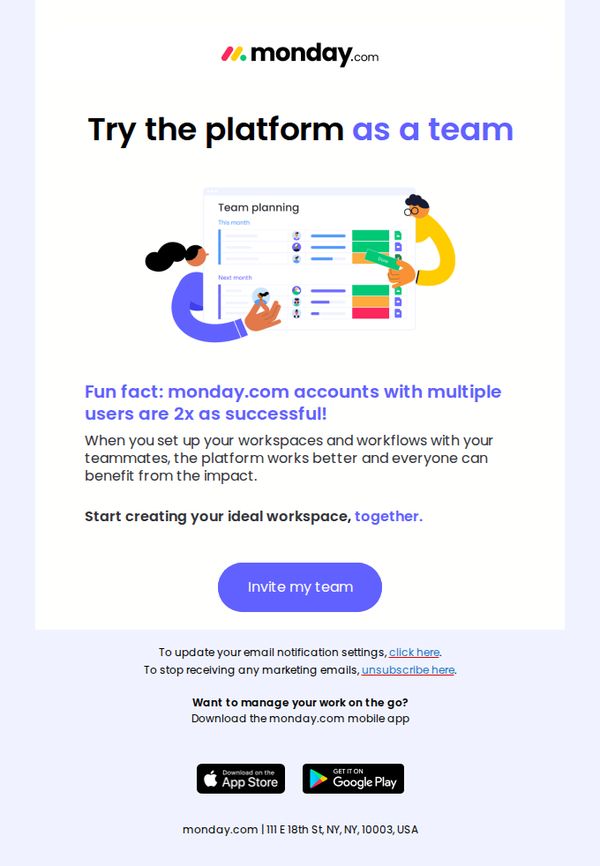
The email aims to encourage existing users to invite their teammates to join monday.com, emphasizing that collaborative adoption increases success rates and enhances workflow impact across the team.
Why this works
Positioning team adoption as a success multiplier, not just a feature, transforms the invitation from a courtesy into a strategic advantage, making users feel they’re unlocking greater value by including others.
How to implement
Using a simple, friendly illustration of two people collaborating on a shared workspace visually reinforces the emotional and functional benefits of teamwork, making abstract value feel tangible and inviting.
Pro Tip
Add a subtle countdown or progress indicator (e.g., 'Join 5,000+ teams who invited colleagues this week') near the CTA to create urgency and normalize the behavior through social momentum. • Include a micro-testimonial or quote from a real user who saw results after inviting their team, even one sentence would humanize the stat and strengthen emotional resonance before the CTA.
2. Fostering relationships across teams
Objective
This email aims to position monday.com as a thought leader in modern workplace dynamics by delivering curated, insightful content on team collaboration, AI’s role in work, and workplace culture, while subtly reinforcing the brand’s relevance to leaders seeking to strengthen human connections in a digital-first environment.
Why this works
The email brilliantly balances data-driven workplace insights with actionable leadership advice, making complex trends feel personal and immediately applicable, this dual approach builds trust while positioning the brand as a guide, not just a tool.
How to implement
By embedding relatable, real-world examples like AI-generated actors and sign language inclusion, the campaign humanizes abstract workplace trends, helping readers emotionally connect with the content and subconsciously associate monday.com with empathy-driven, forward-thinking leadership.
Pro Tip
The primary CTA 'Download the monday.com mobile app' is buried at the bottom and lacks urgency or benefit-driven language; reposition it above the fold with a value-focused variant like 'Stay connected with your team, download the app and never miss a beat' to align with the relationship-building theme. • The 'Fostering relationships across your team' section offers excellent advice but misses an opportunity to link to a monday.com template or feature that enables those actions, adding a subtle 'Try this in monday.com' button after each subheading would bridge insight to product seamlessly.
3. Easing team anxiety
Objective
This email aims to position monday.com as a trusted resource for leaders navigating workplace uncertainty by offering actionable strategies to ease team anxiety during change, ultimately driving sign-ups for a free trial through empathetic, insight-driven content.
Why this works
The email masterfully balances data-driven workplace trends with empathetic leadership advice, making complex organizational challenges feel personally relevant and solvable for managers overwhelmed by change.
How to implement
By framing monday.com as a tool that streamlines workflows and improves transparency during uncertainty, the campaign subtly positions the platform as an emotional stabilizer, not just a productivity tool, for anxious teams.
Pro Tip
Add a subtle countdown timer or urgency indicator near the CTA to nudge readers toward immediate action, since the current static 'Start a free trial' button lacks temporal pressure despite the theme of change and anxiety. • Integrate a short testimonial or case study within the 'Easing team anxiety' section to show real-world impact, reinforcing credibility and helping readers visualize how monday.com has helped similar teams navigate stress.
4. Starting strong in 2026
Objective
This email aims to position monday.com as a thought leader in workplace strategy by delivering timely, actionable insights for leaders preparing their teams for 2026, while subtly reinforcing the brand’s relevance in driving organizational clarity and growth.
Why this works
The email masterfully blends data-driven workplace trends with empathetic leadership advice, making complex organizational challenges feel approachable and actionable for time-strapped managers seeking to build resilient, forward-thinking teams.
How to implement
By anchoring the 2026 planning guide in real human experiences, like burnout, AI anxiety, and team alignment, the content transcends generic advice and positions monday.com as a trusted partner in navigating the emotional and strategic layers of modern work.
Pro Tip
The primary CTA to download the mobile app feels disconnected from the educational content; replacing it with a contextually relevant CTA like 'Get Your 2026 Team Planning Checklist' would better align user intent with conversion. • The 'Starting strong in 2026' section lacks visual hierarchy, breaking up dense paragraphs with subheadings, icons, or bullet points would improve scannability and help readers quickly identify actionable takeaways.
5. Time to integrate all your tools! 🔗
Objective
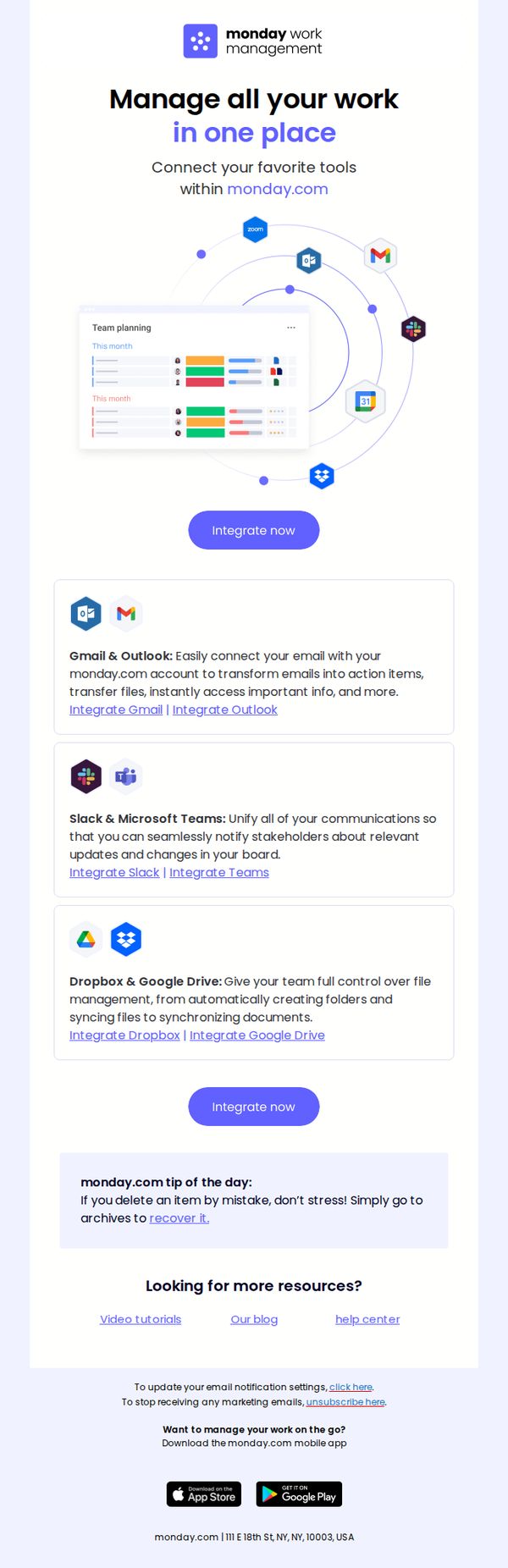
This email aims to drive user adoption of monday.com’s integration capabilities by showcasing how seamlessly popular tools like Gmail, Slack, and Dropbox can be connected to centralize workflow management. It encourages immediate action through clear CTAs and practical use-case examples.
Why this works
The email brilliantly frames integrations not as technical features but as productivity superpowers that eliminate context switching, making the value proposition instantly relatable to busy professionals drowning in app overload.
How to implement
By grouping popular tools into thematic clusters, email, communication, and file management, the campaign simplifies decision-making and reduces cognitive load, helping users visualize exactly how monday.com solves their specific pain points.
Pro Tip
Add a micro-CTA or hover tooltip next to each integration option (e.g., 'See how it works') to reduce friction and give users a preview of the setup process before committing to 'Integrate now'. • Include a short social proof element, such as 'Used by 150K+ teams to unify their tools', near the hero section to build credibility and reinforce the platform’s scalability for enterprise users.
6. Making mid-year reviews count

Objective
This email aims to position monday.com as a strategic partner for mid-year performance reviews by offering actionable leadership frameworks, while subtly promoting its platform as the tool to execute those strategies effectively through a free trial CTA.
Why this works
By framing mid-year reviews not as evaluations but as collaborative brainstorms, the email reframes a typically stressful process into a strategic opportunity, making monday.com’s platform feel like an enabler of growth rather than a performance tracker.
How to implement
The inclusion of Harvard Business Review data and real-world leadership questions transforms generic advice into credible, actionable guidance, subtly positioning monday.com as a thought leader that understands the emotional and operational realities of modern management.
Pro Tip
The CTA 'Start a free trial' appears only once, buried after a long educational section; it should be repeated above the fold and after each key strategy point to capture intent at multiple decision moments. • The 'Help team member bring their full selves to work' section feels disconnected from the mid-year review theme; it should be rephrased to explicitly link empowerment tools to review outcomes, such as 'Use monday.com to turn review insights into personalized growth plans.'
7. Welcome to monday.com 🎉
Objective
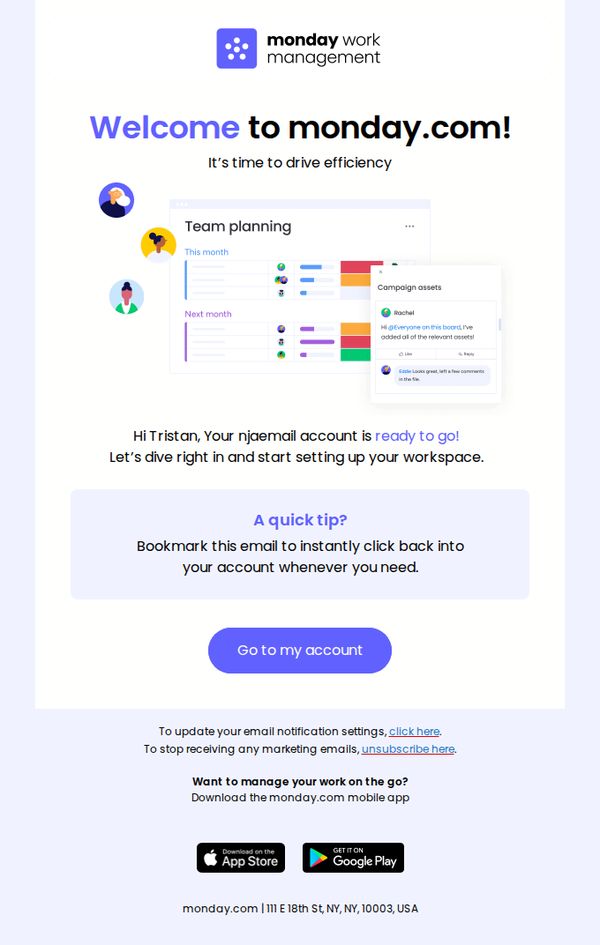
This email aims to warmly welcome new users to monday.com and guide them to immediately access their account, encouraging early engagement by framing the platform as a tool to drive efficiency from day one.
Why this works
The email opens with a celebratory tone and personalized greeting, making the new user feel recognized and excited to begin, a smart emotional hook that reduces onboarding friction and builds immediate rapport.
How to implement
Including a practical tip to bookmark the email transforms a one-time message into a persistent resource, subtly encouraging return visits and reinforcing the platform’s value as a long-term productivity partner.
Pro Tip
Add a brief 'What’s Next' section after the CTA with 2–3 bullet points outlining immediate onboarding steps (e.g., 'Invite your team,' 'Create your first board') to reduce uncertainty and guide users toward their first meaningful action. • Include a small visual preview of the dashboard or a short animated GIF showing a quick win (like creating a task) to visually demonstrate value and reduce the cognitive leap from email to platform.
8. [Confirm your email]
![8. [Confirm your email]](https://nudge-growth-experimental.s3.amazonaws.com/nudge/email-screenshots/2871729.jpg)
Objective
This email aims to verify the user’s email address to confirm account ownership and prevent unauthorized signups, while gently reassuring them that no action is needed if they didn’t initiate the registration.
Why this works
The email opens with a clear, reassuring subject line and header that immediately tells the recipient why they’re receiving it, reducing confusion and building trust from the first glance.
How to implement
By including a polite disclaimer that users can safely ignore the email if they didn’t sign up, monday.com reduces friction and anxiety, making the verification feel like a helpful safeguard rather than a demand.
Pro Tip
Add a subtle countdown timer or expiration notice near the CTA to create gentle urgency, encouraging faster action without compromising the email’s calm, reassuring tone. • Include a brief, one-line value reminder beneath the CTA, such as 'Get started managing your team’s projects in minutes', to reinforce why confirming matters beyond just security.
9. Explore these key monday.com resources
Objective
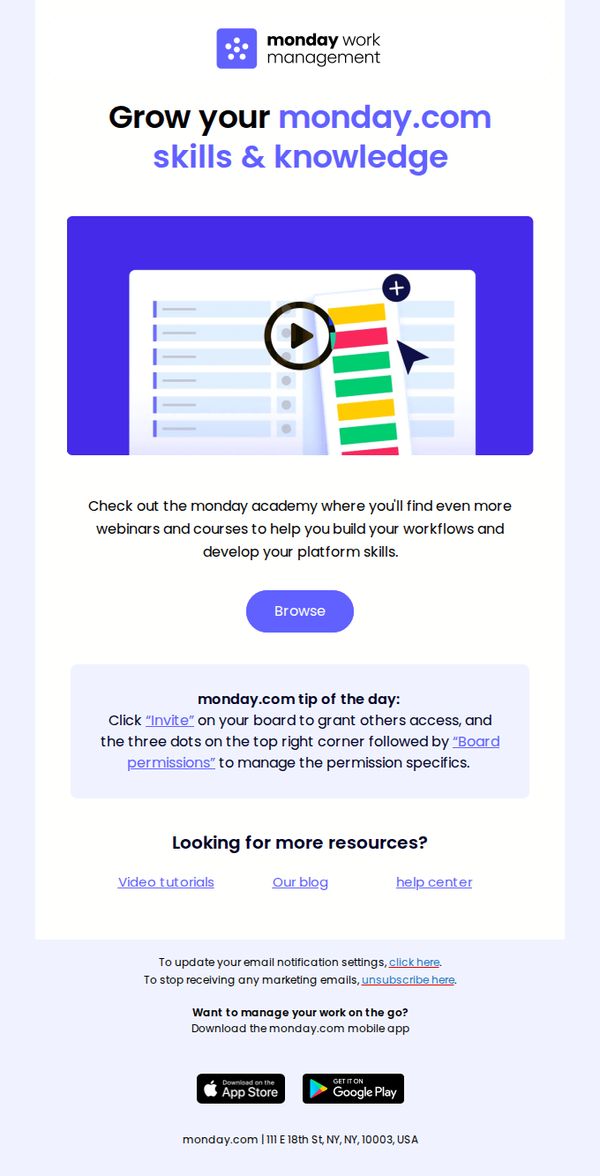
This email aims to encourage users to deepen their platform expertise by exploring educational resources like webinars and courses through the monday.com Academy, while also reinforcing product usage tips and driving app adoption.
Why this works
The email strategically positions learning as growth, framing the Academy not as training but as a way to build workflows and develop platform skills, making education feel like career advancement rather than a chore.
How to implement
Including a practical, bite-sized 'tip of the day' with actionable steps transforms passive reading into immediate product engagement, subtly reinforcing platform features while building user confidence through micro-successes.
Pro Tip
Add a countdown timer or urgency cue near the 'Browse' CTA to encourage immediate action, since the current design lacks time-sensitive motivation despite promoting educational content that benefits from timely engagement. • Include a short testimonial or user stat (e.g., '92% of users who complete Academy courses report faster workflow setup') to strengthen social proof and reinforce the value proposition of investing time in learning.
10. Leading through “The Great Flattening”

Objective
This email aims to position monday.com as a strategic partner for leaders navigating organizational flattening by offering actionable management advice, while subtly promoting its platform as the solution to scale leadership and maintain team cohesion during structural change.
Why this works
The email brilliantly ties a macro business trend, organizational flattening, to a specific, emotional pain point for leaders, then immediately offers monday.com as the empathetic, structured solution that turns chaos into clarity without sounding salesy.
How to implement
By embedding practical, step-by-step leadership advice under subheadings like 'Communicate changes with empathy' and 'Delegate, delegate, delegate,' the email builds trust and authority, making the CTA feel like a natural next step rather than a hard sell.
Pro Tip
The CTA 'Start a free trial' is generic and doesn’t mirror the email’s leadership-focused tone, consider reframing it to something like 'Build a flatter, stronger team with monday.com' to reinforce the thematic alignment and increase relevance-driven clicks. • The 'Water cooler chatter' and 'Just for laughs' sections, while entertaining, dilute the email’s core leadership narrative, consider moving them to a separate, lighter newsletter or appending them after the CTA to preserve the primary message’s persuasive momentum.