Proven podcast relational campaign email designs you can use


1. Jay Shetty: Your question deserves a real conversation
Objective
This email aims to convert readers of The Daily Wisdom into participants of the Ask Jay LIVE virtual Q&A event by framing unanswered personal questions as emotional burdens that require guided, compassionate conversation, positioning the event as the solution. It seeks to drive sign-ups through storytelling, social proof, and tiered pricing options.
Why this works
The email masterfully transforms a simple Q&A event into an emotionally resonant experience by opening with a vulnerable, real-life story that mirrors the reader’s own unspoken struggles, making the invitation feel less like a pitch and more like a personal invitation to healing.
How to implement
Instead of leading with pricing, the campaign first validates the reader’s hesitation by naming the hidden costs of indecision, framing inaction as the true expense, which builds psychological urgency before introducing the solution, making the offer feel like relief rather than a transaction.
Pro Tip
The primary CTA 'Read more about Ask Jay LIVE' is too passive for a conversion-focused email; it should be action-oriented like 'Reserve Your Spot Now' or 'Join the Live Conversation Today' to match the urgency of the emotional hook and drive immediate sign-ups. • The email lacks a visual countdown timer or limited-availability indicator near the pricing section, adding one would amplify urgency, especially since the event is tied to a specific month (January) and could benefit from scarcity messaging to reduce decision paralysis.
2. Jay Shetty: We’re Asking the Wrong Question
Objective
This email aims to provoke self-reflection on personal and technological biases while positioning The Rundown AI as a trusted, time-efficient resource for understanding AI’s role in daily life. It subtly drives sign-ups by aligning AI learning with personal growth and Jay Shetty’s philosophy.
Why this works
The email brilliantly reframes AI not as a threat but as a mirror of human bias, making the topic emotionally resonant and personally relevant to every reader regardless of their technical background.
How to implement
By embedding a relatable personal anecdote about cooking as a weakness, Jay Shetty humanizes the message and models the very self-awareness he’s encouraging readers to adopt toward their own limitations.
Pro Tip
Add a visual progress bar or countdown timer near the CTA to create urgency around the '5 minutes a day' promise, subtly reinforcing the time-saving benefit and nudging immediate action. • Include a short, authentic testimonial from a real Rundown AI subscriber within the offer section to validate the claim that 'over a million readers have signed up,' making the social proof more tangible and persuasive.
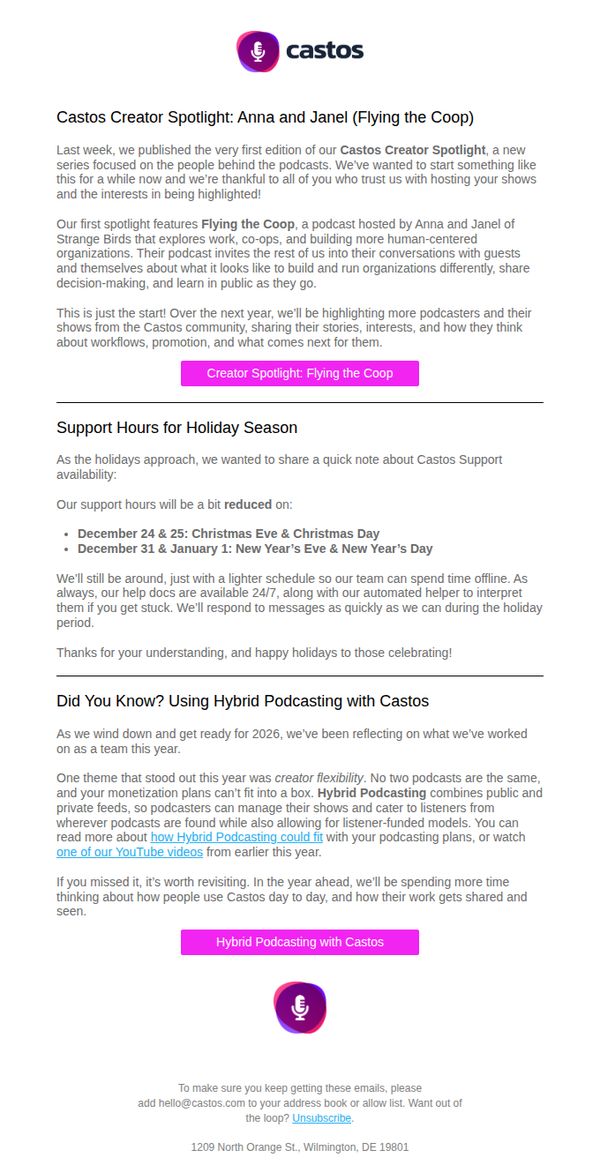
3. Castos: Creator Spotlight and Community Updates
Objective
To strengthen community engagement by spotlighting a featured podcast creator while also informing subscribers about holiday support hours and product updates, fostering loyalty through transparency and shared values.
Why this works
By spotlighting real creators like Anna and Janel, Castos humanizes its brand and builds trust through authentic storytelling, making subscribers feel part of a larger movement rather than just customers.
How to implement
The email smartly ties product updates like Hybrid Podcasting to real-world creator needs, showing how features solve problems rather than just listing specs, which increases perceived value and relevance.
Pro Tip
Add a visual thumbnail or embedded audio player next to the Creator Spotlight CTA to immediately convey the format and encourage clicks by offering a preview of the content. • Reposition the 'Hybrid Podcasting with Castos' CTA higher in the email or duplicate it near the top, since it’s a strategic product message that deserves equal visual weight with the creator spotlight.
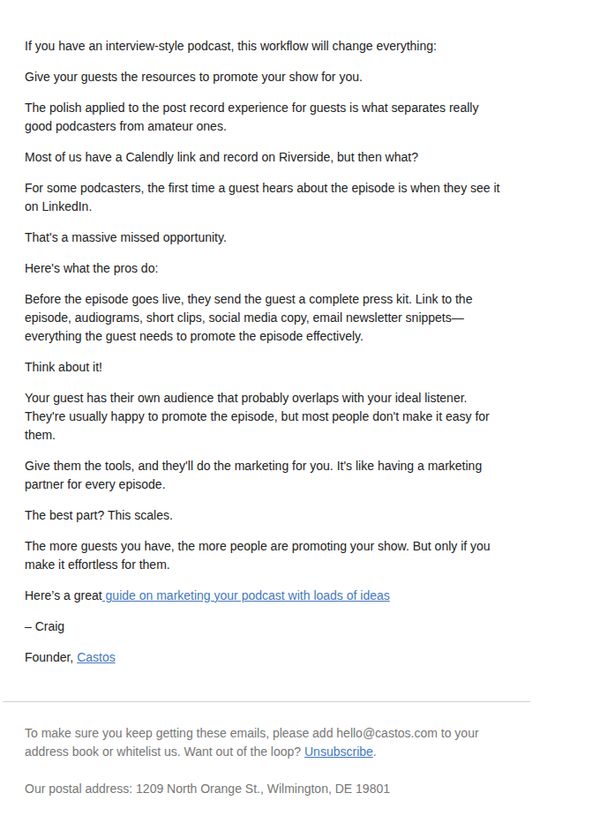
4. Castos: turn every guest into a marketing partner
Objective
This email aims to convince podcasters to adopt a guest marketing workflow that turns interview guests into active promoters of their episodes, positioning Castos as the solution that enables scalable, effortless guest-driven promotion.
Why this works
The email brilliantly reframes guests as untapped marketing partners by highlighting the missed opportunity when podcasters fail to equip them with promotional tools, making the reader feel they’re leaving growth on the table.
How to implement
By positioning the guest’s audience as overlapping with the host’s ideal listener, the message creates a compelling, self-interest-driven incentive for podcasters to adopt the workflow without sounding salesy or pushy.
Pro Tip
Add a visual example or screenshot of the 'press kit' mentioned to make the offer more tangible and reduce cognitive load for readers unsure what ‘everything the guest needs’ actually looks like. • Include a short testimonial or case study from a podcaster who successfully scaled promotion using this method to strengthen social proof and demonstrate real-world results beyond theoretical benefits.
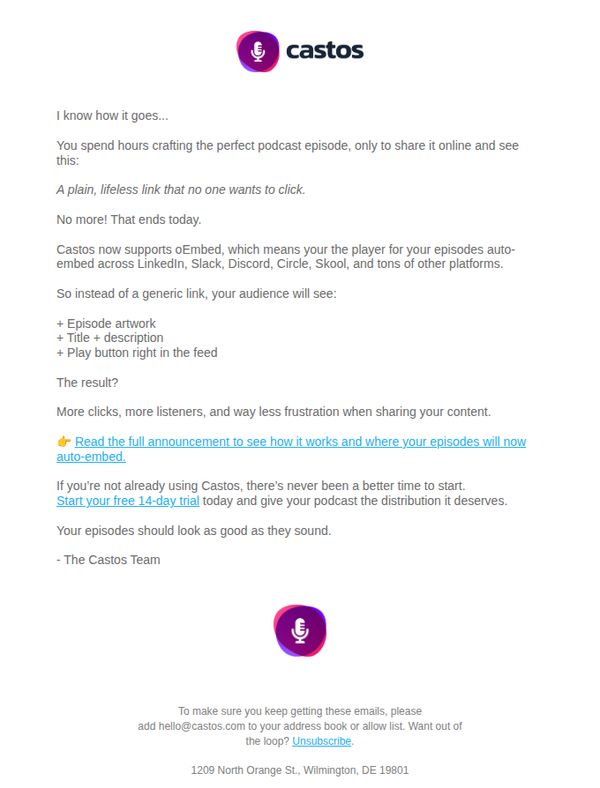
5. Castos: a better way to promote your episodes
Objective
This email aims to introduce Castos’s new oEmbed feature to podcasters, helping them promote episodes more effectively by auto-embedding rich media players across platforms, thereby increasing clicks and listener engagement.
Why this works
The email opens with a relatable pain point, spending hours crafting episodes only to share a lifeless link, immediately hooking podcasters by validating their frustration before offering a solution.
How to implement
By listing specific platforms like LinkedIn, Slack, and Discord where the oEmbed player auto-embeds, the email builds credibility and conveys tangible value, making the feature feel immediately useful and widely applicable.
Pro Tip
Add a visual mockup or screenshot showing the embedded player in action on a platform like LinkedIn to help users visualize the benefit, reducing cognitive load and increasing perceived value. • Include a short testimonial or stat from an existing user who saw increased engagement after using oEmbed to strengthen social proof and reinforce the claim of ‘more clicks, more listeners.’
6. Descript : Scroll-stopping clips for social media in minutes
Objective
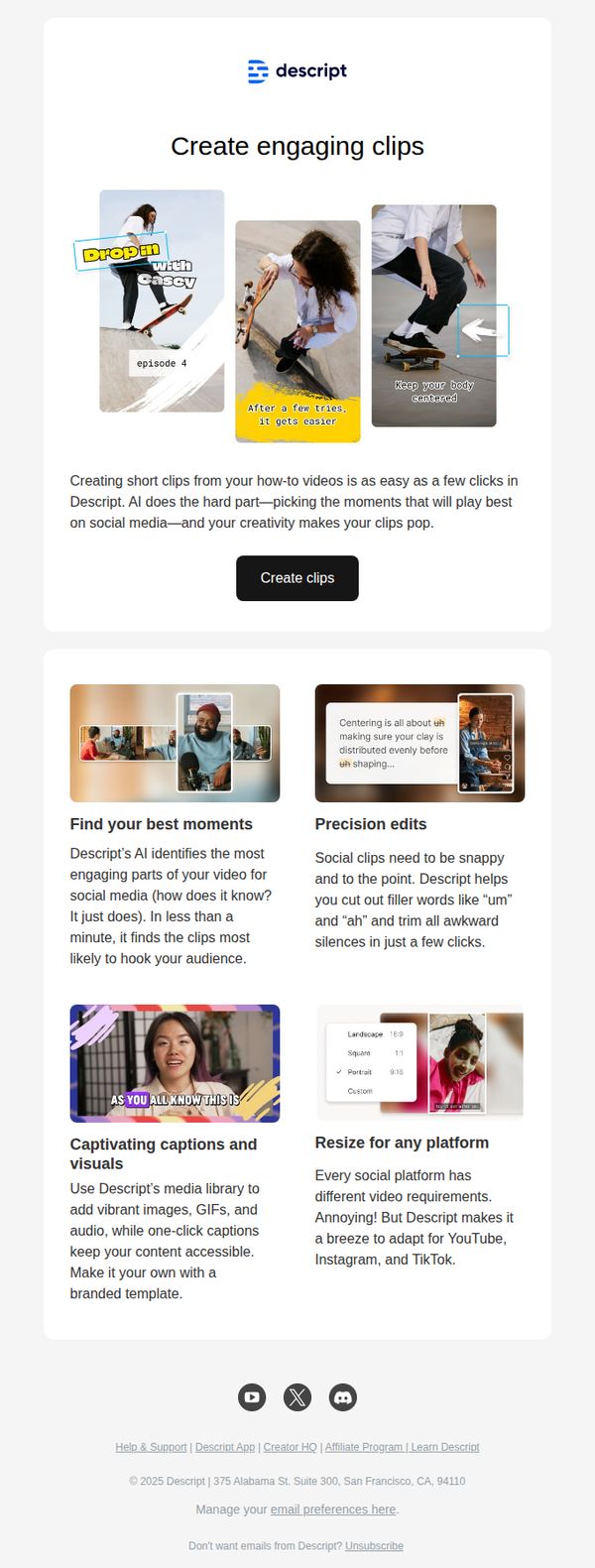
The email aims to drive users to create social media clips using Descript’s AI-powered editing tools by showcasing how quickly and easily engaging content can be produced from longer videos. It positions the product as a time-saving, creativity-enhancing solution for content creators.
Why this works
Descript brilliantly frames its AI as the ‘smart editor’ that does the heavy lifting, identifying viral moments so creators can focus on storytelling, which reduces friction and positions the tool as indispensable for busy content teams.
How to implement
The email uses real-world, relatable video snippets with overlaid text cues like ‘Drop in with Casey’ and ‘Keep your body centered’ to demonstrate intuitive editing, making abstract features feel tangible and immediately useful to the viewer.
Pro Tip
Add a subtle countdown timer or urgency cue near the CTA to nudge immediate action, since the email positions speed as a core benefit, reinforcing time-sensitive value could boost conversion rates. • Include a short testimonial or social proof snippet under the hero section, such as ‘Used by 50K+ creators to grow their channels’, to build trust and validate the AI’s effectiveness before users scroll to feature details.
7. Lewis Howes: 🔑 Unlock Your Potential with a Mindset Shift
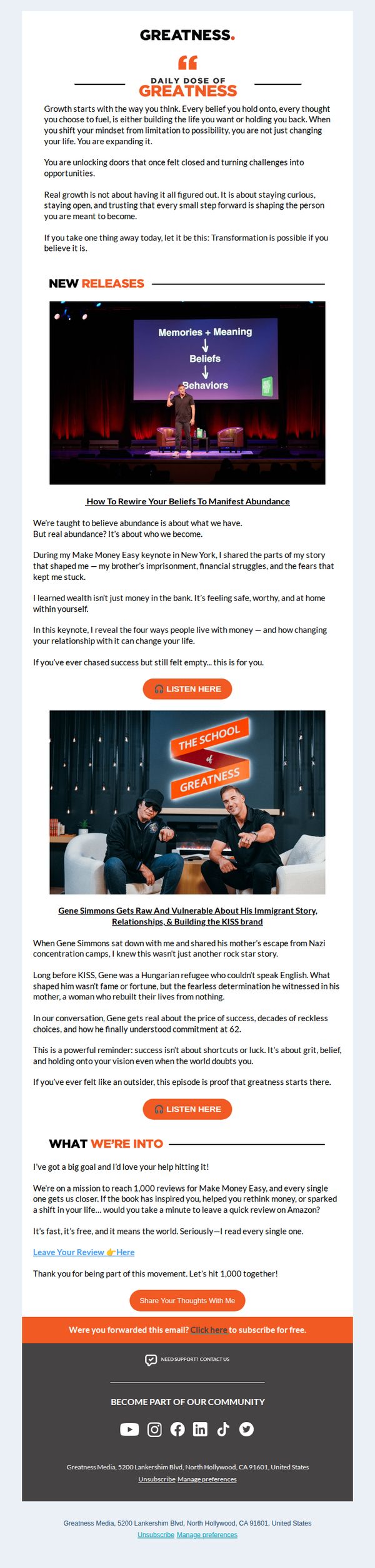
Objective
This email aims to inspire subscribers to embrace a growth mindset while promoting recent podcast content and encouraging audience engagement through reviews. It seeks to deepen emotional connection by sharing vulnerable stories and positioning Lewis Howes as a guide for personal transformation.
Why this works
The email opens with a powerful mindset reframing that positions personal growth as an internal shift rather than external achievement, making the message instantly relatable and emotionally resonant for readers seeking transformation.
How to implement
By weaving real, vulnerable stories from high-profile guests like Gene Simmons into the narrative, the campaign builds trust and authenticity, showing that even successful people faced deep struggles, which lowers psychological barriers to engagement.
Pro Tip
Add a visual progress bar or counter near the '1,000 reviews' goal to create urgency and social proof, making the mission feel tangible and motivating subscribers to contribute before the milestone is reached. • Reposition the 'Share Your Thoughts With Me' CTA higher in the flow, perhaps after the Gene Simmons story, to capture emotional momentum and increase response rates before readers scroll to the footer.
8. Lewis Howes: ✨Today is a powerful day to manifest the life you want
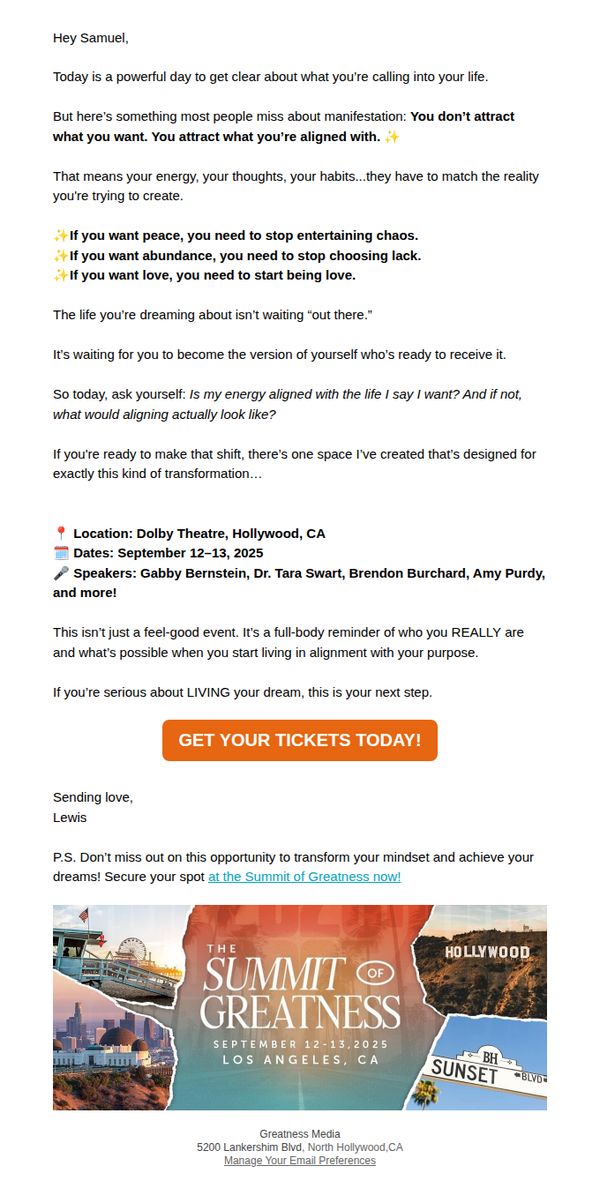
Objective
This email aims to inspire recipients to align their inner energy with their desired reality, positioning the Summit of Greatness as the transformative next step for personal and spiritual growth. It seeks to convert inspiration into action by driving ticket sales through emotional resonance and urgency.
Why this works
The email masterfully reframes manifestation not as wishful thinking but as energetic alignment, a subtle yet powerful shift that positions the event as a necessary internal transformation rather than just another self-help seminar.
How to implement
By using direct, imperative language like 'stop entertaining chaos' and 'start being love,' the copy creates a sense of personal responsibility and urgency, making the reader feel the change is both possible and immediately actionable.
Pro Tip
Add a countdown timer above the CTA to amplify urgency, since the event is in September 2025, a dynamic element would help combat procrastination and reinforce the 'today is the day' messaging. • Include a short testimonial quote or attendee stat (e.g., '92% of past attendees reported life-changing shifts') near the CTA to strengthen social proof and reduce perceived risk before the purchase decision.
9. Lewis Howes: 💔 The Ugly Truth About Fame
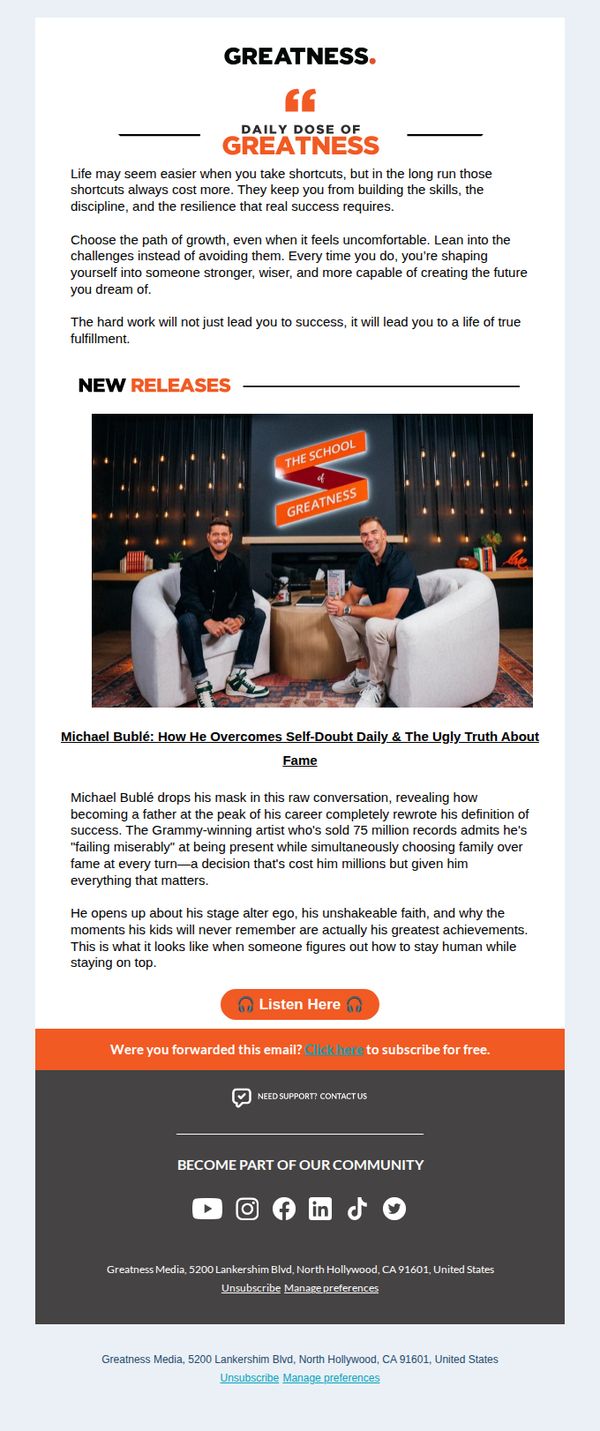
Objective
This email aims to engage subscribers with a thought-provoking narrative about the hidden costs of fame, while promoting a new podcast episode featuring Michael Bublé to deepen audience connection and drive listens. It also encourages list growth by inviting forwarded readers to subscribe.
Why this works
The email opens with a philosophical hook that reframes success as a journey of discipline and resilience, not shortcuts, a powerful emotional anchor that aligns with the brand’s mission of personal growth and authenticity.
How to implement
By spotlighting Michael Bublé’s vulnerability around fame and fatherhood, the email transforms a celebrity interview into a relatable human story, making the content feel intimate and emotionally resonant rather than promotional.
Pro Tip
Add a short 10-second audio preview or quote snippet from the episode above the CTA to give hesitant listeners a taste of the emotional depth and encourage higher click-through rates. • Include a subtle social proof element, such as 'Over 50,000 listeners downloaded this episode in the first 48 hours', to amplify urgency and credibility without cluttering the clean layout.
10. Jay Shetty: Productivity begins with rest

Objective
This email aims to reframe productivity as rooted in intentional rest, offering practical mindfulness techniques while subtly promoting Paleovalley Organic Coffee as a ritual-aligned morning companion that supports calm focus without overstimulation.
Why this works
The email brilliantly reframes rest not as laziness but as a non-negotiable foundation for true productivity, using Jay Shetty’s voice to make mindfulness feel accessible and essential rather than indulgent or optional.
How to implement
By embedding the product offer within a narrative about morning rituals and mental clarity, the campaign avoids hard selling and instead positions Paleovalley Coffee as a natural extension of the reader’s self-care journey, making the CTA feel like a personal upgrade.
Pro Tip
Add a small visual indicator or icon next to each of the three mindfulness techniques (box breathing, 5-4-3-2-1, tech-free zone) to make them more scannable and memorable for readers skimming the email. • Include a subtle countdown timer or urgency cue near the 15% discount offer to encourage immediate action, since the current CTA lacks temporal motivation despite the limited-time framing.