HubSpot Sales email examples & ideas




1. Set it, forget it… regret it?
Objective
This email aims to educate readers on the risks of passive investing, particularly as it relates to 401(k) accounts and market concentration, while subtly positioning active investment strategies as a more thoughtful alternative to avoid future regret.
Why this works
The email brilliantly frames passive investing not as a neutral strategy but as a potential regret trigger, using the provocative subject line 'Set it, forget it… regret it?' to immediately hook readers emotionally and intellectually.
How to implement
By anchoring the narrative in real-world data, like the S&P 500’s rise and the dominance of the Magnificent Seven, the email transforms abstract financial concepts into tangible, urgent concerns that resonate with everyday investors.
Pro Tip
Add a clear, secondary CTA after the education section, such as 'Explore active investing options' or 'Get a free portfolio review', to guide readers toward a next step beyond just sharing the article. • Integrate a short, bold visual summary or checklist near the top (e.g., '3 Signs Your 401(k) Is Too Passive') to improve scannability and help time-pressed readers grasp the core message before diving into the data-heavy sections.
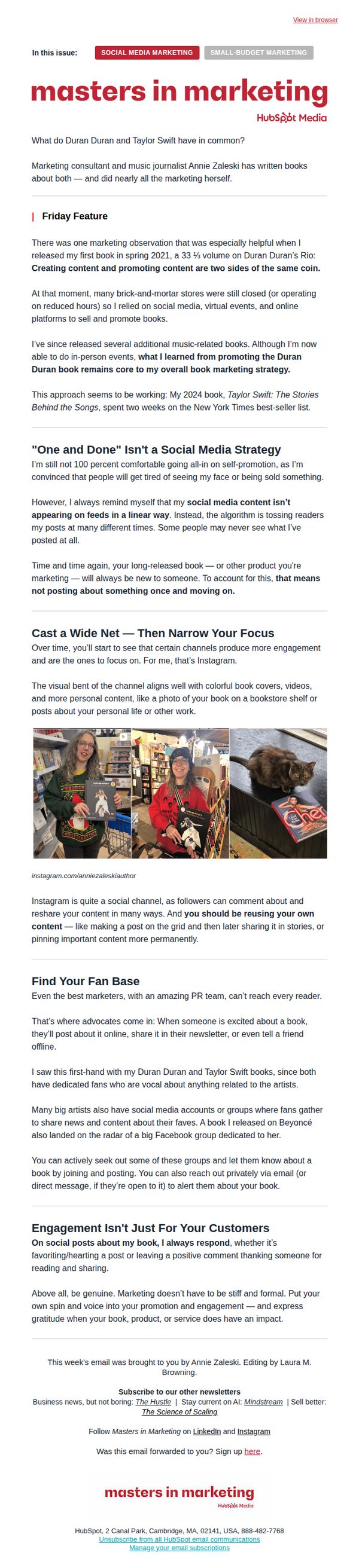
2. When you're the only marketer 📚
Objective
This email aims to educate solo marketers on sustainable, low-budget social media strategies by sharing real-world lessons from promoting music-related books, while positioning HubSpot as a trusted resource for practical marketing wisdom.
Why this works
The email brilliantly reframes the struggle of being a solo marketer as a relatable, human challenge, not a weakness, which builds instant rapport and positions the advice as battle-tested, not theoretical.
How to implement
By anchoring the entire piece in a personal story about promoting a niche book, the writer transforms abstract marketing principles into tangible, memorable lessons that feel earned rather than lectured.
Pro Tip
The CTA 'Subscribe to our other newsletters' is too generic and buried; it should be more benefit-driven (e.g., 'Get more solo-marketer hacks like this') and placed above the footer for higher visibility. • The email lacks a clear visual hierarchy to guide readers through the key takeaways; adding subheadings with icons or bold color accents would help solo marketers quickly scan and retain core strategies.
3. 🧣 The Life of a Marketer 🧣
Objective
This email aims to engage marketers by drawing parallels between Taylor Swift’s promotional genius and actionable B2B marketing strategies, encouraging readers to adopt fan-centric, consistent, and personality-driven tactics to grow their own brands.
Why this works
The email brilliantly leverages pop culture relevance by tying Taylor Swift’s marketing moves to B2B strategies, making complex concepts feel relatable and memorable while keeping the tone playful yet professional for marketers who appreciate cultural references.
How to implement
It transforms abstract marketing principles into concrete, executable tactics, like rewarding loyal customers or building content calendars, by anchoring each tip in a real-world example, which helps readers visualize implementation without feeling overwhelmed by theory.
Pro Tip
Add a visual progress bar or checklist after each numbered tip to help readers track which strategies they’ve implemented, increasing perceived value and encouraging follow-through beyond passive reading. • Include a short embedded video or GIF of Taylor Swift’s fan engagement moment (e.g., Secret Sessions) to reinforce the emotional hook and break up text-heavy sections, improving retention and scroll depth.
4. How do you sell the world's least appealing products?
Objective
This email aims to educate marketers on how to creatively sell taboo or socially awkward products by leveraging humor, authenticity, and strategic discomfort, turning embarrassment into engagement and sales.
Why this works
The email brilliantly reframes uncomfortable products as marketing opportunities by using humor and cultural insight, proving that even the most taboo items can be sold when you speak to real human experiences with wit and empathy.
How to implement
By spotlighting real campaigns like Tena Men and Anusol, the email demonstrates how brands can disarm audiences with absurdity and honesty, turning potential embarrassment into memorable, shareable moments that build trust and curiosity.
Pro Tip
Add a visual timeline or infographic summarizing the three case studies (Tena Men, Anusol, Blood Normal) to help readers quickly grasp the strategic evolution and contrast between humor, shock, and normalization approaches. • Include a short, punchy CTA box after each case study, like 'Steal This Tactic: Use Absurdity to Disarm Skepticism', to turn insights into immediately actionable takeaways for marketers.
5. Paying the trash can premium
Objective
This email aims to inform readers about the surprising costs and complexities behind public trash can procurement in American cities, using San Francisco as a case study, while subtly positioning HubSpot as a source of insightful, data-driven business and urban policy analysis.
Why this works
The email masterfully uses a quirky, unexpected topic, municipal trash cans, to draw readers in with humor and curiosity, then delivers substantive policy analysis that feels both surprising and deeply relevant to urban business operations.
How to implement
By embedding real-world data visualizations like cost comparisons and city rankings, the email transforms a seemingly trivial subject into a compelling narrative about public spending inefficiencies, making complex municipal budgeting accessible and engaging for a broad audience.
Pro Tip
The primary CTA is buried in the header and lacks urgency or value proposition; relocating a stronger, benefit-driven CTA (e.g., 'Discover how cities waste millions on trash, read the full breakdown') near the middle or end would better capture engaged readers. • While the email is rich in data, it lacks a clear visual hierarchy guiding the reader through the narrative arc; adding subtle section dividers, pull quotes, or annotated graphics would improve scannability and reinforce key takeaways for time-constrained audiences.
6. ☎️ The 2 types of top cold callers (according to new data)

Objective
This email aims to engage sales professionals by revealing data-driven insights into the psychological profiles of top cold callers, while positioning HubSpot as a thought leader in sales strategy and driving interest in their sales playbook and related content.
Why this works
The email brilliantly reframes cold calling from a dreaded chore into a data-backed science by spotlighting two distinct psychological profiles, intellectual curiosity and analytical detachment, making the content feel both fresh and deeply actionable for sales leaders.
How to implement
By anchoring insights in real survey data from 300+ sales leaders and citing Panopli as the source, the email builds instant credibility and positions HubSpot as a trustworthy authority, which subtly primes readers to trust their recommended playbook and resources.
Pro Tip
Add a visual progress bar or checklist under the 'What can you do with this insight?' section to help reps and managers quickly map the advice to their own workflows, increasing perceived value and actionability. • Include a short video testimonial or quote snippet from a sales leader who implemented these insights, even if fictionalized, to strengthen social proof and make the data feel more immediately applicable to the reader’s context.
7. The woman who puts America to sleep

Objective
This email aims to engage readers by telling the compelling origin story of Kathryn Nicolai, founder of Nothing Much Happens, while subtly positioning sleep and storytelling as valuable, marketable solutions to America’s insomnia crisis. It also encourages social sharing and newsletter retention.
Why this works
The email masterfully blends human storytelling with data-driven context, using Kathryn Nicolai’s personal journey to frame a broader cultural problem, insomnia, making the content emotionally resonant while still grounded in market relevance.
How to implement
By embedding infographics that visualize sleep statistics and economic costs, the campaign transforms abstract problems into tangible, relatable insights, helping readers internalize the value of sleep solutions without feeling lectured or sold to.
Pro Tip
Add a clear, secondary CTA after the first infographic, such as 'Discover how storytelling helps people sleep', to guide readers toward deeper engagement before they reach the bottom of the long-form narrative. • Include a brief, bulleted 'Why This Matters' summary after the 'Cost of Insomnia' section to reinforce the business case for sleep solutions and connect Kathryn’s story directly to reader pain points or opportunities.
8. ✈️ Luxury air

Objective
This email aims to engage readers with curated, trend-driven business and tech news while subtly promoting HubSpot’s resources and side hustle ideas. It positions HubSpot as a thought leader by blending industry insights with actionable opportunities for entrepreneurial growth.
Why this works
The email masterfully blends timely, quirky news hooks, like the Farmers’ Almanac shutdown and Starbucks’ Bearista cup, with deeper business insights, making complex trends feel accessible and entertaining without sacrificing substance or brand authority.
How to implement
By anchoring the 'AI-Powered Side Hustle Suggestions' section with a bold visual and a clear CTA, the email transforms passive readers into potential converters, offering immediate value while gently guiding them toward HubSpot’s broader ecosystem of entrepreneurial tools and content.
Pro Tip
The CTA 'See the full spread' lacks urgency or benefit-driven language; rephrasing it to 'Unlock 120+ AI Side Hustles Now' would better align with the section’s value proposition and increase click-through intent. • The 'Air travel just got better, for the rich' section, while compelling, lacks a clear transition or CTA to related HubSpot content (e.g., 'How to market luxury services' or 'AI tools for premium customer experiences'), missing an opportunity to deepen engagement with high-intent readers.
9. The ick from marketing 🤢

Objective
This email aims to engage marketers by confronting the emotional discomfort ('the ick') they feel in their work, using Cristina Jerome’s candid insights to reframe marketing as a human-centered, story-driven practice. It seeks to inspire deeper connection with audiences and internal purpose, while subtly promoting HubSpot’s educational content and tools.
Why this works
By naming the emotional friction marketers feel, the 'ick', and validating it as a sign of authenticity, this email transforms discomfort into a strategic asset, encouraging readers to lean into vulnerability as a path to more resonant, human-centered campaigns.
How to implement
Positioning a guest expert not as a polished guru but as a relatable truth-teller with real-world scars and wins builds instant credibility and emotional resonance, making the advice feel earned rather than prescribed, which increases reader trust and retention.
Pro Tip
The CTA '11 power prompts' is buried mid-email and visually underwhelming; it should be elevated with stronger visual contrast, larger typography, and placed immediately after the AI prompt section to capitalize on reader momentum and curiosity. • The 'Lingering Questions' section, while thoughtful, disrupts the flow by shifting tone abruptly; consider moving it to the footer or integrating it as a teaser for next week’s issue to maintain the current email’s narrative cohesion and persuasive arc.
10. The unlikely winner of the US's wine wars

Objective
This email aims to inform readers about the unexpected economic and cultural ripple effects of U.S.-Canada trade tensions on the wine industry, while positioning HubSpot’s media arm as a source of insightful, data-driven business storytelling. It also subtly reinforces brand authority by aligning with timely, complex global trade narratives.
Why this works
The email masterfully turns a niche trade dispute into a compelling human story by spotlighting individual winemakers and regional economic shifts, making complex policy feel personal and urgent to a broad business audience.
How to implement
By embedding data visualizations directly into the narrative flow, like the wine glass chart showing export losses, the email transforms dry statistics into emotionally resonant moments that reinforce the stakes without overwhelming the reader.
Pro Tip
The primary CTA 'Check out all of our prizes here' feels disconnected from the article’s serious tone and subject matter; it should be rephrased to align with the content, such as 'Explore how global trade shapes local industries' to maintain thematic consistency. • The email lacks a clear secondary CTA or content upgrade (e.g., downloadable report, webinar invite) that could deepen engagement after the story, adding one would help convert informed readers into leads without disrupting the editorial experience.